
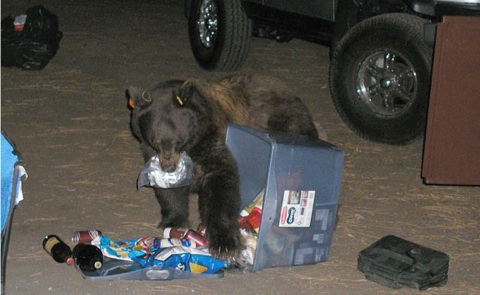
What are the odds this banquet came out of a minivan? Photo by Jeffrey Booker via NPS.
Fuel economy, it seems, is just as important to black bears in Yosemite National Park as it is with many visitors. And so when the bruins shop for fuel, more and more they tend to find themselves munching out in minivans, according to a study published in the Journal of Mammalogy.
Yep, while BMWs are sleek, Subarus utilitarian, and Tacoma's rugged, the best meals seem to show up time and again in minivans, according to the study.
For a seven-year period, the top choice of vehicle by black bears in Yosemite National Park has been the minivan. The bears seem to base this decision on “fuel efficiency”—that is, which vehicle offers the best opportunity of finding a meal. As a result, black bears have shown a strong preference for breaking into minivans over other types of vehicles.
The study, written by Stewart W. Breck, Nathan Lance, and Victoria Seher of the U.S. Agriculture Department's Wildlife Service and published in this month's issue of the journal, counted the number of vehicles broken into by make and model. From 2001 to 2007 minivans had the largest or second-largest number of incidents; when the number of break-ins was compared to the numbers of each type of vehicle visiting the park in 2004 – 2005, only minivans were broken into at a rate higher than expected based on their availability, noted the authors.
As Yogi would have you know, Yosemite's black bears are not your average bears!
Potential costs to bears came in the form of energy spent breaking into vehicles and considerable risk because park rangers were deployed nightly for surveillance and bears detected in or around campgrounds and parking lots received aggressive negative conditioning. The trade-off between food acquisition and penal actions by humans likely pressured bears to target vehicles with the highest probability of attaining food.
There are several non–mutually exclusive hypotheses for why bears selected minivans. First, it is possible that minivans were more likely to emit food odors regardless of whether they contained meaningful amounts of food available. This argument is based on the fact that minivans are designed for families with children and small children in particular are notorious for spilling food and drink while riding in vehicles. Thus, vehicles transporting children would emit greater food odors, making them attractive to bears.
If this hypothesis is correct then any vehicle transporting small children, regardless of class type, should be targeted by bears. To test this supposition, park personnel collecting information on vehicles broken into should also note whether car seats were present, or whether small children are regularly transported in the vehicle, or both. Second, it is possible that passengers of minivans were more prone to leave large caches of food (e.g., coolers or grocery bags) in vehicles parked overnight.
Evidence from the incident reports supports this contention by indicating that most vehicles broken into (regardless of vehicle class) had evidence of available food. What is unknown from these reports is the amount and type of food available, which could vary from micro-trash resulting from children to large quantities of food such as coolers or grocery bags.
Passengers of all vehicles entering Yosemite National Park are exposed to the same educational material regarding storing food in food lockers rather than vehicles and it is difficult to imagine why drivers of minivans would be biased toward leaving food in their vehicles. Additional data to evaluate this hypothesis could include the quantity and types of food present in incidents. Third, it is possible that minivans were structurally easier to break into than other vehicles.
Our observations indicate that bears entering minivans typically did so by popping open a rear side window and it seems that this was easier for minivans compared to other vehicle classes. We note that bears are strong and well equipped (long claws) to open a variety of structurally sound materials (e.g., logs and ant mounds), and we commonly saw car doors bent open, windows on all sides of the vehicle broken, and seats ripped out, all of which appeared effortless for bears.
Finally, selection of minivans could reflect the foraging decisions of a few individuals that developed a learned behavior for breaking into minivans. Anecdotal evidence supports this idea and indicates that most of the break-ins resulted from a maximum of 5 bears and possibly as few as 2 individuals.
Reports detailing 908 vehicles broken into by Yosemite black bears between 2001 and 2007 were reviewed. The rates of break-ins for nine categories included: minivan, 26 percent; sport-utility vehicle, 22.5 percent; small car, 17.1 percent; and sedan, 13.7 percent.
In conclusion, the authors suggested not only that park rangers redouble their efforts to warn visitors about leaving food in their vehicles, but could also possibly "include greater education efforts focused on vehicles carrying small children..."

Story Categories:
A copy of National Parks Traveler's financial statements may be obtained by sending a stamped, self-addressed envelope to: National Parks Traveler, P.O. Box 980452, Park City, Utah 84098. National Parks Traveler was formed in the state of Utah for the purpose of informing and educating about national parks and protected areas.
Residents of the following states may obtain a copy of our financial and additional information as stated below:
- Florida: A COPY OF THE OFFICIAL REGISTRATION AND FINANCIAL INFORMATION FOR NATIONAL PARKS TRAVELER, (REGISTRATION NO. CH 51659), MAY BE OBTAINED FROM THE DIVISION OF CONSUMER SERVICES BY CALLING 800-435-7352 OR VISITING THEIR WEBSITE. REGISTRATION DOES NOT IMPLY ENDORSEMENT, APPROVAL, OR RECOMMENDATION BY THE STATE.
- Georgia: A full and fair description of the programs and financial statement summary of National Parks Traveler is available upon request at the office and phone number indicated above.
- Maryland: Documents and information submitted under the Maryland Solicitations Act are also available, for the cost of postage and copies, from the Secretary of State, State House, Annapolis, MD 21401 (410-974-5534).
- North Carolina: Financial information about this organization and a copy of its license are available from the State Solicitation Licensing Branch at 888-830-4989 or 919-807-2214. The license is not an endorsement by the State.
- Pennsylvania: The official registration and financial information of National Parks Traveler may be obtained from the Pennsylvania Department of State by calling 800-732-0999. Registration does not imply endorsement.
- Virginia: Financial statements are available from the Virginia Department of Agriculture and Consumer Services, 102 Governor Street, Richmond, Virginia 23219.
- Washington: National Parks Traveler is registered with Washington State’s Charities Program as required by law and additional information is available by calling 800-332-4483 or visiting www.sos.wa.gov/charities, or on file at Charities Division, Office of the Secretary of State, State of Washington, Olympia, WA 98504.


National parks and their natural resources belong to you. The National Parks Traveler works to ensure you know how these essential places are being cared for.
Sign Up For Our Weekly Newsletter
Unsubscribe at any time.
INN Member

The easiest way to explore RV-friendly National Park campgrounds.

Here’s the definitive guide to National Park System campgrounds where RVers can park their rigs.
Our app is packed with RVing- specific details on more than 250 campgrounds in more than 70 national parks.
You’ll also find stories about RVing in the parks, tips helpful if you’ve just recently become an RVer, and useful planning suggestions.


Comments
This preference for minivans aside, Yosemite bears have always had their favorite models of cars. In the past (I don't know if this still holds true), Hondas and Toyotas were easiest to break into. Mother bears have taught their cubs how to peel open car window frames “like a banana.”
I think the most interesting statistic that should be pointed out, if I understood their report, is that only 7% of vehicles present were mini vans but the break ins of mini vans accounted for 26% of all break ins. Also the sedan represented about 28% of vehicles present but only 13.7% of break ins. So in conclusion, a sedan might be a good choice to go to the park for the night.
Naw, the most interesting statistic was "most of the break-ins resulted from a maximum of 5 bears and possibly as few as 2 individuals." If true, this proves that the "criminal mind" exists in the bear kingdom, just as it does in human. They could tag the repeat violators with a tracking device so a warning system can be developed.
Tagging the "repeat offenders" is already something that's done. Check out the photo with the bear with two ear tags. Last summer I saw a bear manage to break into a malfunctioning bear box. That bear had ear tags and a transmitter collar. The campgrounds have antennas/receivers to determine when collared bears are visiting campgrounds and rangers on bear patrol get alerted. We had a park ranger there in less than 3 minutes although that was enough time for the bear to have munched quite a bit of food.
My favorite story from Yosemite is of "Camaro Bear". Just take a wild guess what his favorite vehicle was.
One of the main problems (and possibly the hardest to solve) is that there isn't a vehicle parked in Yosemite that hasn't at one time transported food. There might be food spills in the car or maybe some crumbs. There are some concerns that maybe just maybe some bears breaking into cars may be doing so more or less randomly after scoring food once or twice. Of course particularly odiferous food stored in a car might send off the jackpot meter for a bear to break into a particular car.
And yes we tried to haze the bear but it didn't get phased. Only the park ranger - with threats of rubber bullets or paintballs - got it to take off.
We've worked at the Concession for Yosemite & although we know as much as the public & NPS, it still makes me nervous, after having children that our car can be broken into! Any National Park that has bears, you're always taking a risk. This Winter will be our first time back since working there in Yosemite & I'm nervous, since we have a toddler that gets sick easily & will have two carseats!!
Some National Parks with bears have limited or zero restrictions/recommendations on food storage in cars. It was recommended to not store food/drinks/coolers in plain sight in a vehicle at Yellowstone and Grand Teton. At Olympic and Mt Rainier we were simply asked to store food in the vehicle (even in plain sight) but not worry about bears breaking into cars. Their primary worry was about squirrels and birds.
The are very few specific places where bears have knowledge of breaking into cars.