
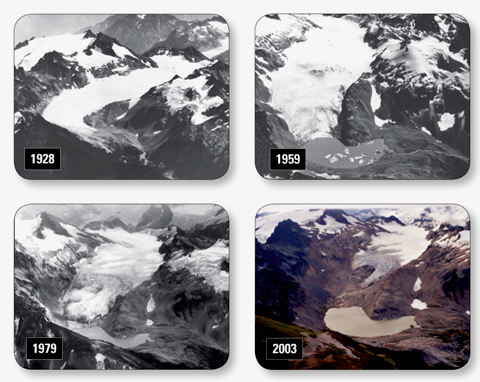
These photos track the retreat of the South Cascade Glacier in Washington state. USGS photos.
A half-century worth of data on glacial advance and retreat released by the Interior Department clearly illustrates how climate change is affecting these rivers of ice in Alaska and Washington state.
Formally released Thursday by Interior Secretary Ken Salazar, the USGS study shows that glaciers are dramatically changing in mass, length and thickness as a result of climate change. The specific glaciers monitored by the USGS were Alaska’s Gulkana and Wolverine glaciers and Washington’s South Cascade Glacier. The study is the longest compiled on glaciers in North America, according to Interior officials.
“This report we are releasing today is great example of the science and data our department has gathered over the past 50 years,” said Secretary Salazar. “This information is helpful in tackling the effects of climate change and it is exactly the kind of science we need to invest in to measure and mitigate the dangerous impacts of climate change.”
Glacier shrinkage has global impacts, including sea level rise that threatens low-lying and coastal communities. Smaller glaciers will also result in a decrease of water runoff, and impacts are especially important during the dry late summer when other water sources are limited.
“There is no doubt that most mountain glaciers are shrinking worldwide in response to a warming climate. Measuring changes in glacier mass provides direct insight to the link between glaciers and climate, ultimately helping predict glacier response to anticipated climate conditions,” said USGS scientist Edward Josberger.
The three glaciers monitored for the study are known as benchmark glaciers. They are widely spaced, represent different climate regimes, and can be used to understand the thousands of other glaciers in nearby regions.
USGS scientists study glacier behavior during different seasons, including summer melt and winter snow accumulation, as well as their response to both short and long term climate variations. This allows for more detailed insight regarding how and when the climate is changing.
“In addition to these three glaciers, more than 99 percent of America’s thousands of large glaciers have long documented records of an overall shrinkage as climate warms,” said USGS scientist Bruce Molnia. “Many people are surprised to learn that a few glaciers are thickening and advancing. These glaciers are responding to unusual and unique local conditions, including having large, high elevation areas where snow accumulates. Except for these anomalous few , most of America’s glaciers are shrinking and these exceptions emphasize how natural variability is an inherent part of a complex Earth system.”
For a look at how the South Cascade Glacier has receded down through the years, check out the video at this site: http://wa.water.usgs.gov/projects/glacier/video.html
Story Categories:
A copy of National Parks Traveler's financial statements may be obtained by sending a stamped, self-addressed envelope to: National Parks Traveler, P.O. Box 980452, Park City, Utah 84098. National Parks Traveler was formed in the state of Utah for the purpose of informing and educating about national parks and protected areas.
Residents of the following states may obtain a copy of our financial and additional information as stated below:
- Florida: A COPY OF THE OFFICIAL REGISTRATION AND FINANCIAL INFORMATION FOR NATIONAL PARKS TRAVELER, (REGISTRATION NO. CH 51659), MAY BE OBTAINED FROM THE DIVISION OF CONSUMER SERVICES BY CALLING 800-435-7352 OR VISITING THEIR WEBSITE. REGISTRATION DOES NOT IMPLY ENDORSEMENT, APPROVAL, OR RECOMMENDATION BY THE STATE.
- Georgia: A full and fair description of the programs and financial statement summary of National Parks Traveler is available upon request at the office and phone number indicated above.
- Maryland: Documents and information submitted under the Maryland Solicitations Act are also available, for the cost of postage and copies, from the Secretary of State, State House, Annapolis, MD 21401 (410-974-5534).
- North Carolina: Financial information about this organization and a copy of its license are available from the State Solicitation Licensing Branch at 888-830-4989 or 919-807-2214. The license is not an endorsement by the State.
- Pennsylvania: The official registration and financial information of National Parks Traveler may be obtained from the Pennsylvania Department of State by calling 800-732-0999. Registration does not imply endorsement.
- Virginia: Financial statements are available from the Virginia Department of Agriculture and Consumer Services, 102 Governor Street, Richmond, Virginia 23219.
- Washington: National Parks Traveler is registered with Washington State’s Charities Program as required by law and additional information is available by calling 800-332-4483 or visiting www.sos.wa.gov/charities, or on file at Charities Division, Office of the Secretary of State, State of Washington, Olympia, WA 98504.


National parks and their natural resources belong to you. The National Parks Traveler works to ensure you know how these essential places are being cared for.
Sign Up For Our Weekly Newsletter
Unsubscribe at any time.
INN Member

The easiest way to explore RV-friendly National Park campgrounds.

Here’s the definitive guide to National Park System campgrounds where RVers can park their rigs.
Our app is packed with RVing- specific details on more than 250 campgrounds in more than 70 national parks.
You’ll also find stories about RVing in the parks, tips helpful if you’ve just recently become an RVer, and useful planning suggestions.


Comments
Thanks for those links, Kurt. Decreased runoff and warmer rivers will also further stress salmon and
steelhead runs.
It's fascinating to me that one of the few advancing glaciers is in the recent crater of Mount St. Helens.
Here's a link to the best photo I could find:
http://geology.rockbandit.net/2008/04/23/mount-st-helens-glacier-growing/
also a locally produced video, that I believe shows the glacier surrounding the lava dome:
http://www.opb.org/programs/ofg/videos/view/287-Return-to-Mt-St-Helens
I believe glaciers on Mount Shasta in northern California are growing as well. I seem to recall that the warming Pacific of recent winters is responsible, as it produced some prodigious snowstorms on Shasta and other coastal ranges.
Wow! The video is pretty grim. Kurt, thank you for the links. They reinforce what we already know, that glaciers are retreating all over the world. I attach a link of a NASA article which goes into detail about the retreat of the Greenland ice sheets. This article includes photos illustrating the retreat over time: http://www.nasa.gov/vision/earth/lookingatearth/jakobshavn.html
To my mind the evidence is overwhelming, but from comments made on similar articles on this site I know there are those who choose to discount any mention of global warming. Their "skepticism" reeks of energy interest profiteering, and certainly makes the case for "fundamentalism". I suppose those same people would also deny the existence of the laws of physics.
As a scientist, I must say that the pictures and video are quite disturbing and certainly demonstrate that our climate is changing - the laws of physics are most assuredly in play. As a scientist, I must also say that evidence is quite strong that change in climate is not caused by what we do here but rather by solar activity - and that is not a ploy or plot against Al Gore, just trying to ALL of the facts:
http://www.junkscience.com/Greenhouse/
Jimi, I do not question your title as a scientist. However, I am surprised that you use the junkscience site as a credible source of scientific data. I suggest that USGS, NASA, and meteorological research divisions associated with major universities might be more appropriate sources of climate related information and opinion. I believe human forcing plays a significant role in modern climate change.
Ray - you are right, I had just read that and it was a quick fresh reference. I agree, as I did before, that there is massive change - but, I still have not seen ANY evidence that it is caused by man. The near surface Earth temperature is actually going down, has over the last ten years? Is that more likely to be due to less activity by man or less solar activity?
Beamis - I tend to agree with you that most of what is happening is due to solar activity, that is what I have read from most scientsts that ARE NOT FUNDED BY THE GOVERNMENT. Several years ago, television channels that were delivered by satelite were constantly bothered by solar flares - not so much any more? That, of course, is anecdotal as is most of what we read about 'global warming.' I do see a pattern in results depending on where the funding for the research comes from - not saying that either side has convinced me, but it is disturbing to know that the answer depends on the funding organization. I know I am repeating but I have seen evidence that solar activity is cyclic and that we are approaching a cool spell and I have seen NO evidence that man has any affect on the near surface temperature of the Earth, hence no effect on the temperature of the 'globe.'.
With all due respect to Jimi I would rather put my faith in the facts as presented by scientific entities like NASA and USGS. The junkscience site just doesn't inspire my confidence. There's so many disclaimers in it, it's no wonder that whoever wrote it wasn't even confident enough to put his name on it. I think there's plenty of documented proof out there of how human activity degrades Earth's biosphere. No amount of smoke and mirrors will make it go away. As for predictions, there's so much we DON'T know that our best guess may as well come from a fortune cookie.
Actions have consequences. Over the past 200 years, and particularly over the last century, humans have extracted, burned and returned to the active atmosphere billions of years of carbon accumulation. From a geological perspective, it has been a massive, planet-wide carbon eruption. To believe that human forcing is of no significance in climate change seems illogical.
Pardon me butting in again, but I recently read an article in the June 29, edition of the New Yorker titled, "The Catastrophist" by Elizabeth Kolbert. It is a profile of James Hansen, Director of NASA's Goddard Institute. Hansen is actively working to educate the public and political leaders on perils of human forcing of climate change. He pulls no punches in presenting scientific findings tracing global warming with human activities and that postponing actions to significantly reduce CO2 emissions verges on the criminal.
How strange! On the front page of the El Dorado News-Times (my hometown paper) THIS morning there is an article about a speech given by a retired chemical engineer, Nick Macchiarolo. Here is a quote " Follow the money, check the FACTS and review the history of the world about global warming: it is an inevitable fact of nature, with no solid corroborating contribution from human activities." He goes on to point out that there have been seven ice ages and at least seven periods of global warming - "and we are still all here." The last ice age, "the little ice age" ran from about 1400 to 1850, ending with a period of global warming - without global warming we would all be under 2,000 feet of ice! Lief Erickson named Greenland because of all of the GREENERY - the subsequent ice age ended that. June 24, 1974 - the Time magazine cover story was on the threat of another ice age because the U. S. temperature went down by 0.15 degrees (while CO2 levels increased from 290 to 330 PPM). The bottom line seems to be, you can't look at the last 30, or 50, or 200 years - this is a long SLOW process and it has been occurring for hundreds, nee thousands, of years and we will continue to go through these cycles!
Kyoto, according to "Nature" in October 2003, will change the temperature by 0.05 degrees - who cares?
The computer models the government uses to predict the temperature change over the next 100 years vary by 400% - who cares what they say?
Why are the ice caps in Antarctica not melting? Wouldn't global warming affect the whole globe?
"Nature in 2001 details the impact of the sun on global climate and temperature AND we cannot do anything about what the sun does.
Greenpeace, The Sierra Club, The Natural Resources Defense Fund and others only exist to get federal funds to fight global warming - do you think that they would suggest that it is a problem we cannot fix?
We spend $25 Billion on this - wouldn't that money be better spent elsewhere? We can do something about people starving or tyrannies in the world, we cannot even predict what the Earth's temperature will be in 20 years, much less a hundred or a thousand!
This is my last entry, you cannot change a mind that is firmly entrenched in the gospel of the day...
Wow, a lot of misinformation here. Come on, just think about it. When you lay in bed at night, if you put on another blanket you are more insulated and get warmer. That's just what happens. We are adding (literally) tons of greenhouse gases to our atmosphere. Greenhouse gases trap heat. Shocking, we're getting warmer as we further insulate ourselves. That's what greenhouse gases do. To deny that is to deny basic laws of physics.
I find it amazing to read the round-about conjectures trying to explain our increasing warmth as NOT being the result of adding that extra layer of insulation. Occam's Razor and all.
I am also fascinated to read that some believe that government scientists with guaranteed year-to-year funding regardless of results are supposedly less-believable sources than scientists funded by oil companies and the like. If a chemist from this company (http://en.wikipedia.org/wiki/Great_Lakes_Chemical_Corporation) doesn't believe in human-caused climate change, surely it can't be true!
Yesterday I hiked through a record breaking August snowstorm in the High Sierra.
I pushing my chips toward the Beamis and Whitten corner.
The glaciers will return, perhaps with a vengeance, and we may rue the day.
As with Health Care Reform, the public debate on global warming is fraught with mis-information. Some of this is organized and funded by industry, some stems from the influence organized public relations campaigns have had on uninformed opinion, including the opinion of so-called scientists.
It's amazing to me how many who comment in opposition to anthropogenic climate change discount official sources of information, including the detailed report by the Intergovernmental Panel on Climate Change (IPCC) because they are "government funded." The report of the IPCC is quite thorough. It addresses the important role that the sun plays in determining climate change over the past decades and centuries. However, the IPCC concludes that there is a 90% chance that the shifts in climate are due to increases in green house gases emitted from human activities.
Thus, my chips go with Kurt, Matt, and Ray. Nevertheless, I hope Haunted Hiker is right and that the glaciers will one day return, within my limited lifetime.
Owen Hoffman
Oak Ridge, TN 37830