
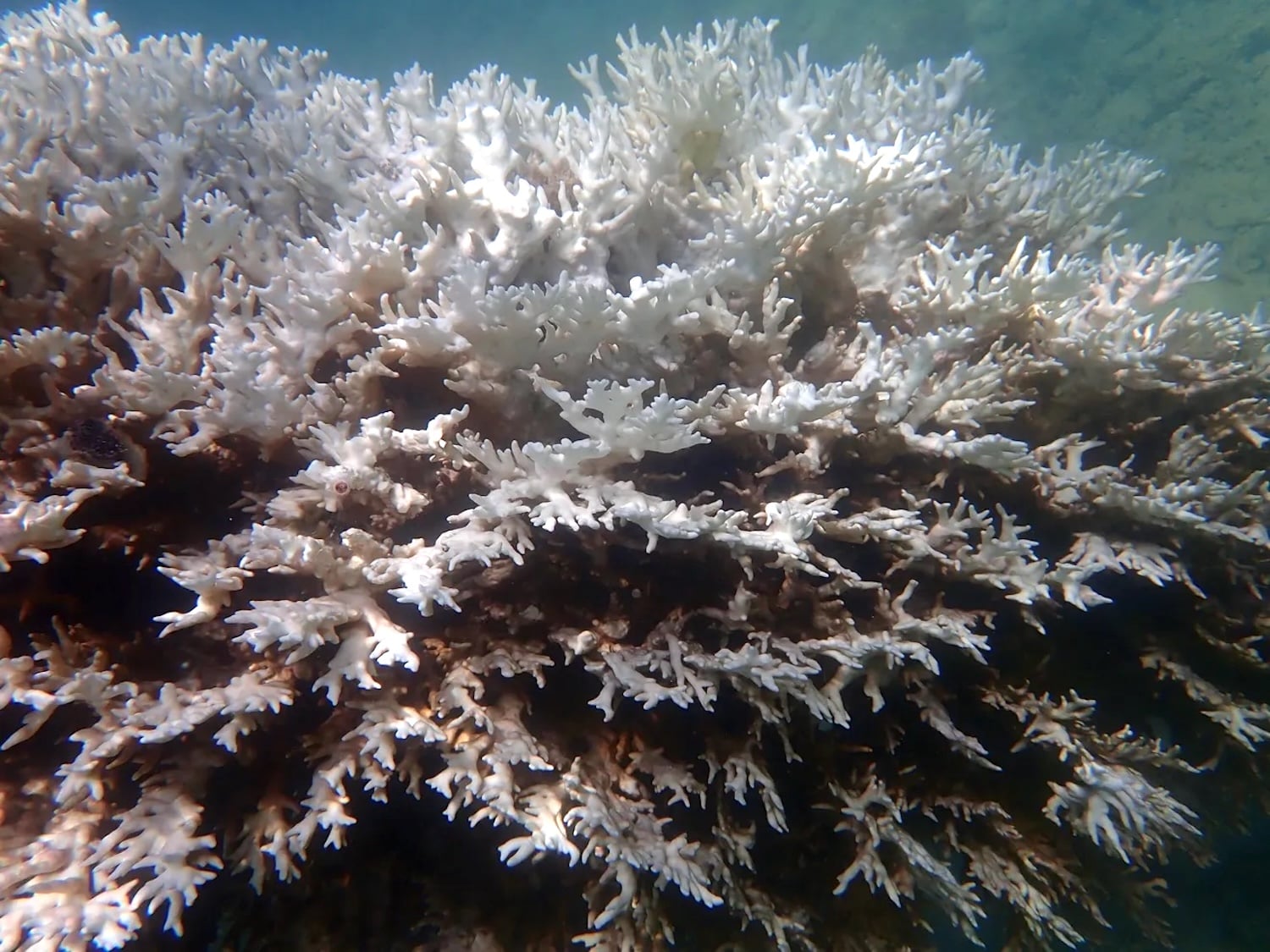
A new method is helping reef managers predict coral bleaching five to six months in advance, giving them time to put protections in place, according to a recent study (attached). Researchers found that since 1990, 10 of 11 coral bleaching events off the coast of Curaçao occurred when three large-scale Pacific and Atlantic climate modes aligned, offering insight into the factors that need to be present for coral bleaching to occur.
To build a long-term bleaching record, the research team analyzed skeletal cores from massive reef-building corals collected from Curaçao’s reefs. Using CT scans of 44 coral cores, the researchers reconstructed a 72-year bleaching history from 1950 to 2022, revealing that significant bleaching events on Curaçao began only around 1990, after ocean temperatures had already warmed significantly.
The study found that bleaching has occurred repeatedly in years when three large-scale climate modes align: Atlantic Multidecadal Variability, El Niño–Southern Oscillation, and North Atlantic Oscillation. When these patterns combine in certain ways, they weaken regional winds and reduce cooling induced by upwelling currents, allowing reef temperatures to rise above bleaching thresholds.
Although the Bleaching Event Early Predictor was developed for Curaçao, researchers say the framework is likely adaptable across reef systems. This could help reef managers in places like the Florida Reef, which sits within Biscayne and Dry Tortugas national parks, put reef protections in place ahead of predicted bleaching events.
Coral reefs in national parks in Hawai’i have also been hit hard by coral bleaching. A recent study found that between the early 2000s and 2022, live coral cover declined across three parks. On the Florida Reef, staghorn and elkhorn corals are considered functionally extinct after dwindling in the face of repeated marine heatwaves and coral bleaching.
“Existing bleaching forecasts track heat stress in near-real time, and also rely on generalized thresholds for predicting bleaching risk, which means they often do not provide reef managers and restoration practitioners with enough lead time to prepare and respond effectively, or the predictions are inaccurate,” explained Mariya Galochkina, lead author of the study. “We take a different approach by using large-scale climate patterns that interact to shape regional ocean and atmosphere conditions with a time lag, which lets us identify bleaching risk months in advance.”
With advanced warning, reef managers can move coral fragments from in-situ restoration nurseries to cooler areas on the reef or out of the water and into land-based nurseries if bleaching is forecast.
“Coral reefs are among the most vulnerable ecosystems on the planet,” said Anne Cohen, senior scientist at WHOI and co-author of the study. “Advances like this give us a better chance to protect them in a warming ocean.”

Stories about:
Story Categories:
A copy of National Parks Traveler's financial statements may be obtained by sending a stamped, self-addressed envelope to: National Parks Traveler, P.O. Box 980452, Park City, Utah 84098. National Parks Traveler was formed in the state of Utah for the purpose of informing and educating about national parks and protected areas.
Residents of the following states may obtain a copy of our financial and additional information as stated below:
- Florida: A COPY OF THE OFFICIAL REGISTRATION AND FINANCIAL INFORMATION FOR NATIONAL PARKS TRAVELER, (REGISTRATION NO. CH 51659), MAY BE OBTAINED FROM THE DIVISION OF CONSUMER SERVICES BY CALLING 800-435-7352 OR VISITING THEIR WEBSITE. REGISTRATION DOES NOT IMPLY ENDORSEMENT, APPROVAL, OR RECOMMENDATION BY THE STATE.
- Georgia: A full and fair description of the programs and financial statement summary of National Parks Traveler is available upon request at the office and phone number indicated above.
- Maryland: Documents and information submitted under the Maryland Solicitations Act are also available, for the cost of postage and copies, from the Secretary of State, State House, Annapolis, MD 21401 (410-974-5534).
- North Carolina: Financial information about this organization and a copy of its license are available from the State Solicitation Licensing Branch at 888-830-4989 or 919-807-2214. The license is not an endorsement by the State.
- Pennsylvania: The official registration and financial information of National Parks Traveler may be obtained from the Pennsylvania Department of State by calling 800-732-0999. Registration does not imply endorsement.
- Virginia: Financial statements are available from the Virginia Department of Agriculture and Consumer Services, 102 Governor Street, Richmond, Virginia 23219.
- Washington: National Parks Traveler is registered with Washington State’s Charities Program as required by law and additional information is available by calling 800-332-4483 or visiting www.sos.wa.gov/charities, or on file at Charities Division, Office of the Secretary of State, State of Washington, Olympia, WA 98504.
INN Member

The easiest way to explore RV-friendly National Park campgrounds.

Here’s the definitive guide to National Park System campgrounds where RVers can park their rigs.
Our app is packed with RVing- specific details on more than 250 campgrounds in more than 70 national parks.
You’ll also find stories about RVing in the parks, tips helpful if you’ve just recently become an RVer, and useful planning suggestions.

