
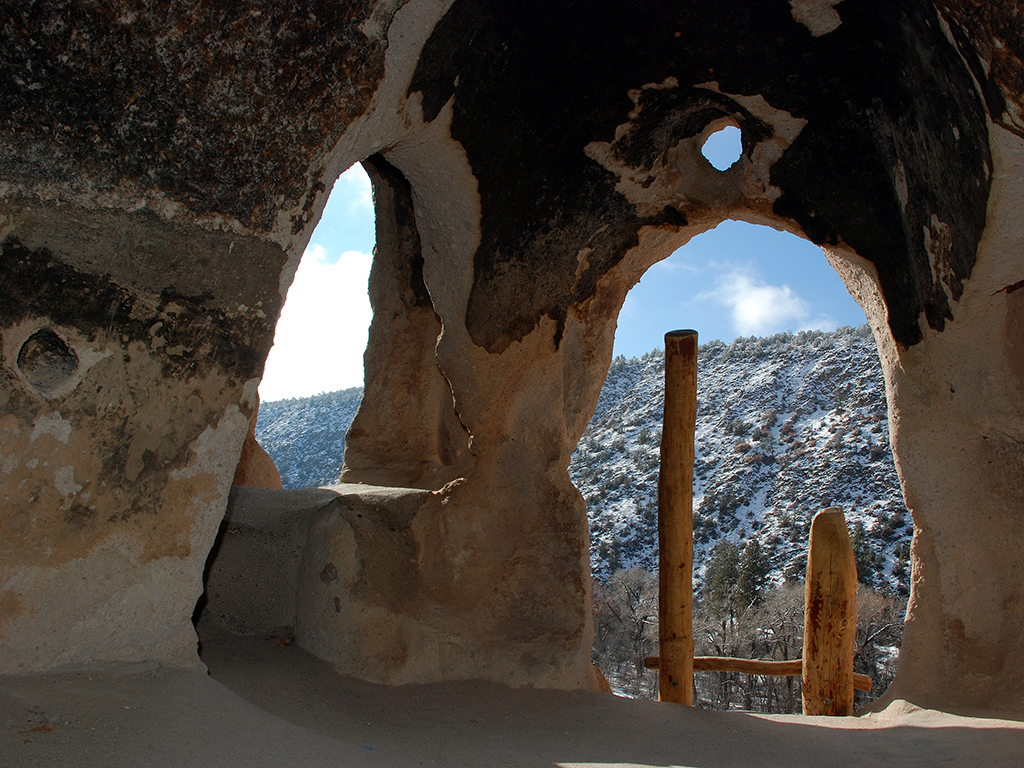
Bandelier National Monument in New Mexico protects and preserves the culture and architecture of the Ancestral Puebloans, who lived for 400 years within the land now bounded by this park unit. Here, these people farmed corn, beans, and squash; foraged for yucca, cholla and prickly pear cactus in addition to other native plants used for food and materials; and hunted large and small game such as deer and rabbits. They even domesticated turkeys and dogs.
At Bandelier National Monument, you can wander the landscape which supported the Ancestral Puebloans for centuries and even explore their homes of cliff dwellings and cavates carved into the cliffs of soft volcanic tuff (a compacted and cemented rock composed of volcanic ash, glass, and rock fragments).
You can also learn about the history of not only the Ancestral Puebloans and the places where they lived, but also about the Great Depression and the Civilian Conservation Corps (CCC), who constructed the road to this park in addition to trails and buildings, and about World War II and the housing of the Manhattan Project Staff within this national monument.
Getting to Bandelier is easy, since it’s 88 miles (142 kilometers) from the Albuquerque International Sunport in New Mexico. This is the largest nearby airport with the most airline selections if you plan to fly into the area then rent a vehicle.
Once you arrive at the park, you can drive to the various trailheads or park your car and leave the driving to others with the seasonal free shuttle service from March 19 – October 14, 2026. The shuttle runs every 30 minutes and only operates between parking areas within Bandelier. During previous years, the shuttle was mandatory, but for 2026 it will only be mandatory if all the parking lots are full.
Note: Shuttle service will not take you directly to the archaeological sites.
What can you do in the park?

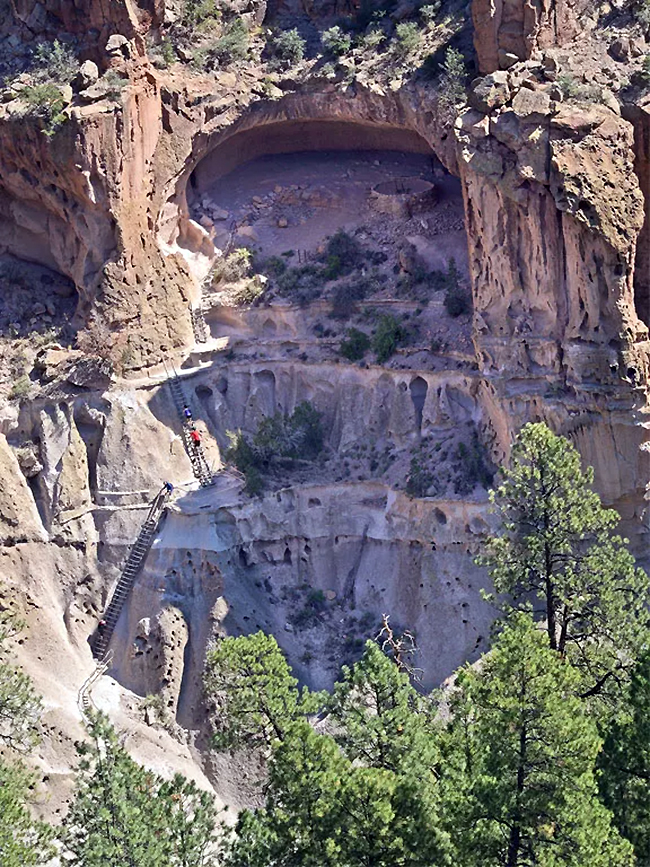
Explore some of the dwellings up close … if you don’t mind climbing up ladders. Some cavates require only a single short ladder climb. Alcove House, on the other hand, is a 140-foot (42.7-meter) ascent requiring a climb up four long, wooden, Pueblo-style ladders as well as many stone stairs. Along the trails and within some of these dwellings are petroglyphs (carvings etched into rock) and pictographs (paintings on the rock).
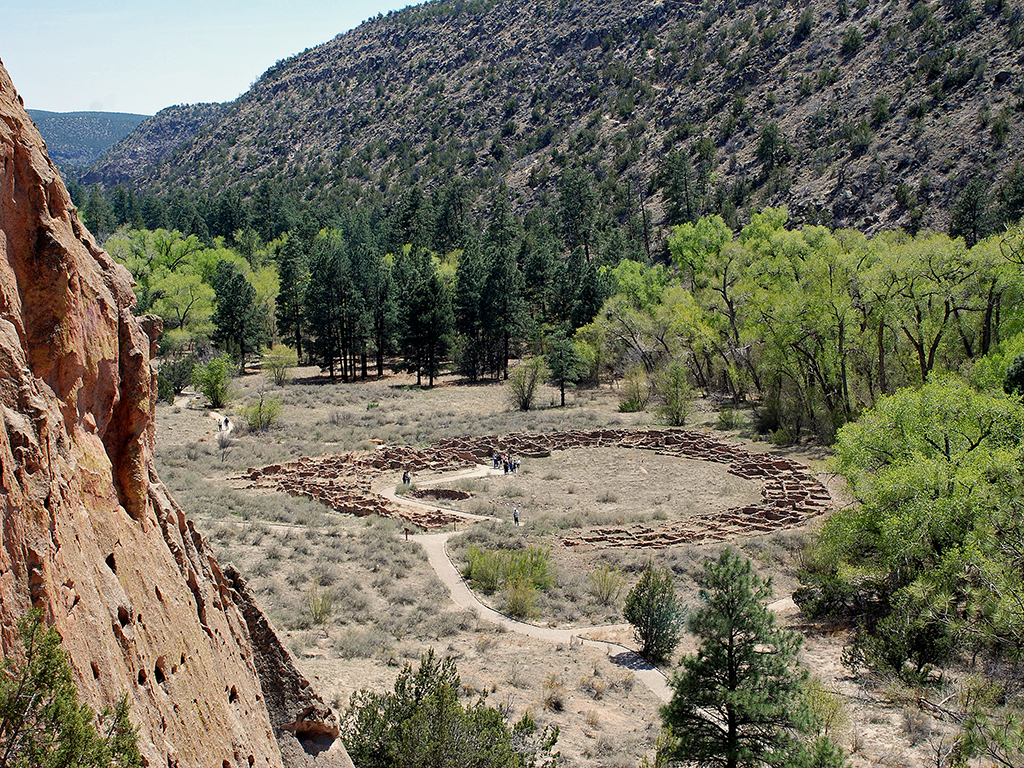
Take a hike. There are over 70 miles (113 kilometers) of hiking trails at Bandelier ranging from short hikes of as little as one mile (1.61 kilometers) roundtrip among archaeological sites, to longer hikes exceeding 12 miles (19.3 kilometers) roundtrip which can lead you into the backcountry (you’ll need a free permit for backcountry camping).
Ranger programs are offered throughout the year, with a strong emphasis on summer and fall presentations. You can learn about the history, wildlife, plant life, and geology seen within the national monument.
Because Bandelier National Monument is the traditional homeland of many tribal nations, the park provides a venue for these tribes to introduce visitors to their culture, art, and crafts through the Cultural Demonstration Program. Taking place on the back patio of the Bandelier visitor center, these free demonstrations range from traditional pottery making methods to watching traditional dance.
Bring your cross-country skis or snowshoes with you during a winter visit and you can enjoy a brisk day exploring one or more of four trails. While these trails are open all year to hiking, the ski and snowshoe season usually lasts from mid-November to mid-March. Be aware that snow volumes vary year to year and it’s a good idea to contact the visitor center for current conditions before packing your snow gear.
What if you decide one day is not enough to absorb all that you’ve seen at Bandelier, and you’d like to spend more time hiking and learning about this national monument?
There are two campgrounds within the park, each offering individual sites for tents and RVs as well as group sites. The majority of these campsites within both campgrounds may be reserved through recreation.gov, while other available sites are first-come, first-served.
The campgrounds make great “base camps” from which to take side trips to such places as Los Alamos (12 miles/19.3 kilometers away), Santa Fe (41 miles/66 kilometers away), Albuquerque (85 miles/137 kilometers away) and several other units of the National Park System including Petroglyph National Monument and Fort Union National Monument, all in New Mexico. They also are great places to view the starry sky on a clear night and feel a sense of awe and wonder as well as a connection to the heavens that the Ancestral Puebloans must also have felt.
Is brick-and-mortar lodging more your style? There is no longer any in-park lodging; the Frijoles Canyon Lodge closed in the 1980s.

However, nearby communities including Los Alamos, White Rock, Española, and Santa Fe offer not only a wide range of overnight options from hotels to fancy resorts to B&Bs to vacation rentals but also dining choices with a New Mexican flare.
Traveler’s Choice For: History, archaeology, families, photography
Stories about:
Story Categories:
A copy of National Parks Traveler's financial statements may be obtained by sending a stamped, self-addressed envelope to: National Parks Traveler, P.O. Box 980452, Park City, Utah 84098. National Parks Traveler was formed in the state of Utah for the purpose of informing and educating about national parks and protected areas.
Residents of the following states may obtain a copy of our financial and additional information as stated below:
- Florida: A COPY OF THE OFFICIAL REGISTRATION AND FINANCIAL INFORMATION FOR NATIONAL PARKS TRAVELER, (REGISTRATION NO. CH 51659), MAY BE OBTAINED FROM THE DIVISION OF CONSUMER SERVICES BY CALLING 800-435-7352 OR VISITING THEIR WEBSITE. REGISTRATION DOES NOT IMPLY ENDORSEMENT, APPROVAL, OR RECOMMENDATION BY THE STATE.
- Georgia: A full and fair description of the programs and financial statement summary of National Parks Traveler is available upon request at the office and phone number indicated above.
- Maryland: Documents and information submitted under the Maryland Solicitations Act are also available, for the cost of postage and copies, from the Secretary of State, State House, Annapolis, MD 21401 (410-974-5534).
- North Carolina: Financial information about this organization and a copy of its license are available from the State Solicitation Licensing Branch at 888-830-4989 or 919-807-2214. The license is not an endorsement by the State.
- Pennsylvania: The official registration and financial information of National Parks Traveler may be obtained from the Pennsylvania Department of State by calling 800-732-0999. Registration does not imply endorsement.
- Virginia: Financial statements are available from the Virginia Department of Agriculture and Consumer Services, 102 Governor Street, Richmond, Virginia 23219.
- Washington: National Parks Traveler is registered with Washington State’s Charities Program as required by law and additional information is available by calling 800-332-4483 or visiting www.sos.wa.gov/charities, or on file at Charities Division, Office of the Secretary of State, State of Washington, Olympia, WA 98504.


National parks and their natural resources belong to you. The National Parks Traveler works to ensure you know how these essential places are being cared for.
Sign Up For Our Weekly Newsletter
Unsubscribe at any time.
INN Member

The easiest way to explore RV-friendly National Park campgrounds.

Here’s the definitive guide to National Park System campgrounds where RVers can park their rigs.
Our app is packed with RVing- specific details on more than 250 campgrounds in more than 70 national parks.
You’ll also find stories about RVing in the parks, tips helpful if you’ve just recently become an RVer, and useful planning suggestions.

