
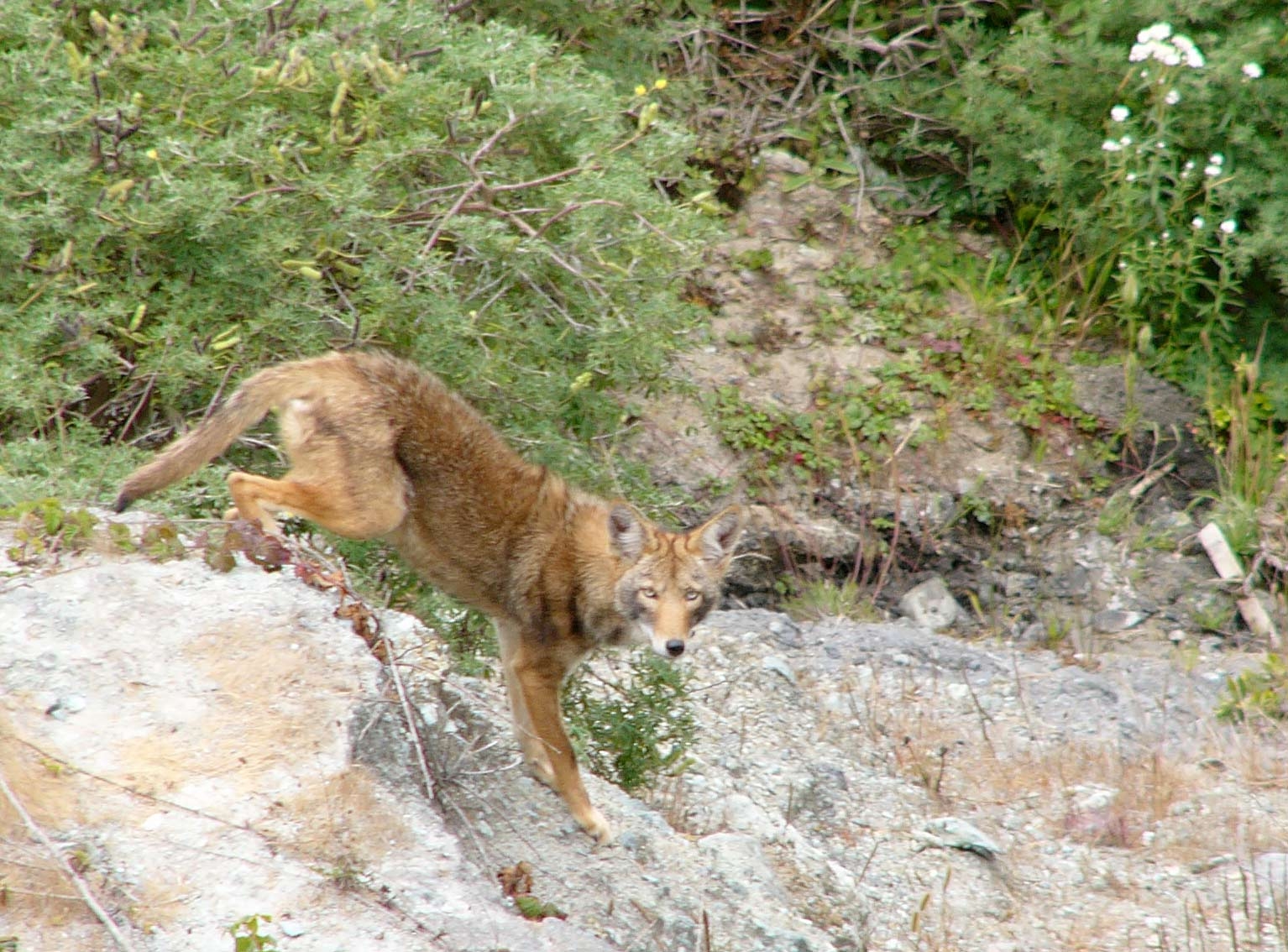
A male coyote that became famous after swimming to Alcatraz Island in January likely came from Angel Island State Park, according to National Park Service researchers, who used DNA from the coyote’s scat to figure out where he originated.
It was originally assumed that he came from San Francisco, as it represents a significantly shorter swim. The distance between Alcatraz and Angel Island is nearly two miles.
“Three distinct coyote populations could have been the source of the Alcatraz coyote, San Francisco, Southern Marin, and Angel Island,” said Dr. Ben Sacks from UC Davis. “Our lab was able to take the DNA sample and match it to a coyote previously sampled from the Angel Island population.”
“We are surprised by the coyote’s origin,” said park service wildlife ecologist Bill Merkle. “Our working assumption was that the coyote made the swim from San Francisco because it is a significantly shorter distance. We couldn’t help being impressed by his accomplishment in making it to Alcatraz.”
In late January, an Alcatraz visitor spotted and photographed the coyote as it climbed from the water and onto the island, which led park staff to begin monitoring the area. Biologists found fresh coyote tracks and scat in the following days and installed trail cameras and audio recording devices. Despite months of follow-up monitoring, the coyote was never seen again or his presence captured on the recording devices.
Researchers were interested in locating the coyote because of Alcatraz’s role as a seabird nesting habitat. Staff were prepared to safely capture and relocate him within Golden Gate National Recreation Area if he could be located.
Park Service researchers say there is no evidence the coyote is still on Alcatraz Island, and no remains have been found. “We don’t know what happened to the coyote,” said Merkle. “But he proved himself an expert swimmer to get to Alcatraz, and I hope he made a successful swim back home to Angel Island.”
Stories about:
Story Categories:
A copy of National Parks Traveler's financial statements may be obtained by sending a stamped, self-addressed envelope to: National Parks Traveler, P.O. Box 980452, Park City, Utah 84098. National Parks Traveler was formed in the state of Utah for the purpose of informing and educating about national parks and protected areas.
Residents of the following states may obtain a copy of our financial and additional information as stated below:
- Florida: A COPY OF THE OFFICIAL REGISTRATION AND FINANCIAL INFORMATION FOR NATIONAL PARKS TRAVELER, (REGISTRATION NO. CH 51659), MAY BE OBTAINED FROM THE DIVISION OF CONSUMER SERVICES BY CALLING 800-435-7352 OR VISITING THEIR WEBSITE. REGISTRATION DOES NOT IMPLY ENDORSEMENT, APPROVAL, OR RECOMMENDATION BY THE STATE.
- Georgia: A full and fair description of the programs and financial statement summary of National Parks Traveler is available upon request at the office and phone number indicated above.
- Maryland: Documents and information submitted under the Maryland Solicitations Act are also available, for the cost of postage and copies, from the Secretary of State, State House, Annapolis, MD 21401 (410-974-5534).
- North Carolina: Financial information about this organization and a copy of its license are available from the State Solicitation Licensing Branch at 888-830-4989 or 919-807-2214. The license is not an endorsement by the State.
- Pennsylvania: The official registration and financial information of National Parks Traveler may be obtained from the Pennsylvania Department of State by calling 800-732-0999. Registration does not imply endorsement.
- Virginia: Financial statements are available from the Virginia Department of Agriculture and Consumer Services, 102 Governor Street, Richmond, Virginia 23219.
- Washington: National Parks Traveler is registered with Washington State’s Charities Program as required by law and additional information is available by calling 800-332-4483 or visiting www.sos.wa.gov/charities, or on file at Charities Division, Office of the Secretary of State, State of Washington, Olympia, WA 98504.
INN Member

The easiest way to explore RV-friendly National Park campgrounds.

Here’s the definitive guide to National Park System campgrounds where RVers can park their rigs.
Our app is packed with RVing- specific details on more than 250 campgrounds in more than 70 national parks.
You’ll also find stories about RVing in the parks, tips helpful if you’ve just recently become an RVer, and useful planning suggestions.

