
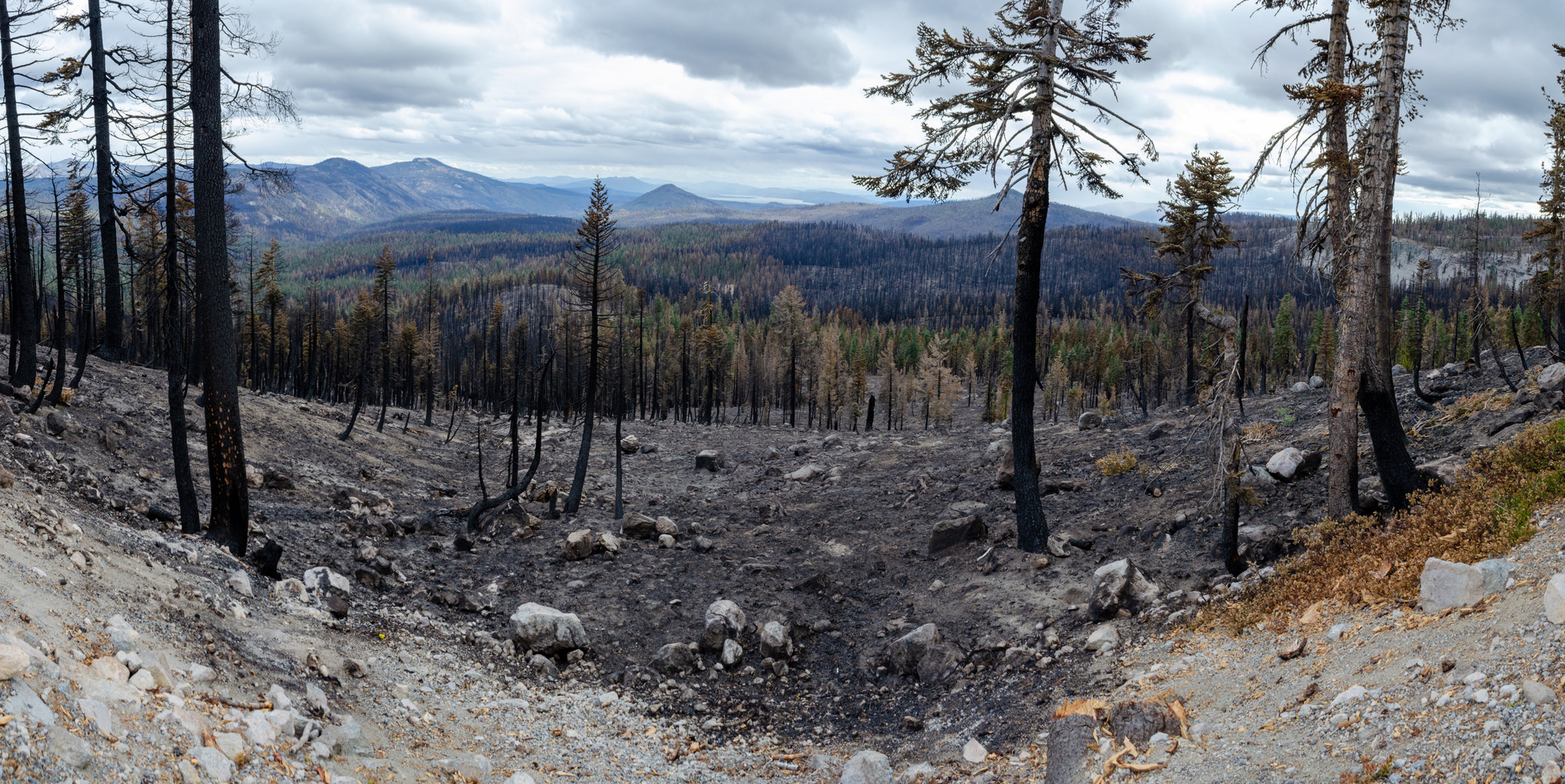
While a research team worked to examine a stratified sample of plots in Lassen Volcanic National Park in California in 2021, the Dixie Fire arrived, growing into a nearly 1-million-acre blaze that devastated parts of the park over 104 days. The researchers had been studying how the forest that’s hands-off to residents and most fire-suppression measures had recovered from naturally occurring forest fires as far back as the mid-1980s.
The Dixie Fire halted their research efforts, but they ultimately found an opportunity in the fire’s aftermath. “The Dixie Fire rolled through and just blew our research project up,” said Alan Taylor, a professor emeritus of geography at Pennsylvania State University. “But it then gave us a chance to see how these massive and ever-increasing mega fires are impacting the forest. We wanted to know if and how the forest would recover after this extraordinary event.”
In 2022, the team altered their research objective and now wanted to see how the same landscape responded to extreme wildfire, and study how prior fires influenced chances of forest recovery. Their research (attached) found that despite more than 40 percent of the Dixie Fire burning at high severity, the forest showed signs of regeneration.
Just after the Dixie fire, 32 percent of the plots in the park had at least one seedling, and about half were considered “stocked,” a label the U.S. Forest Service applies when a plot is deemed likely to make a full recovery. Of all seedlings in the plots in 2021, 19 percent survived the Dixie fire.
The researchers also discovered that plots on steeper and wetter sites, farther from forest edges, with lower ground cover, and burned twice by previous fires rather than once before the Dixie Fire stood a stronger chance of having seedlings survive. Moreover, regeneration was less likely to persist where more ground cover was consumed by the Dixie Fire because that causes fires to burn hotter.
“In the past few decades, there has been a large increase in areas burned by wildfires, and these wildfires are now burning over areas that burned before,” Taylor explained. “Factors contributing to the persistence of forest regeneration in this overlapping mosaic of reburns is poorly known, and this research provides insights on where forest management activities could be focused to improve persistence of regeneration through reburns and new regeneration after fires.”
Despite the extreme temperatures created by the Dixie Fire, researchers found only about half the fire’s path resulted in a total loss of tree canopy.
“We’re seeing more high severity fires,” said Lucas Harris, a co-author of the study. “It’s a really important question whether forests are able to recover from these fires, and this research shows in many areas that they are.”
The study demonstrated how lessening fuels at forest edges and in large areas of high severity fire where fire-killed trees have fallen to the forest floor can lead to greater rates of forest recovery. Fuel reduction treatments during the Dixie Fire were also able to save many of the facilities and structures that were treated in the park.
“When you have a landscape in which you’re concerned about mega fire, which have become more common, the use of smaller scale, controlled fires under moderate weather conditions could offer very real protective benefits when you inevitably do have a larger scale disturbance,” said Dani Niziolek, a lead author on the research.

Stories about:
Story Categories:
A copy of National Parks Traveler's financial statements may be obtained by sending a stamped, self-addressed envelope to: National Parks Traveler, P.O. Box 980452, Park City, Utah 84098. National Parks Traveler was formed in the state of Utah for the purpose of informing and educating about national parks and protected areas.
Residents of the following states may obtain a copy of our financial and additional information as stated below:
- Florida: A COPY OF THE OFFICIAL REGISTRATION AND FINANCIAL INFORMATION FOR NATIONAL PARKS TRAVELER, (REGISTRATION NO. CH 51659), MAY BE OBTAINED FROM THE DIVISION OF CONSUMER SERVICES BY CALLING 800-435-7352 OR VISITING THEIR WEBSITE. REGISTRATION DOES NOT IMPLY ENDORSEMENT, APPROVAL, OR RECOMMENDATION BY THE STATE.
- Georgia: A full and fair description of the programs and financial statement summary of National Parks Traveler is available upon request at the office and phone number indicated above.
- Maryland: Documents and information submitted under the Maryland Solicitations Act are also available, for the cost of postage and copies, from the Secretary of State, State House, Annapolis, MD 21401 (410-974-5534).
- North Carolina: Financial information about this organization and a copy of its license are available from the State Solicitation Licensing Branch at 888-830-4989 or 919-807-2214. The license is not an endorsement by the State.
- Pennsylvania: The official registration and financial information of National Parks Traveler may be obtained from the Pennsylvania Department of State by calling 800-732-0999. Registration does not imply endorsement.
- Virginia: Financial statements are available from the Virginia Department of Agriculture and Consumer Services, 102 Governor Street, Richmond, Virginia 23219.
- Washington: National Parks Traveler is registered with Washington State’s Charities Program as required by law and additional information is available by calling 800-332-4483 or visiting www.sos.wa.gov/charities, or on file at Charities Division, Office of the Secretary of State, State of Washington, Olympia, WA 98504.
INN Member

The easiest way to explore RV-friendly National Park campgrounds.

Here’s the definitive guide to National Park System campgrounds where RVers can park their rigs.
Our app is packed with RVing- specific details on more than 250 campgrounds in more than 70 national parks.
You’ll also find stories about RVing in the parks, tips helpful if you’ve just recently become an RVer, and useful planning suggestions.

