
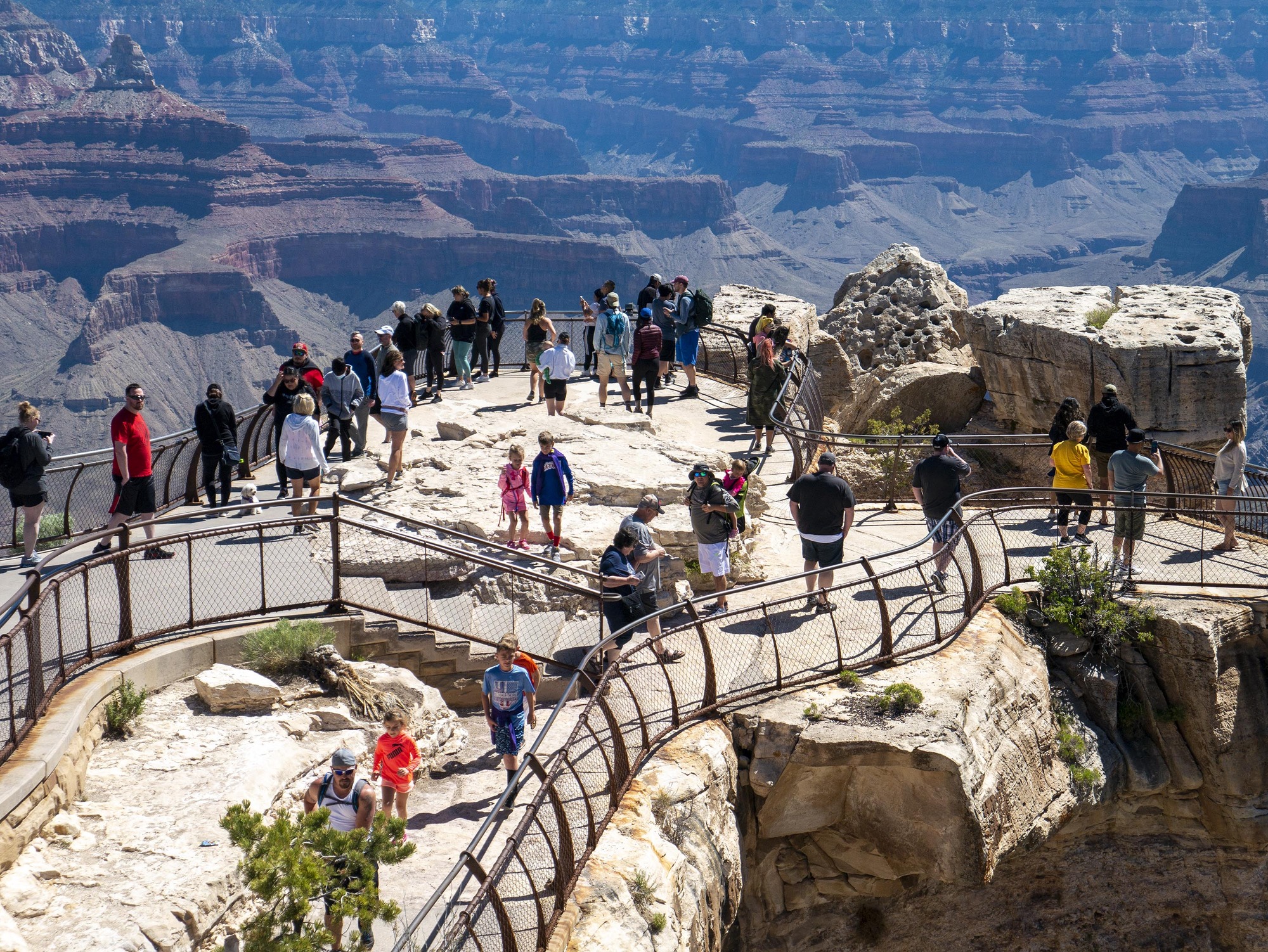
Crowding in national parks may not always be a bad thing, according to a study published in February 2026 (attached). While “crowding” is generally considered a downside for visitors at national parks, encountering others in these shared natural spaces can also lead to “communitas,” which the researchers define as a “transformative experience that goes to the root of each person’s being and finds in that root something profoundly communal and shared.”
According to the study, “much of the research conducted at U.S. national parks assumes that a higher visitor density is always non-preferable, and each additional encounter unequivocally negatively impacts the experience.” Furthermore, the visitor use management frameworks currently being used often lack the ability to capture the potential positive value of crowding, especially for more diverse visitors.
Park policies, visitor use standards, and even research frameworks have helped cement expectations of solitude in national parks, say the researchers. This happened many years before the dramatic increase of visitor numbers, often without sufficient reflection on the cultural specificity or normative origins of solitude.
Of course, crowding can be problematic. The study acknowledges that increasing visitor numbers can degrade the ecological systems and local community, and at times, there is a need “to limit them for resource protection, visitor experience, and community well-being.” However, the default assumption should not be that crowding is always negative.
For example, a higher density of people may enhance visitors’ experience and enjoyment by providing a sense of security, social vibrancy, and “people-watching” opportunities. This is especially true for minority groups, who often hold distinct values related to crowding.
According to the study, community-based approaches to outdoor recreation are more culturally resonant to Latino visitors than solitary wilderness experiences. For African Americans, their relationships with outdoor recreation spaces emphasize a collective memory and community-based experiences and demonstrate a preference for group-oriented outdoor activities. In addition, family-centered and community-oriented approaches to outdoor recreation are central to many Asian Americans' cultural traditions.
The researchers underscore that “there is no ‘one-size-fits-all’ criterion for all visitors, and we probably should not manage national parks as such. Furthermore, we may need to design national parks with certain features to encourage inter-group communication between diverse visitor demographics.”
“By integrating the concept of collective experience, the future of national parks lies not in preserving solitude as the default ideal, but in providing a spectrum of opportunities where every American can find their place, including witnessing wonder together, not apart,” concludes the study.

Story Categories:
A copy of National Parks Traveler's financial statements may be obtained by sending a stamped, self-addressed envelope to: National Parks Traveler, P.O. Box 980452, Park City, Utah 84098. National Parks Traveler was formed in the state of Utah for the purpose of informing and educating about national parks and protected areas.
Residents of the following states may obtain a copy of our financial and additional information as stated below:
- Florida: A COPY OF THE OFFICIAL REGISTRATION AND FINANCIAL INFORMATION FOR NATIONAL PARKS TRAVELER, (REGISTRATION NO. CH 51659), MAY BE OBTAINED FROM THE DIVISION OF CONSUMER SERVICES BY CALLING 800-435-7352 OR VISITING THEIR WEBSITE. REGISTRATION DOES NOT IMPLY ENDORSEMENT, APPROVAL, OR RECOMMENDATION BY THE STATE.
- Georgia: A full and fair description of the programs and financial statement summary of National Parks Traveler is available upon request at the office and phone number indicated above.
- Maryland: Documents and information submitted under the Maryland Solicitations Act are also available, for the cost of postage and copies, from the Secretary of State, State House, Annapolis, MD 21401 (410-974-5534).
- North Carolina: Financial information about this organization and a copy of its license are available from the State Solicitation Licensing Branch at 888-830-4989 or 919-807-2214. The license is not an endorsement by the State.
- Pennsylvania: The official registration and financial information of National Parks Traveler may be obtained from the Pennsylvania Department of State by calling 800-732-0999. Registration does not imply endorsement.
- Virginia: Financial statements are available from the Virginia Department of Agriculture and Consumer Services, 102 Governor Street, Richmond, Virginia 23219.
- Washington: National Parks Traveler is registered with Washington State’s Charities Program as required by law and additional information is available by calling 800-332-4483 or visiting www.sos.wa.gov/charities, or on file at Charities Division, Office of the Secretary of State, State of Washington, Olympia, WA 98504.
INN Member

The easiest way to explore RV-friendly National Park campgrounds.

Here’s the definitive guide to National Park System campgrounds where RVers can park their rigs.
Our app is packed with RVing- specific details on more than 250 campgrounds in more than 70 national parks.
You’ll also find stories about RVing in the parks, tips helpful if you’ve just recently become an RVer, and useful planning suggestions.

