
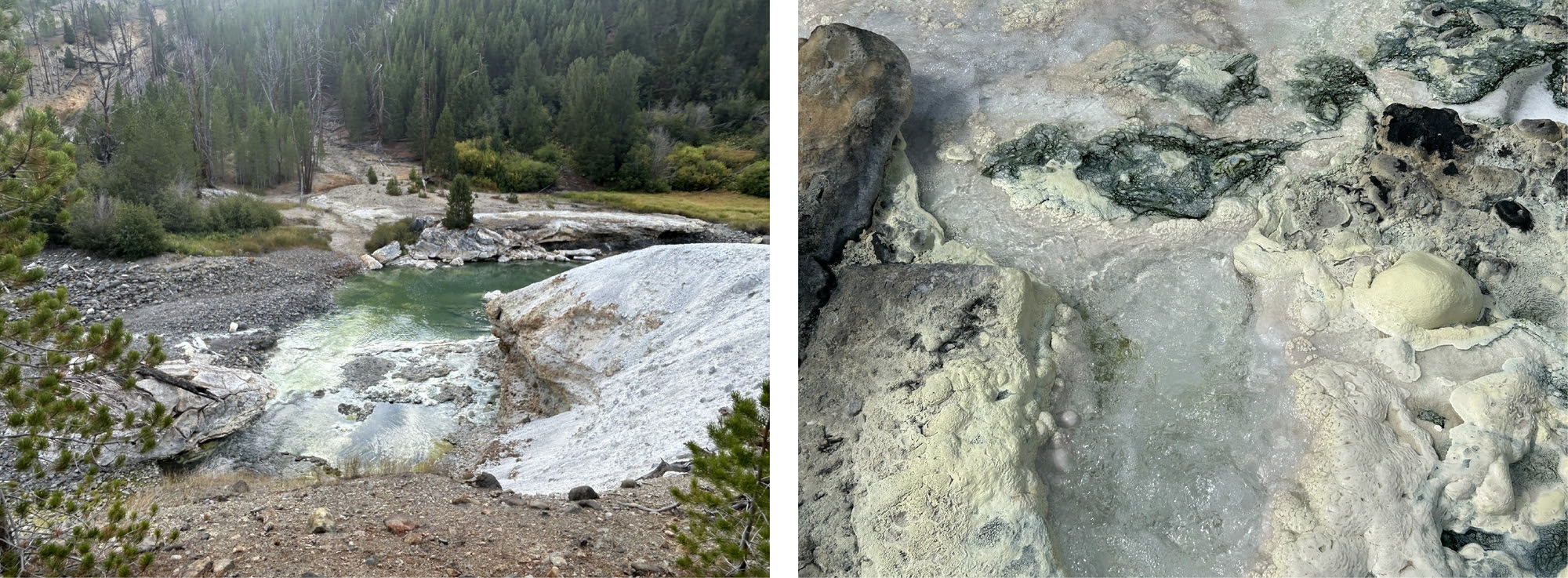
Editor's Note: Yellowstone Caldera Chronicles is a weekly column written by scientists and collaborators of the Yellowstone Volcano Observatory. This week's contribution is from Blaine McCleskey, Shaul Hurwitz, Sara Peek, and David Roth, geochemists with the U.S. Geological Survey.
The 1900 book The Biography of a Grizzly, by Ernest Thompson Steton (one of the founders of the Boy Scouts of America), is a fictional story about the life of a grizzly bear named Wahb—a name meaning Whitebear that was given to the light-colored bear by a member of the Shoshone tribe. Ultimately Wahb, plagued with a lifetime of injuries, chose Death Gulch, located on the south side of Cache Creek (a tributary of the Lamar River) in northeast Yellowstone National Park, as his final resting place:
But as he [Wahb] climbed with shaky limbs, and short uncertain steps, the west wind brought the odor of Death Gulch, that fearful little valley where everything was dead, where the very air was deadly. It used to disgust him and drive him away, but now Wahb felt that it had a message for him; he was drawn by it. It was in his line of flight, and he hobbled slowly toward the place. He went nearer, nearer, until he stood upon the entering ledge. A Vulture that had descended to feed on one of the victims was slowly going to sleep on the untouched carcass. Wahb swung his great grizzled muzzle and his long white beard in the wind. The odor that he once had hated was attractive now. There was a strange biting quality in the air. His body craved it. For it seemed to numb his pain and it promised sleep, as it did that day when first he saw the place.

Death Gulch is a deep V-shaped drainage that was described in 1888 by geologists Walter Weed and Arnold Hague. They found the gulch to be a natural death trap for animals because of carbon dioxide and hydrogen sulfide accumulation. At high concentrations in the air, these gases are lethal, and the death of one animal is thought to lure in others, who are then also overcome. The source of carbon dioxide was articulately described by Thomas Jagger in his 1899 article “DEATH GULCH, A NATURAL BEAR-TRAP”:
The gas is probably generated by the action of the acid water on the ancient limestones that here underlie the lavas at no great depth; outcrops of these limestones occur only a few miles away at the mouth of Soda Butte Creek. This gas must emanate from fissures in the rock just above the bears [or higher in the drainage], and on still nights it may accumulate to a depth of two or three feet in the ravine, settling in a heavy, wavy stratum, and probably rolling slowly down the bed of the rill into the valley below.
The Biography of a Grizzly was sold in Yellowstone National Park and became such a favorite that the springs located near the base of Death Gulch were named after the grizzly on the 1904 park map—Wahb Springs!
Most thermal features in Yellowstone are underlain by rhyolite lava flows and tuffs or by carbonate rocks (as at Mammoth Hot Springs). In contrast, Wahb Springs is in the Absaroka Volcanic Province, which consists of basaltic and sedimentary rocks and can easily be viewed between Tower Junction and Canyon Junction.
A team of researchers from the U.S. Geological Survey, equipped with gas masks and monitors, visited Wahb Springs and Death Gulch in the fall of 2024 to collect water and gas samples. (Scientists visiting in bygone years would carry torches into Death Gulch, and if those torches went out due to a lack of oxygen that was their indication to leave the area!) The samples were later analyzed in USGS laboratories to determine the chemical compositions.

Wahb Springs is in a low-temperature thermal area with water temperatures of about 35 °C (95 °F). Waters at the springs have some of the highest concentrations of dissolved calcium and magnesium, carbon, and hydrogen sulfide (44 milligrams per liter) ever measured in Yellowstone. The unusually high concentration of hydrogen sulfide in the water is probably a result of sulfur-rich sediments underlying the springs, as well as the water’s cooler temperature. In addition, small travertine deposits, perhaps similar in color to the white grizzly Wahb, are forming around the springs. The gases emitted in Death Gulch and around Wahb Springs are enriched in carbon dioxide (~95%) and hydrogen sulfide (~2%); however, during the site visit gases were not accumulating in Death Gulch.
Although springs in Yellowstone have a wide range of chemical compositions, the composition of water at Wahb Springs is anomalous. This is all thanks to the underlying geology. The water at Wahb Springs flows through and reacts with sulfur-rich sediments that are very different from the rhyolites in and around Yellowstone Caldera and the carbonate sediments at Mammoth Hot Springs. So the unusual names of Death Gulch and Wahb Springs are due to unusual chemical compositions of the water and gas, which are a result of the unusual geology!
Acknowledgement: Some of the information from this article was taken from Lee H. Whittlesey’s book Yellowstone Place Names.
Stories about:
Story Categories:
A copy of National Parks Traveler's financial statements may be obtained by sending a stamped, self-addressed envelope to: National Parks Traveler, P.O. Box 980452, Park City, Utah 84098. National Parks Traveler was formed in the state of Utah for the purpose of informing and educating about national parks and protected areas.
Residents of the following states may obtain a copy of our financial and additional information as stated below:
- Florida: A COPY OF THE OFFICIAL REGISTRATION AND FINANCIAL INFORMATION FOR NATIONAL PARKS TRAVELER, (REGISTRATION NO. CH 51659), MAY BE OBTAINED FROM THE DIVISION OF CONSUMER SERVICES BY CALLING 800-435-7352 OR VISITING THEIR WEBSITE. REGISTRATION DOES NOT IMPLY ENDORSEMENT, APPROVAL, OR RECOMMENDATION BY THE STATE.
- Georgia: A full and fair description of the programs and financial statement summary of National Parks Traveler is available upon request at the office and phone number indicated above.
- Maryland: Documents and information submitted under the Maryland Solicitations Act are also available, for the cost of postage and copies, from the Secretary of State, State House, Annapolis, MD 21401 (410-974-5534).
- North Carolina: Financial information about this organization and a copy of its license are available from the State Solicitation Licensing Branch at 888-830-4989 or 919-807-2214. The license is not an endorsement by the State.
- Pennsylvania: The official registration and financial information of National Parks Traveler may be obtained from the Pennsylvania Department of State by calling 800-732-0999. Registration does not imply endorsement.
- Virginia: Financial statements are available from the Virginia Department of Agriculture and Consumer Services, 102 Governor Street, Richmond, Virginia 23219.
- Washington: National Parks Traveler is registered with Washington State’s Charities Program as required by law and additional information is available by calling 800-332-4483 or visiting www.sos.wa.gov/charities, or on file at Charities Division, Office of the Secretary of State, State of Washington, Olympia, WA 98504.
INN Member

The easiest way to explore RV-friendly National Park campgrounds.

Here’s the definitive guide to National Park System campgrounds where RVers can park their rigs.
Our app is packed with RVing- specific details on more than 250 campgrounds in more than 70 national parks.
You’ll also find stories about RVing in the parks, tips helpful if you’ve just recently become an RVer, and useful planning suggestions.

