
Since its inception, the Interior Department’s Adaptive Management Work Group (AMWG) has failed to fulfill an intent of the Grand Canyon Protection Act: to assure Glen Canyon Dam is operated to protect, mitigate adverse impacts to, and improve the values for which Glen Canyon National Recreation Area (GCNRA) was established.1
It has also contravened its Charter, which directs the organization to inform the Secretary of the Interior about how to manage the dam’s operations, while protecting GCNRA.2
Historically, AMWG’s activities have focused exclusively on GCNRA’s resources downstream of Glen Canyon Dam, even though more than 90 percent of the park’s 1.25 million acres are upstream of the dam, including about 300 miles of the Colorado, San Juan, Escalante and Dirty Devil rivers.3
Like a defective gene inserted into its bureaucratic DNA, this disregard for the vast majority of GCNRA has created AMWG’s self-replicating pattern of neglect. Today, the home page for AMWG’s website states that it brings “varied interests to a consensus on how to protect downstream resources and strike a wise balance on river operations.”4 (emphasis added). The statement contravenes a clear purpose of the Grand Canyon Protection Act, and AMWG’s Charter.
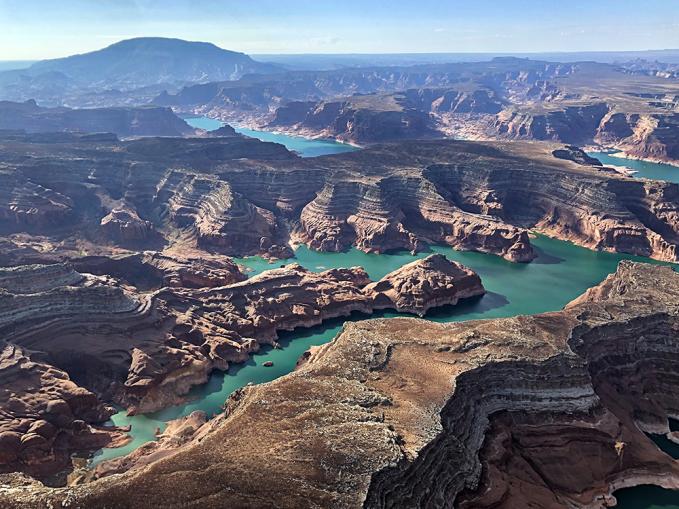
By focusing exclusively on downstream resources, AMWG has disregarded emerging resources in GCNRA, including habitat that could be critical for sustaining endangered species. As Lake Powell has retreated, about 100,000 acres of GCNRA are no longer submerged. The sediment-filled, denuded landscape of the park’s formerly flooded sections were rendered sterile temporarily by the indiscriminate drowning of all previous inhabitants. Now, riparian landscapes along the rivers and dozens of their tributaries are undergoing rapid ecological succession with native vegetation and animals dominating the process, habitat that could enhance the survival of federally-protected terrestrial endangered species, which have been documented in GCNRA.5
In addition, as Lake Powell has receded, it has been replaced by about 35 miles of riverine habitat along both the Colorado and San Juan Rivers. This has created habitat for endangered fish such as the Colorado pikeminnow and razorback sucker. If the reservoir were to rise, it would destroy these important new assets.6
The process for developing post-2026 guidelines for managing Lake Powell and Lake Mead provide an opportunity to remedy AMWG’s long-standing practice of ignoring how Glen Canyon Dam impacts the vast majority of resources within GCNRA. The new guidelines must take into account and promote the remarkable eco-restoration occurring in GCNRA, and assign as much value to the resources within it, as it does to resources downstream of the dam. GCNRA should no longer be treated as a neglected subordinate within the National Park System.
Ron Rudolph, a former assistant executive director of Friends of the Earth, spent 35 years in various engineering companies, including MWH Global, CH2M Hill, Jacobs Engineering, and Cardno with a career focused on infrastructure development and environmental remediation.
1 P.L. 102-575; Section 1802(a)
2 Secretary of the Interior, Renewal Charter, Glen Canyon Dam Adaptive Management Work Group, September 12, 2025
3 for references see DFC Ad Hoc Committee, Desired Future Conditions for the Colorado River Ecosystem in Relation to Glen Canyon Dam; January 23, 2012, page 1; Memorandum from Assistant Secretary of the Interior, Water and Science to the Secretary, Report and Recommendations From the Glen Canyon Dam Adaptive Work Group Federal Advisory Committee, April 26, 2012; Memorandum from Secretary of the Interior to Assistant Secretary, Water and Science, Report and Recommendations From the Glen Canyon Dam Adaptive Work Group; April 30, 2012,and Decision Memorandums for the Secretary, December 9, 2013; September 29, 2014, November 12, 2015; December 9, 2016; April 16, 2019 and December 16, 2020
4 https://www.usbr.gov/uc/progact/amp/amwg.html
5 Seth Arens,“A Renewed Glen Canyon Emerges,” A Watershed Moment:The American West and the Age of Limits, University of Utah Press, 2024; also see https://www.nps.gov/glca/learn/nature/birds.htm, which notes that several federally listed species have been documented in GCNRA, including the Mexican spotted owl (Strix occidentalis), bald eagle (Haliaeetus leucocephalus), and Southwestern willow flycatcher (Empidonax traillii)
6 U.S. Bureau of Reclamation, Draft Environmental Impact Statement, Post-2026 Operational Guidelines and Strategies for Lake Powell and Lake Mead, Technical Appendix 8, Biological Resources, page 8-36
Stories about:
Story Categories:
A copy of National Parks Traveler's financial statements may be obtained by sending a stamped, self-addressed envelope to: National Parks Traveler, P.O. Box 980452, Park City, Utah 84098. National Parks Traveler was formed in the state of Utah for the purpose of informing and educating about national parks and protected areas.
Residents of the following states may obtain a copy of our financial and additional information as stated below:
- Florida: A COPY OF THE OFFICIAL REGISTRATION AND FINANCIAL INFORMATION FOR NATIONAL PARKS TRAVELER, (REGISTRATION NO. CH 51659), MAY BE OBTAINED FROM THE DIVISION OF CONSUMER SERVICES BY CALLING 800-435-7352 OR VISITING THEIR WEBSITE. REGISTRATION DOES NOT IMPLY ENDORSEMENT, APPROVAL, OR RECOMMENDATION BY THE STATE.
- Georgia: A full and fair description of the programs and financial statement summary of National Parks Traveler is available upon request at the office and phone number indicated above.
- Maryland: Documents and information submitted under the Maryland Solicitations Act are also available, for the cost of postage and copies, from the Secretary of State, State House, Annapolis, MD 21401 (410-974-5534).
- North Carolina: Financial information about this organization and a copy of its license are available from the State Solicitation Licensing Branch at 888-830-4989 or 919-807-2214. The license is not an endorsement by the State.
- Pennsylvania: The official registration and financial information of National Parks Traveler may be obtained from the Pennsylvania Department of State by calling 800-732-0999. Registration does not imply endorsement.
- Virginia: Financial statements are available from the Virginia Department of Agriculture and Consumer Services, 102 Governor Street, Richmond, Virginia 23219.
- Washington: National Parks Traveler is registered with Washington State’s Charities Program as required by law and additional information is available by calling 800-332-4483 or visiting www.sos.wa.gov/charities, or on file at Charities Division, Office of the Secretary of State, State of Washington, Olympia, WA 98504.
INN Member

The easiest way to explore RV-friendly National Park campgrounds.

Here’s the definitive guide to National Park System campgrounds where RVers can park their rigs.
Our app is packed with RVing- specific details on more than 250 campgrounds in more than 70 national parks.
You’ll also find stories about RVing in the parks, tips helpful if you’ve just recently become an RVer, and useful planning suggestions.

