

Perhaps one of the most iconic views within Canyon de Chelly National Monument in Arizona is the vista from the Spider Rock Overlook. As you gaze down upon this red rock landscape with the two spires soaring 700-800 feet (213.4-244 meters) into the air, you just might even hear the keeeeeeeyar call of a red-tailed hawk above, in your imagination if not for real.
You are standing within the Navajo Nation. Canyon de Chelly (pronounced duh SHAY) is home to the Diné (Navajo for “the People”) who have lived in these canyons for almost 5,000 years. The park was designated in 1931 to protect prehistoric villages built between 350 and 1300 A.D., and is cooperatively managed by the Navajo Nation and the National Park Service.
Four miles (6.4 kilometers) from Chinle, Arizona (population 4,395 as of 2023), itself five miles (8 kilometers) east from the U.S. 191 turnoff, this national monument is more than just the Spider Rock Overlook.
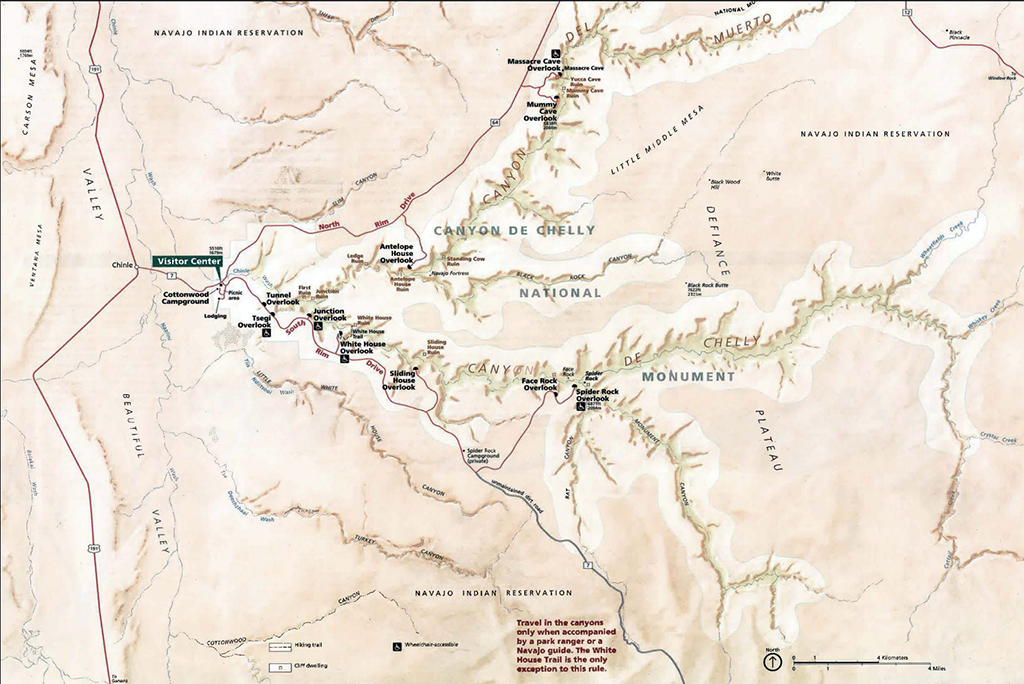
Shaped by tectonic uplift and carved by streams, with water and rich soil creating sustainable living for both humans and wildlife, you’ll find more than just overlooks (there are 10 of them, by the way) of photo-worthy geography.

You’ll see an ancient ruin snugged against a sandstone cliff shelter and walk past petroglyph and pictograph rock art on the sandstone walls.
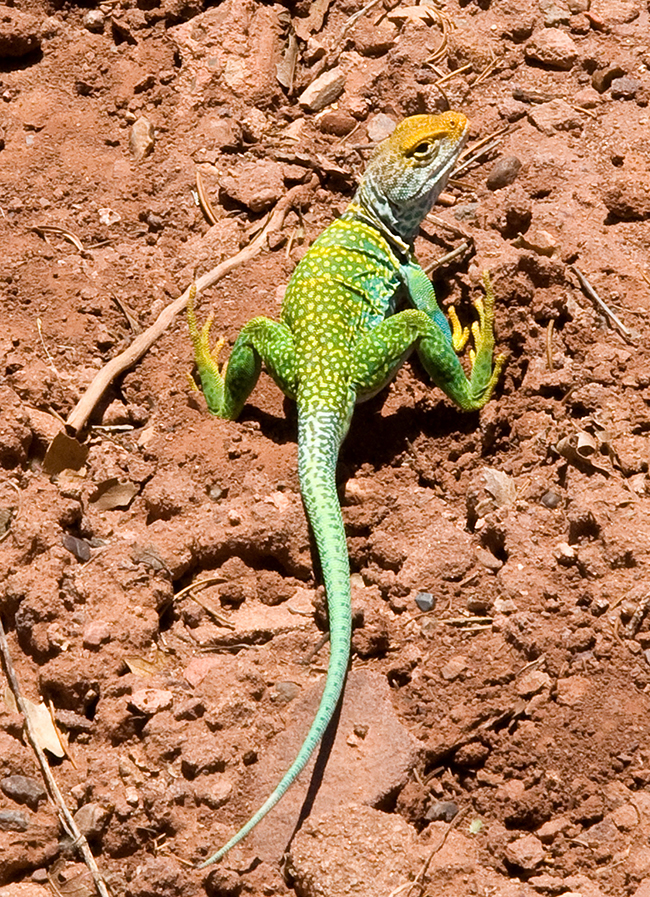
While exploring this terrain, you might spy any of eight amphibian, 147 bird, 34 fish, 49 mammal, or 14 reptile species. Perhaps you’ll see a colorful lizard sunning itself on a rock, or that red-tailed hawk you heard, or a common nighthawk or broad-tailed hummingbird. You might also spot mule deer, fox, or coyotes. Even black bears make their home in this national monument. Canyon de Chelly occupies several life zones providing homes for a wide variety of plant life and wildlife.
Canyon de Chelly National Monument is, indeed, a park in which you can spend a few hours or an entire day while seeing amazing sights and learning about Diné culture.
What can you do in a day?
Drive the two paved rim roads to those 10 overlooks. Park Staff recommend visiting the three overlooks on the North Rim for great morning photography and the seven South Rim overlooks for afternoon photo ops. Allow yourself plenty of time to take in the views. The overlooks are open year-round.
If you feel like stretching your legs on a self-guided hike, you can do that on the 2.5-mile (4-kilometer) roundtrip White House Trail descending 600 feet (183 meters) to the White House cliff dwelling ruins.
For longer hikes as well as horseback rides and canyon tours by vehicle, you can hire a private company registered with the Navajo Parks and Recreation Department. For a list of companies, email [email protected]; or visit navajonationparks.org for more information.
Ranger programs are offered throughout the year, including hikes and talks. You can check the park’s Welcome Center or their Facebook page. If you choose a ranger-guided hike (limited to 15 people), the Park Staff want you to understand the following:
- Some trailheads are off road and require high clearance vehicles; NPS staff cannot transport hikers.
- Hikers are required to stay together during hike with Park Ranger.
- Hikes are moderately strenuous to strenuous.
- Hikes can involve some climbing; hiking down/up uneven slick rock; and through sand, mud and water.
- Be prepared and dress in layers, wear comfortable shoes (no flip flops), bring a hat, and carry a pack with water, snacks, first aid kit, and insect repellent.
- Weather can be unpredictable; prepare for heat, dust storms, rain and snow.
You are responsible for your own safety. Entering the canyon is at your own risk.
Do not attempt hikes if you had recent surgery or have respiratory, ankle, knee or back problems; difficulty climbing stairs; or fear of heights.
If you’d like to visit this national monument for two or more days, there is in-park lodging for those of you wishing a brick-and-mortar overnight option. If you'd rather pitch your tent or park your RV directly beneath the stars, there is also a campground.
The 74-room Thunderbird Lodge, a non-smoking property, is under management of the Navajo Hospitality Enterprise and offers a motel, gift shop, cafeteria and canyon tours. The lodge sits on the site of a trading post built in 1896, and there are a range of rooms to choose from. Costs per night range from $90 - $150 (not including taxes) depending upon room choice.
Tseyi’ Dine’ Heritage Area – Cottonwood Campground (TDHA) is located near the entrance to Canyon de Chelly and is open year-round, offering about 90 individual sites and two group sites. There are six designated accessible sites, according to the campground map, three restroom facilities with sinks and flushable toilets, and a dump station. There are no hookups and no showers. Maximum RV/Vehicle-trailer length is 40 feet. Services are limited during the winter.
After spending time at Canyon de Chelly, why not take a side trip to Navajo National Monument, approximately 97-135 miles (156-217 kilometers) depending upon route taken, or Hubbell Trading Post National Historic Site located 38.4 miles (61.8 kilometers) away.
Traveler’s Choice For: Photography, archaeology, geology, Navajo culture
Stories about:
Story Categories:
A copy of National Parks Traveler's financial statements may be obtained by sending a stamped, self-addressed envelope to: National Parks Traveler, P.O. Box 980452, Park City, Utah 84098. National Parks Traveler was formed in the state of Utah for the purpose of informing and educating about national parks and protected areas.
Residents of the following states may obtain a copy of our financial and additional information as stated below:
- Florida: A COPY OF THE OFFICIAL REGISTRATION AND FINANCIAL INFORMATION FOR NATIONAL PARKS TRAVELER, (REGISTRATION NO. CH 51659), MAY BE OBTAINED FROM THE DIVISION OF CONSUMER SERVICES BY CALLING 800-435-7352 OR VISITING THEIR WEBSITE. REGISTRATION DOES NOT IMPLY ENDORSEMENT, APPROVAL, OR RECOMMENDATION BY THE STATE.
- Georgia: A full and fair description of the programs and financial statement summary of National Parks Traveler is available upon request at the office and phone number indicated above.
- Maryland: Documents and information submitted under the Maryland Solicitations Act are also available, for the cost of postage and copies, from the Secretary of State, State House, Annapolis, MD 21401 (410-974-5534).
- North Carolina: Financial information about this organization and a copy of its license are available from the State Solicitation Licensing Branch at 888-830-4989 or 919-807-2214. The license is not an endorsement by the State.
- Pennsylvania: The official registration and financial information of National Parks Traveler may be obtained from the Pennsylvania Department of State by calling 800-732-0999. Registration does not imply endorsement.
- Virginia: Financial statements are available from the Virginia Department of Agriculture and Consumer Services, 102 Governor Street, Richmond, Virginia 23219.
- Washington: National Parks Traveler is registered with Washington State’s Charities Program as required by law and additional information is available by calling 800-332-4483 or visiting www.sos.wa.gov/charities, or on file at Charities Division, Office of the Secretary of State, State of Washington, Olympia, WA 98504.
INN Member

The easiest way to explore RV-friendly National Park campgrounds.

Here’s the definitive guide to National Park System campgrounds where RVers can park their rigs.
Our app is packed with RVing- specific details on more than 250 campgrounds in more than 70 national parks.
You’ll also find stories about RVing in the parks, tips helpful if you’ve just recently become an RVer, and useful planning suggestions.

