
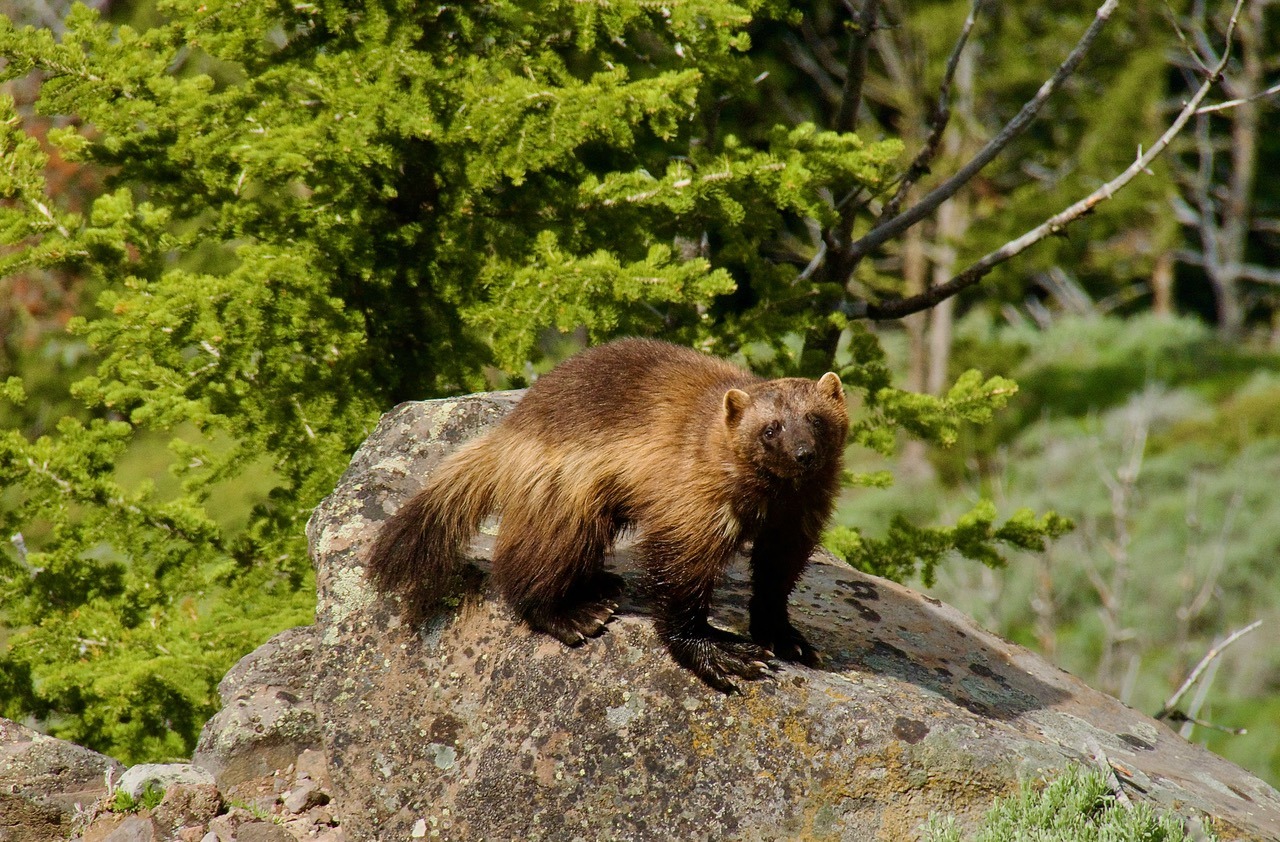
A coalition of wildlife advocates filed a complaint against the U.S. Fish and Wildlife Service for failing to designate critical habitat for the wolverine. The wolverine was listed as threatened under the Endangered Species Act in November of 2023, and the law requires the Service to designate critical habitat within a year of listing. The designation has not happened yet, and with only about 300 wolverines remaining in the Lower 48 states, time is of the essence.
“In an age when wild, undisturbed areas have already become too rare, we believe it is vital that the USFWS identify and protect the critical habitat the wolverine, a species which perhaps best symbolizes the spirit of wildness, needs to survive," said Jeff Juel, forest policy director for Friends of the Clearwater. "And this means improving core habitat security and also landscape connectivity so this wide-ranging species can increase its precariously low population of only about 300 in the Lower 48 states to fully recover across its historic home range in the Northern U.S. Rocky Mountains and beyond."
Critical habitat has recently been targeted by the Trump administration in its efforts to undermine the ESA. For example, one of the rules the administration wants to change involves how critical habitat for species is defined, specifying that economic and national interests can overrule habitat decisions.
The Western Environmental Law Center points out that scientific studies have shown that critical habitat designation is a primary driver in the recovery of imperiled species. For that reason, in the Endangered Species Act, Congress directed the U.S. Fish and Wildlife Service to provide a “means whereby the ecosystems upon which endangered species and threatened species depend may be conserved,” with explicit deadline requirements to do so.
“For over a decade, the Fish and Wildlife Service has dragged its feet on providing wolverines the protections the Endangered Species Act requires despite clear science showing their imperilment,” said Bethany Cotton, conservation director with Cascadia Wildlands. “It’s time for the feds to follow the law and ensure these amazing animals have the habitat protections they need to survive and recover.”
In their complaint, the wildlife advocates seek to promote wolverine recovery by ensuring the most important areas for their survival are protected via a court-ordered, agreed upon deadline for the agency to designate critical habitat.
The Coalition to Protect America’s National Parks has also taken notice of the delay in wolverine protections. It recently submitted a letter to the Colorado Parks and Wildlife Commissioners (CPW) urging them to move forward with plans to reintroduce the wolverine to Colorado in places like Rocky Mountain National Park and Great Sand Dunes National Park.
The letter notes that “Colorado contains the largest remaining block of unoccupied wolverine habitat, and could support a substantial number of wolverines, making reintroduction one of the most meaningful opportunities to conserve the species.” It also points to the bipartisan Restoration of Wolverines Act (SB24-171), which was passed in 2024 and empowered CPW to begin a multi-year, state-led reintroduction process.
“The endurance and tenacity of citizens actively working to protect iconic wolverines are exceeded only by the wolverines themselves,” said Larry Campbell, conservation director at Friends of the Bitterroot. “It’s time to relieve the wolverines of the threats to their existence.”
Story Categories:
A copy of National Parks Traveler's financial statements may be obtained by sending a stamped, self-addressed envelope to: National Parks Traveler, P.O. Box 980452, Park City, Utah 84098. National Parks Traveler was formed in the state of Utah for the purpose of informing and educating about national parks and protected areas.
Residents of the following states may obtain a copy of our financial and additional information as stated below:
- Florida: A COPY OF THE OFFICIAL REGISTRATION AND FINANCIAL INFORMATION FOR NATIONAL PARKS TRAVELER, (REGISTRATION NO. CH 51659), MAY BE OBTAINED FROM THE DIVISION OF CONSUMER SERVICES BY CALLING 800-435-7352 OR VISITING THEIR WEBSITE. REGISTRATION DOES NOT IMPLY ENDORSEMENT, APPROVAL, OR RECOMMENDATION BY THE STATE.
- Georgia: A full and fair description of the programs and financial statement summary of National Parks Traveler is available upon request at the office and phone number indicated above.
- Maryland: Documents and information submitted under the Maryland Solicitations Act are also available, for the cost of postage and copies, from the Secretary of State, State House, Annapolis, MD 21401 (410-974-5534).
- North Carolina: Financial information about this organization and a copy of its license are available from the State Solicitation Licensing Branch at 888-830-4989 or 919-807-2214. The license is not an endorsement by the State.
- Pennsylvania: The official registration and financial information of National Parks Traveler may be obtained from the Pennsylvania Department of State by calling 800-732-0999. Registration does not imply endorsement.
- Virginia: Financial statements are available from the Virginia Department of Agriculture and Consumer Services, 102 Governor Street, Richmond, Virginia 23219.
- Washington: National Parks Traveler is registered with Washington State’s Charities Program as required by law and additional information is available by calling 800-332-4483 or visiting www.sos.wa.gov/charities, or on file at Charities Division, Office of the Secretary of State, State of Washington, Olympia, WA 98504.
INN Member

The easiest way to explore RV-friendly National Park campgrounds.

Here’s the definitive guide to National Park System campgrounds where RVers can park their rigs.
Our app is packed with RVing- specific details on more than 250 campgrounds in more than 70 national parks.
You’ll also find stories about RVing in the parks, tips helpful if you’ve just recently become an RVer, and useful planning suggestions.

