

There are over 800 miles (1,287.5 kilometers) of hiking trails at Sequoia and Kings Canyon National Parks in California. These trails range from 0.3-mile (0.5-kilometer) one-way strolls to longer day hikes of 5 miles (8 kilometers) or more, ranging from easy to strenuous ability levels. A very short trail I wandered while visiting Kings Canyon National Park was the General Grant Tree Trail, often mentioned as one of the most popular day hike trails.
I’d already hiked the General Sherman Tree Trail in Sequoia National Park, where lives the largest tree in the world by volume. I wanted to see the world’s second largest tree – the General Grant Tree, dubbed “The Nation’s Christmas Tree.” So, one misty, rainy morning, I hopped in my vehicle and drove to Grant Grove for a walk along the 0.33 mile/0.5 kilometer (one-way) General Grant Tree Trail.
Grant Grove is about 1.1 miles (1.77 kilometers) from Grant Grove Village along Grant Tree Road. The Grant Grove parking lot is large, with portions big enough for a 27-foot (or longer) RV. This area is not just for the paved General Grant Tree Trail. A maze of unpaved trails extends from the main trail, as you can see on the map below.

There are two trailheads from the parking lot – one paved and the other one (the one I took) unpaved but eventually connecting to the paved trail. The route I took is a trailhead but not the official trailhead, even though it does lead to the General Grant Tree through the “back door.”

I began my own hike at this unpaved trail next to a small group of very tall sequoia trees.

I passed a sequoia stump and, at one point along the trail, was given the option to veer slightly right to continue that trail, or make a hard left turn, passing around the Michigan Tree - a giant sequoia undercut by a natural spring which ultimately caused the tree to topple in 1931.

I turned left to wend my way around that tree and ultimately onto the paved portion of the main trail, which circles completely around the 1,650-year-old General Grant Tree so you can view the tree in its entirety, including the rear burn scar, believed to be the result of at least one, if not more, wildfires over the centuries.

The General Grant Tree stands 268.1 feet (88.7 meters) tall, with a ground circumference of 07.5 feet (32.8 meters) and a trunk volume of 46,608 cubic feet (1320 cubic meters). It’s the largest giant sequoia in the General Grant Grove and second largest tree in the world (by volume) next to the General Sherman Tree in Sequoia National Park.

According to Wikipedia:
The tree was named in 1867 after Ulysses S. Grant, Union Army general and the 18th President of the United States (1869–1877). President Calvin Coolidge proclaimed it the "Nation's Christmas Tree" on April 28, 1926. Due in large part to its huge base, the General Grant Tree was thought to be the largest tree in the world prior to 1931, when the first precise measurements indicated that the General Sherman Tree was slightly larger. On March 29, 1956, President Dwight D. Eisenhower declared the tree a "National Shrine", a memorial to those who died in war. It is the only living object to be so declared.
While other trails branch off from this area, the main paved trail continues north to the Gamlin Cabin, a one-room log cabin built in 1872 by Israel Gamlin, who lived there with his brother Thomas, while grazing their cattle in the mountains. Once the area became a part of Kings Canyon National Park in 1890, the cabin was then used as a store house by the U.S. Cavalry patrolling the park until 1913, and later as the quarters of the first park ranger stationed there.

As you continue along the trail back toward the parking lot, you will pass to your left the remains of the Centennial Stump, a 24-foot (7.3-meter) stump on which ladies from the nearby logging camp conducted Sunday school for the children. I’m going to assume the ladies stood on the stump and the children gathered around it, because from my vantage point, the stump didn’t look large enough to accommodate a very large group.

Continue your hike and you will approach the Fallen Monarch, a downed giant sequoia through which you can walk. It’s located about 0.1 miles (0.03 kilometers) from the official trailhead at the parking lot.

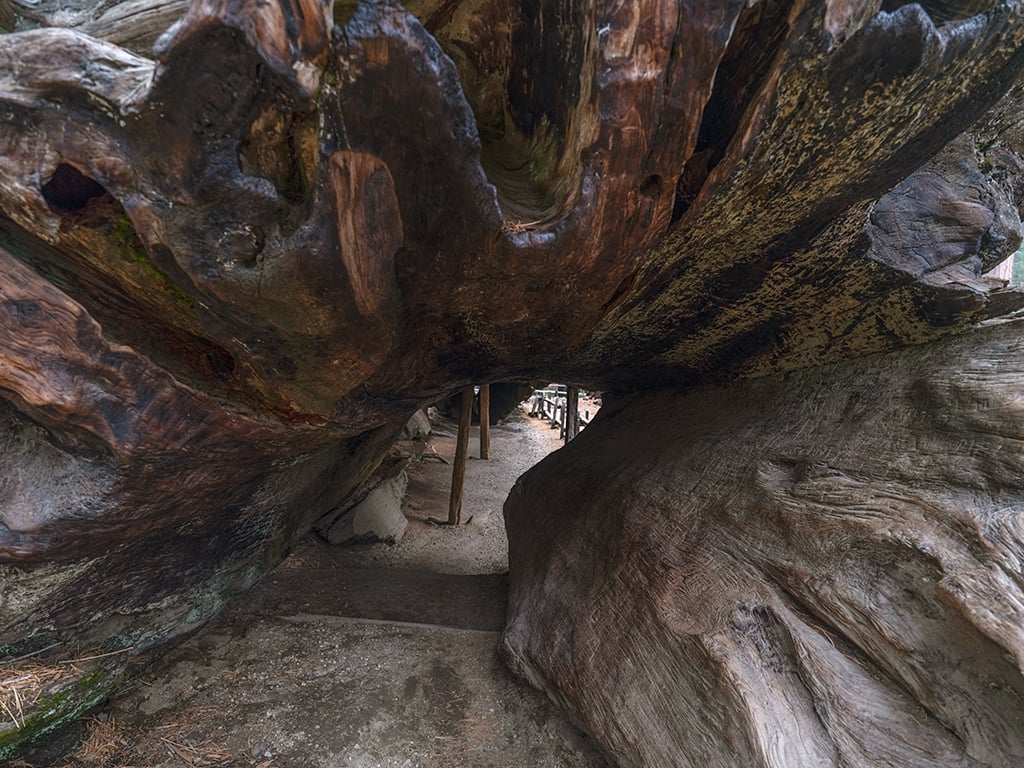


This is such a short paved trail that you might wish to combine it with one of the longer, unpaved trails in the area, such as the North Grove Loop (1.5 miles/2.4 kilometers).
Visit during the autumn and you’ll be guaranteed a little fall foliage color among the conifers along this trail.

Note: If you follow the official paved trailhead (the one at with the actual informational sign next to the trail) instead of the unpaved trailhead at the opposite end of the parking lot, you will approach everything described in this article opposite of what I’ve listed here. You’ll walk through the Fallen Monarch, continue to the Centennial Stump, then the Gamlin Cabin, and on to the General Grant Tree.
FYI, Pets are not allowed on any trails in Sequoia and Kings Canyon National Parks. In developed areas, pets must be kept on a leash at all times.
Stories about:
Story Categories:
A copy of National Parks Traveler's financial statements may be obtained by sending a stamped, self-addressed envelope to: National Parks Traveler, P.O. Box 980452, Park City, Utah 84098. National Parks Traveler was formed in the state of Utah for the purpose of informing and educating about national parks and protected areas.
Residents of the following states may obtain a copy of our financial and additional information as stated below:
- Florida: A COPY OF THE OFFICIAL REGISTRATION AND FINANCIAL INFORMATION FOR NATIONAL PARKS TRAVELER, (REGISTRATION NO. CH 51659), MAY BE OBTAINED FROM THE DIVISION OF CONSUMER SERVICES BY CALLING 800-435-7352 OR VISITING THEIR WEBSITE. REGISTRATION DOES NOT IMPLY ENDORSEMENT, APPROVAL, OR RECOMMENDATION BY THE STATE.
- Georgia: A full and fair description of the programs and financial statement summary of National Parks Traveler is available upon request at the office and phone number indicated above.
- Maryland: Documents and information submitted under the Maryland Solicitations Act are also available, for the cost of postage and copies, from the Secretary of State, State House, Annapolis, MD 21401 (410-974-5534).
- North Carolina: Financial information about this organization and a copy of its license are available from the State Solicitation Licensing Branch at 888-830-4989 or 919-807-2214. The license is not an endorsement by the State.
- Pennsylvania: The official registration and financial information of National Parks Traveler may be obtained from the Pennsylvania Department of State by calling 800-732-0999. Registration does not imply endorsement.
- Virginia: Financial statements are available from the Virginia Department of Agriculture and Consumer Services, 102 Governor Street, Richmond, Virginia 23219.
- Washington: National Parks Traveler is registered with Washington State’s Charities Program as required by law and additional information is available by calling 800-332-4483 or visiting www.sos.wa.gov/charities, or on file at Charities Division, Office of the Secretary of State, State of Washington, Olympia, WA 98504.
INN Member

The easiest way to explore RV-friendly National Park campgrounds.

Here’s the definitive guide to National Park System campgrounds where RVers can park their rigs.
Our app is packed with RVing- specific details on more than 250 campgrounds in more than 70 national parks.
You’ll also find stories about RVing in the parks, tips helpful if you’ve just recently become an RVer, and useful planning suggestions.

