

On the campaign trail, Donald Trump dismissed Project 2025, a policy plan released in 2022 by the Heritage Foundation, a right-wing think tank, for a future Republican presidency. The plan was highly unpopular among voters, with one poll finding that just seven percent of registered Republicans viewed the plan positively. However, a Project 2025 public lands progress report from the Center for Western Priorities shows that the Trump administration is moving nearly in lockstep with the plan.
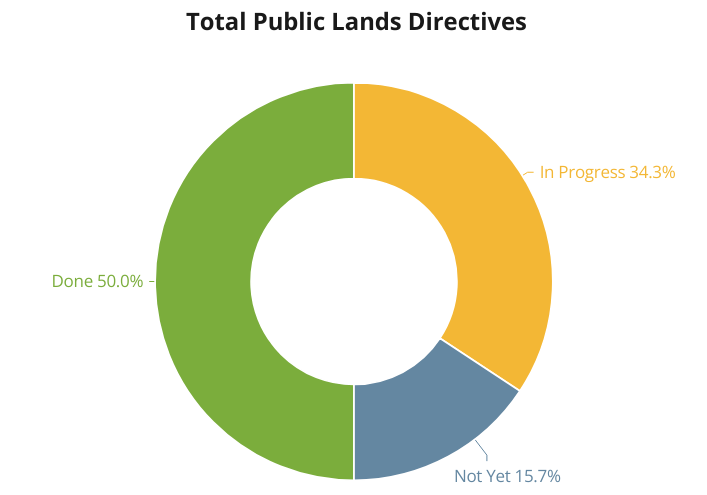
The report highlights how the administration has realized key areas of Project 2025, including actions related to fossil fuels, coal leasing, environmental reviews, agency staffing, logging, and land protections. The analysis of Trump’s actions over the course of 2025 found that he has implemented, or begun to implement, over 80 percent of actions pertaining to public lands recommended by the plan. To come up with this number, the Center for Western Priorities reviewed Project 2025 for actions related to public lands and assessed whether the administration has fully implemented the recommendation, begun to implement it, or has not yet begun to implement it.
“The speed with which President Trump has embraced a plan he once claimed to know nothing about is staggering,” CWP Communications Manager and report co-author Kate Groetzinger said in a statement. “By gutting federal agencies, fast-tracking logging, and locking in long-term drilling leases, the Trump administration is effectively turning our national public lands into sacrifice zones for private profit.”
Trump’s Executive Order, “Unleashing American Energy,” which he signed on his first day in office, formally rescinded Biden-era climate priorities, fulfilling one of the primary directives of Project 2025, to “reinstate the Trump-era Energy Dominance Agenda.” These two actions prioritized federal coal leasing, “America-First” offshore energy strategies, and the removal of “undue burdens” on domestic energy production.
The action is putting national parks, trails, and monuments at risk, as many oil and gas leasing parcels are close enough to affect the air, water, and land within the park boundaries. For example, Friends of the Everglades warned that proposed offshore oil and gas drilling in the Gulf of America (formerly the Gulf of Mexico) could harm Everglades National Park.
Another primary goal of Project 2025 is to attack civil servants across all levels and agencies of the federal government. The report found that around 40 percent of the seven actions related to the funding and staffing of public land management agencies in Project 2025 have been completed by the Trump administration so far, with another 15 percent in progress. The attacks on civil servants have so far resulted in the loss of about a quarter of National Park Service staff.
Project 2025 also calls for opening up millions of acres of Alaska wilderness to drilling, mining, and logging, and around 45 percent of the actions related to Alaska’s public lands have been completed. Most of these actions have occurred under Executive Order 14153 “Unleashing Alaska’s Extraordinary Resource Potential.” This includes the signing of a memorandum in October approving the Ambler Road Project, a 211-mile-long gravel highway through the Brooks Range in the Gates of the Arctic National Park and Preserve that would devastate the arctic tundra, threaten caribou and other wildlife, and harm Alaska Native tribes that rely on hunting and fishing.
The administration has also undermined the National Environmental Policy Act, proposed changes regarding how critical habitat is designated under the Environmental Protection Act, ended the national goal to protect 30 percent of U.S. land and water by 2030 (the 30 by 30 goal), and moved to reduce or eliminate national monuments. All of these actions are laid out in Project 2025.
“Let this report be a warning to those who care about public lands: opposing the sale of public lands is not enough—if the Trump administration and Heritage Foundation have their way, our public lands will be effectively privatized by the end of Trump’s presidency in 2028,” said Groetzinger. “This will be achieved through the gutting of federal agencies, the issuance of long-term logging and drilling leases, and the permanent destruction of habitat by the proliferation of clear cuts, well pads, and mines.”
Story Categories:
A copy of National Parks Traveler's financial statements may be obtained by sending a stamped, self-addressed envelope to: National Parks Traveler, P.O. Box 980452, Park City, Utah 84098. National Parks Traveler was formed in the state of Utah for the purpose of informing and educating about national parks and protected areas.
Residents of the following states may obtain a copy of our financial and additional information as stated below:
- Florida: A COPY OF THE OFFICIAL REGISTRATION AND FINANCIAL INFORMATION FOR NATIONAL PARKS TRAVELER, (REGISTRATION NO. CH 51659), MAY BE OBTAINED FROM THE DIVISION OF CONSUMER SERVICES BY CALLING 800-435-7352 OR VISITING THEIR WEBSITE. REGISTRATION DOES NOT IMPLY ENDORSEMENT, APPROVAL, OR RECOMMENDATION BY THE STATE.
- Georgia: A full and fair description of the programs and financial statement summary of National Parks Traveler is available upon request at the office and phone number indicated above.
- Maryland: Documents and information submitted under the Maryland Solicitations Act are also available, for the cost of postage and copies, from the Secretary of State, State House, Annapolis, MD 21401 (410-974-5534).
- North Carolina: Financial information about this organization and a copy of its license are available from the State Solicitation Licensing Branch at 888-830-4989 or 919-807-2214. The license is not an endorsement by the State.
- Pennsylvania: The official registration and financial information of National Parks Traveler may be obtained from the Pennsylvania Department of State by calling 800-732-0999. Registration does not imply endorsement.
- Virginia: Financial statements are available from the Virginia Department of Agriculture and Consumer Services, 102 Governor Street, Richmond, Virginia 23219.
- Washington: National Parks Traveler is registered with Washington State’s Charities Program as required by law and additional information is available by calling 800-332-4483 or visiting www.sos.wa.gov/charities, or on file at Charities Division, Office of the Secretary of State, State of Washington, Olympia, WA 98504.
INN Member

The easiest way to explore RV-friendly National Park campgrounds.

Here’s the definitive guide to National Park System campgrounds where RVers can park their rigs.
Our app is packed with RVing- specific details on more than 250 campgrounds in more than 70 national parks.
You’ll also find stories about RVing in the parks, tips helpful if you’ve just recently become an RVer, and useful planning suggestions.

