
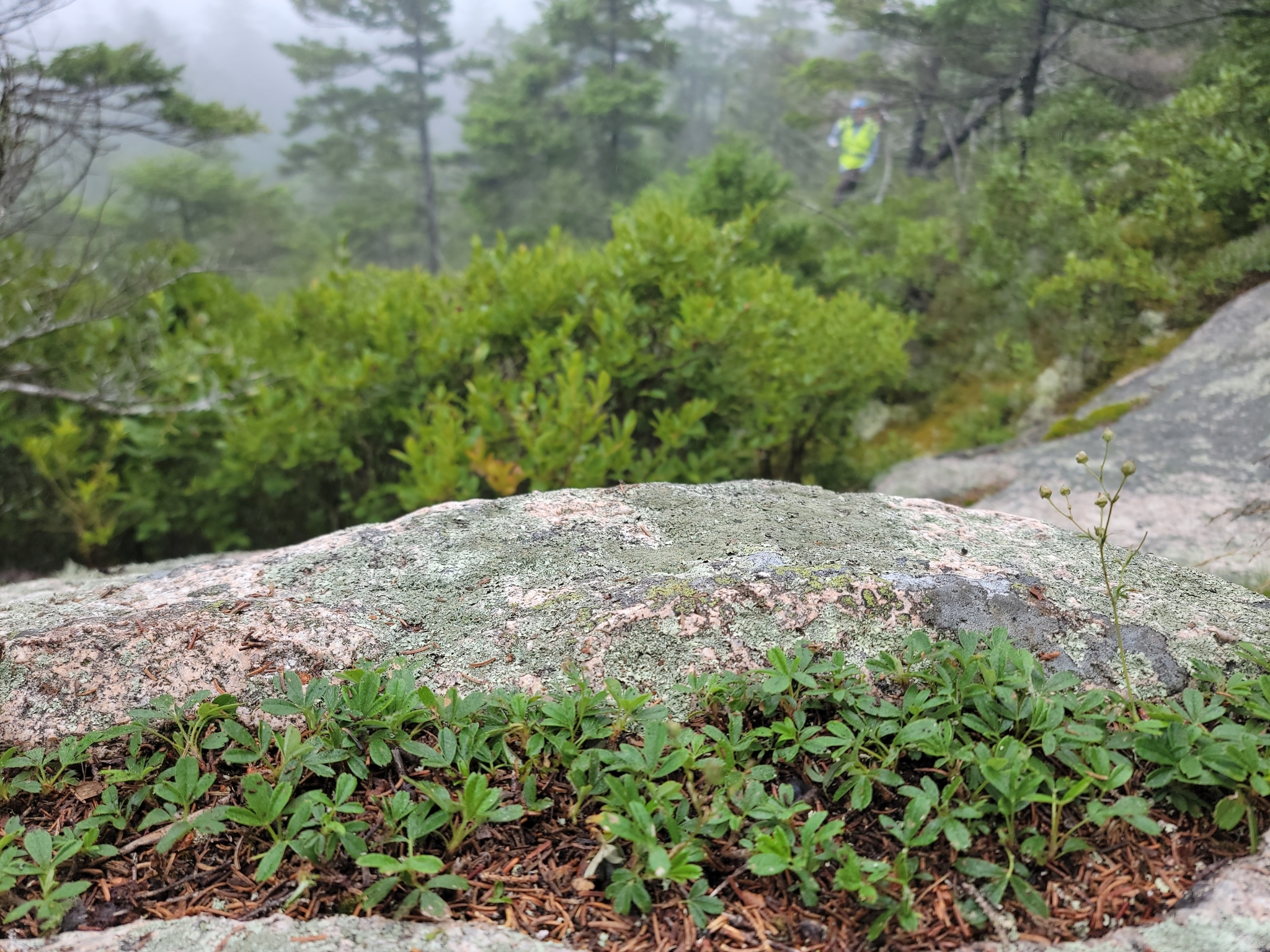
Climate refugia are getting a lot of attention for their potential to offer species a better shot at survival as climate change makes existing habitats increasingly hostile. A 2025 study (attached) is helping Acadia National Park, in particular, improve its approach to its own potential climate refugia and guide plant restoration across the park.
Despite the promising nature of climate refugia, much of the recent research focuses on modeling, which can be useful but often fails to tell the whole story. This study is helping to fill in the gaps by presenting research that went beyond modeling and into the implementation of concrete management actions to gain insight into the usefulness and accuracy of model predictions.
“This is one of the few studies that has gone through this whole climate change refugia conservation cycle, and that includes both testing the models to evaluate if the models are actually identifying important climate variables and identifying where refugia will be,” explained Chris Nadeau, climate change adaptation scientist at Schoodic Institute at Acadia National Park and lead author of the study. “And it involves doing monitoring to try to understand if predicted refugia really are refugia in the future.”
According to the Refugia Research Coalition, “[c]limate refugia are characterized by the occurrence of relatively stable local climatic conditions that persist over time, despite change at regional and global scales.” This means that refugia are locations that will likely experience less change or offer increased resilience compared to the surrounding landscape as climate change worsens.
In the face of climate change, Acadia has been focusing on restoring vegetation to its mountain summits. Because much of the plant life on the summits is low lying vegetation, it is often trampled by park visitors who come to the summits by the millions each year to see the spectacular 360-degree views the park mountains offer. Once the plants get trampled and die, soil erosion soon follows as it washes off or gets blown away.
“It's really, really hard to get those plants back,” said Nadeau, “and so Acadia has been really focused on how to get plants back in these degraded areas. This refugia work has really helped focus where we do some of that restoration.”
The top of Cadillac Mountain in particular has been identified as a climate change refugia for some of the species that were included in the study, species that are used in restoration work on the mountain summits.
Related Content: Senators Have Called On The National Park Service To Focus On Native Plant
The two plants that the study focused on were three-toothed cinquefoil and black crowberry. Both are very common across Acadia and help to fix soil and prevent erosion, making them perfect candidates for the study. They were also ideal considering that they are often found further north than Acadia, meaning that they may be especially vulnerable to temperature increases associated with climate change.
“More than 90 percent of the places that these plants occur in Maine are likely to become too hot for those species in the future,” noted Nadeau. “We wanted to understand how vulnerable are they and are there places in the park where we think we can keep those plants around?”
Part of the study included an unintended experiment wherein the researchers put cinquefoil in a greenhouse south of Acadia National Park and forgot about it for several months. While models would have suggested that the plants would not have tolerated the increased temperatures well, the researchers found upon returning that they were doing just fine. The discovery led them to conclude that the daily irrigation they were receiving in the greenhouse was allowing the plants to survive. A follow-up study confirmed the theory, as plants that did not receive the daily irrigation had much lower survival rates.

“That's probably generally true of a lot of plants,” said Nadeau. “That's a really interesting piece of information to have because it means if we can increase soil moisture in our restoration areas, then we can probably help plants survive through these really hot, dry periods that we get now under climate change.”
There are several ways the park is attempting to do that. One is by adding more organic matter to the soil, which will help to absorb and retain moisture. Another is figuring out how to restore mosses, which act as sponges and can deliver moisture to nearby plants.
Another interesting finding from the study is that crowberry doesn’t seem to do particularly well in coastal areas, which went against model predictions. The researchers believe it may have to do with the exposure to salt that the plants receive so close to the ocean.
“That's interesting because we're considering using crowberry for coastal erosion prevention, but if it can't tolerate that salt, then it's probably the wrong choice for that,” explained Nadeau. He noted that follow-up studies will need to confirm the theory.
Acadia is one of the leaders in climate refugia management action, but other parks are also taking steps to study and manage their own available refugia.
“National parks are places where you're very likely to find refugia, and that's because…you get this diversity of amazing landscapes,” said Nadeau. “You have these mountains and valleys and rivers and coasts, and it's those exact landscapes where you find refugia because landscape diversity results in climate diversity, and if you have climate diversity, then it's likely to remain suitable for whatever species you're interested in in the future.”
That’s likely also the explanation behind why studies have shown that lands that are part of the U.S. National Wildlife Refuge System are more likely to contain refugia.
Toni Lyn Morelli, a U.S. Geological Survey research ecologist, described national park refugia as being “in the slow lane.” Climate change is still happening, but at a slower pace. When scientists first began to look at refugia, they thought of these places as being frozen in time, but that isn’t the case, says Morelli. Refugia will eventually become uninhabitable for many species, but in the meantime, they may give species the gift of time.
“We’re more and more thinking of these places as transitions,” explained Morelli. “National parks could potentially be this place where we’re enabling species to be able to track their climate niche because of refugia there, so they have enough time to evolve or at least adapt. I think the parks end up being this linchpin in the system.”

At Joshua Tree National Park, climate change refugia has been identified for Joshua trees, which has led the park to take action on removing invasive species and trying to prevent wildfires. Identifying refugia within the park has also allowed park staff to help firefighters prioritize the highest value areas in case of a wildfire.
At Sequoia and Kings Canyon National Parks, a similar approach is taking place as they attempt to make their refugia more resilient to wildfires and restore redwoods by planting seedlings.
But more work is needed in researching management actions that go beyond modeling. “I think the reason we were able to get through this whole cycle and not a lot of others do is because we have modelers, and we have experimental ecologists, and we have managers, and we have participatory science experts,” said Nadeau. “We have everybody engaged in this one project, and that's what it takes. It just takes all that expertise. Managing under climate change is just really complicated.”
And because it’s so complicated, recent funding cuts and layoffs across the National Park Service are especially concerning. “We're seeing funding declines for places like Schoodic Institute. We're seeing funding getting frozen. We're seeing new funding not available,” said Nadeau. “It's a lot of work to implement the mission of the National Park Service, to provide excellent visitor experience and to preserve the natural and cultural resources of these amazing places. That doesn't come easy, and it takes a lot of staff to do that, and we as a country need to invest in that if we want these places to stay as special as they are.”
Time is also an issue. Climate refugia is a fairly new area of study, so scientists are still building on each other’s research in the search for answers. “This idea of refugia, borrowing it out of the palaeoecological literature into an anthropogenic climate change context, has just happened in the last 20 years, and so they're sort of normalizing the idea for people,” explained Morelli. “Those first steps of mapping and modeling still need to happen before you can do the other things.”
Ultimately, the importance of studies like this for research on climate refugia can’t be understated, as it helps researchers, climate scientists, and park manages hone their approach to the developing challenges associated with climate change.
“I think what our work has shown is that by [moving beyond modeling], we can learn more about the species we're interested in,” said Nadeau, “and then we can develop better, more effective management practices so that when we invest money in things like conserving refugia, we can ensure that money is spent efficiently and will produce long-term benefits.”

Stories about:
Story Categories:
A copy of National Parks Traveler's financial statements may be obtained by sending a stamped, self-addressed envelope to: National Parks Traveler, P.O. Box 980452, Park City, Utah 84098. National Parks Traveler was formed in the state of Utah for the purpose of informing and educating about national parks and protected areas.
Residents of the following states may obtain a copy of our financial and additional information as stated below:
- Florida: A COPY OF THE OFFICIAL REGISTRATION AND FINANCIAL INFORMATION FOR NATIONAL PARKS TRAVELER, (REGISTRATION NO. CH 51659), MAY BE OBTAINED FROM THE DIVISION OF CONSUMER SERVICES BY CALLING 800-435-7352 OR VISITING THEIR WEBSITE. REGISTRATION DOES NOT IMPLY ENDORSEMENT, APPROVAL, OR RECOMMENDATION BY THE STATE.
- Georgia: A full and fair description of the programs and financial statement summary of National Parks Traveler is available upon request at the office and phone number indicated above.
- Maryland: Documents and information submitted under the Maryland Solicitations Act are also available, for the cost of postage and copies, from the Secretary of State, State House, Annapolis, MD 21401 (410-974-5534).
- North Carolina: Financial information about this organization and a copy of its license are available from the State Solicitation Licensing Branch at 888-830-4989 or 919-807-2214. The license is not an endorsement by the State.
- Pennsylvania: The official registration and financial information of National Parks Traveler may be obtained from the Pennsylvania Department of State by calling 800-732-0999. Registration does not imply endorsement.
- Virginia: Financial statements are available from the Virginia Department of Agriculture and Consumer Services, 102 Governor Street, Richmond, Virginia 23219.
- Washington: National Parks Traveler is registered with Washington State’s Charities Program as required by law and additional information is available by calling 800-332-4483 or visiting www.sos.wa.gov/charities, or on file at Charities Division, Office of the Secretary of State, State of Washington, Olympia, WA 98504.
INN Member

The easiest way to explore RV-friendly National Park campgrounds.

Here’s the definitive guide to National Park System campgrounds where RVers can park their rigs.
Our app is packed with RVing- specific details on more than 250 campgrounds in more than 70 national parks.
You’ll also find stories about RVing in the parks, tips helpful if you’ve just recently become an RVer, and useful planning suggestions.

