
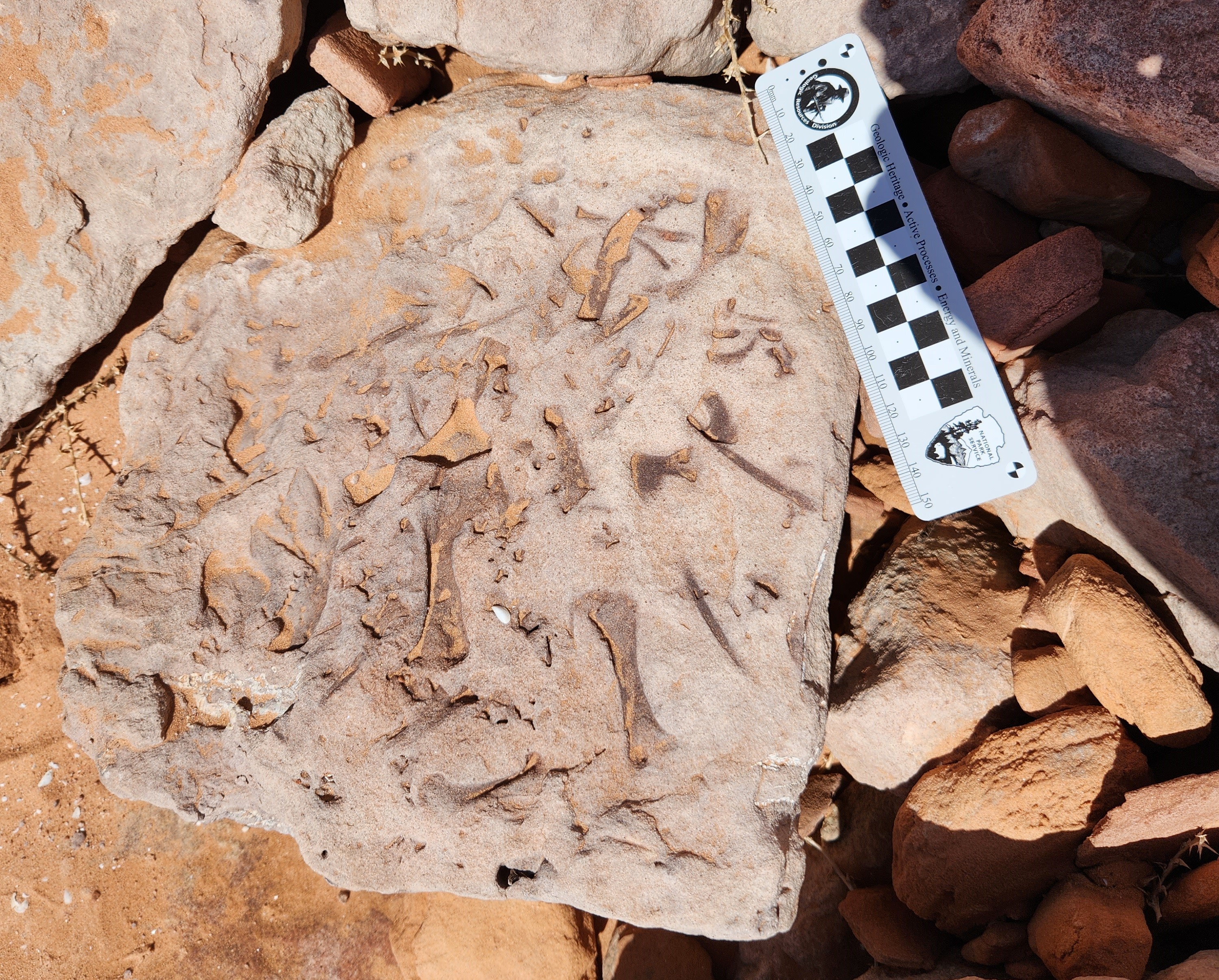
A visual guide (attached) published this year and compiled by paleontology experts within the National Park System offers a fresh look at paleontological resources across the 13 park units in the State of Utah. Included in the guide, thanks to low water levels at Lake Powell, is the unlikely fossil discovery of a rare reptile-like mammal very rarely seen in North America.
The document, published in December 2025, updates previous inventories and literature reviews published more than a decade ago and provides detailed biostratigraphic diagrams – illustrative representations that interpret rock layers and their relative ages – with accompanying descriptions for the 13 units. The information aims to support park managers, educators, and external partners in protecting, preserving, and educating the public on the diverse and scientifically significant paleontological resources across the NPS areas of Utah.
Utah is known for its stunning landscapes, complex geologic history, and globally significant fossil assemblages.
“Although most NPS areas in Utah are best known for their scenic landscapes, they all preserve geologic records with significant paleontological resources,” states the document. “The NPS Paleontology Program, through sustained partnership with such organizations as the Utah Geological Survey and the Utah Geological Association, has conducted years of field inventory and outreach to promote the stewardship, study, and education on paleontological resources within the NPS administered lands.”
James Kirkland, the state paleontologist at the Utah Geological Survey, pointed out that “Utah in total, has perhaps, the most complete fossil record in the world,” making the visual guide an important contribution to paleontological research.
The document emerged from the Park Service’s Inventory and Monitoring program (I&M), which seeks to establish baseline scientific data across the National Park System. “Inventory is basically getting out there, getting the right kinds of scientists…to be able to document the scope and the significance and the distribution of resources so that we can incorporate that into our decision making,” explained NPS Senior Paleontologist Vincent Santucci. “How do we make decisions if we don't even know the resources that are out there under our care?”
The I&M program grew out of the 1998 National Park Service Omnibus Management Act, which required superintendents to be evaluated, in part, based on how they integrate science into their decision-making. Accompanying the bill was $750 million Congress appropriated to support the I&M program.
“$750 million came to establish that baseline data for all of the parks, including what kind of mammals, what kind of birds, what kind of fish, what kind of vascular plants, what are the water quality issues, do we have good geologic maps, all that stuff that's essential to be able to make decisions,” explained Santucci. “That was not for one year. That was for every year going forward.”
“It was a renaissance for the National Park Service in terms of how it changed things to be able to get that good baseline information to inform decision making,” he continued.
Ultimately, the program was adopted for paleontological resources in parks across the country.
In 2000, the Survey published a book with the geological information compiled during paleontological inventories. The book was sold in visitor centers and proved so popular that it had to be reprinted.
Now, 25 years later, the demand for the publication is still strong. However, in the face of cost-cutting measures, the Utah Geological Survey was unable to develop a full book. Instead, it supported a special publication put out by the Utah Geological Association — a printed guide called the Geology of the Intermountain West, a visual inventory that represents one of the most comprehensive looks at Utah’s paleontological resources ever published.
The idea to make the document so visually striking – complete with colored diagrams, maps, and timelines – came from a young paleontologist working on the project. “For some people, including people in the public, that may have more meaning than just a bunch of scientific tables and text,” said Santucci. The document grew into a visual interpretation of which fossils are where, and where they occur over geologic time in different geologic formations.
Despite the plethora of information included in the document, Santucci says the information they’ve uncovered is just the beginning. “We're just dusting off the surface trying to leave every stone unturned to try to understand these resources based on their scientific value, their educational value, and how we need to protect them.”
Of the many discoveries included in the document, a recent find at Lake Powell in Glen Canyon National Recreation Area is one of the most fascinating, according to Santucci.
Two-and-a-half years ago, paleontologists in the NRA were coming up on a window where there was likely going to be the lowest water level at the man-made lake since the Glen Canyon Dam was constructed in the 1960s due to the Southwest’s extended drought. They took advantage of the opportunity to look at the exposed layers visible for the first time in decades.
The team went out on the lakeshores in March. “It was snowing on us, but we wanted to be out there when that low water level hit, and we were able to do it,” said Santucci. “It was quite cold, but we were rewarded with an unbelievable discovery.”
In the exposed rock layers, the team found traces of an exceptionally rare mammal-like reptile, tritylodontid synapsids. They belonged to the group of creatures that ultimately gave rise to the group that led to mammals. These tritylodontids had previously been found mostly in South Africa but are very rare in North America, according to Santucci.
In the newly exposed layers at Lake Powell, tritylodontid tracks were everywhere. Even more surprisingly, the group discovered a bone bed in the same areas as the tracks, which was amazing given that the two almost never occur in the same place.
“Not only were we finding skeletal elements, but it represented multiple individuals,” said Santucci. “We had jaw sections with teeth in it, and it looks like we might have had a burrow or something where these animals were taking refuge together and wound up dying together. We had this bone bed with a mass assemblage of very rare forms that we were able to then get in there and collect.”
When the paleontologists returned to the site less than 30 days later, the water had risen once again, making it inaccessible.
“We were so lucky in so many regards that timing was right…and we forever have rescued those specimens,” said Santucci. “This is one of the most important finds that we've had anywhere in North America, and in the National Park Service, and it was based on this inventory and monitoring that all came together for us.”

Stories about:
Story Categories:
A copy of National Parks Traveler's financial statements may be obtained by sending a stamped, self-addressed envelope to: National Parks Traveler, P.O. Box 980452, Park City, Utah 84098. National Parks Traveler was formed in the state of Utah for the purpose of informing and educating about national parks and protected areas.
Residents of the following states may obtain a copy of our financial and additional information as stated below:
- Florida: A COPY OF THE OFFICIAL REGISTRATION AND FINANCIAL INFORMATION FOR NATIONAL PARKS TRAVELER, (REGISTRATION NO. CH 51659), MAY BE OBTAINED FROM THE DIVISION OF CONSUMER SERVICES BY CALLING 800-435-7352 OR VISITING THEIR WEBSITE. REGISTRATION DOES NOT IMPLY ENDORSEMENT, APPROVAL, OR RECOMMENDATION BY THE STATE.
- Georgia: A full and fair description of the programs and financial statement summary of National Parks Traveler is available upon request at the office and phone number indicated above.
- Maryland: Documents and information submitted under the Maryland Solicitations Act are also available, for the cost of postage and copies, from the Secretary of State, State House, Annapolis, MD 21401 (410-974-5534).
- North Carolina: Financial information about this organization and a copy of its license are available from the State Solicitation Licensing Branch at 888-830-4989 or 919-807-2214. The license is not an endorsement by the State.
- Pennsylvania: The official registration and financial information of National Parks Traveler may be obtained from the Pennsylvania Department of State by calling 800-732-0999. Registration does not imply endorsement.
- Virginia: Financial statements are available from the Virginia Department of Agriculture and Consumer Services, 102 Governor Street, Richmond, Virginia 23219.
- Washington: National Parks Traveler is registered with Washington State’s Charities Program as required by law and additional information is available by calling 800-332-4483 or visiting www.sos.wa.gov/charities, or on file at Charities Division, Office of the Secretary of State, State of Washington, Olympia, WA 98504.
INN Member

The easiest way to explore RV-friendly National Park campgrounds.

Here’s the definitive guide to National Park System campgrounds where RVers can park their rigs.
Our app is packed with RVing- specific details on more than 250 campgrounds in more than 70 national parks.
You’ll also find stories about RVing in the parks, tips helpful if you’ve just recently become an RVer, and useful planning suggestions.

