
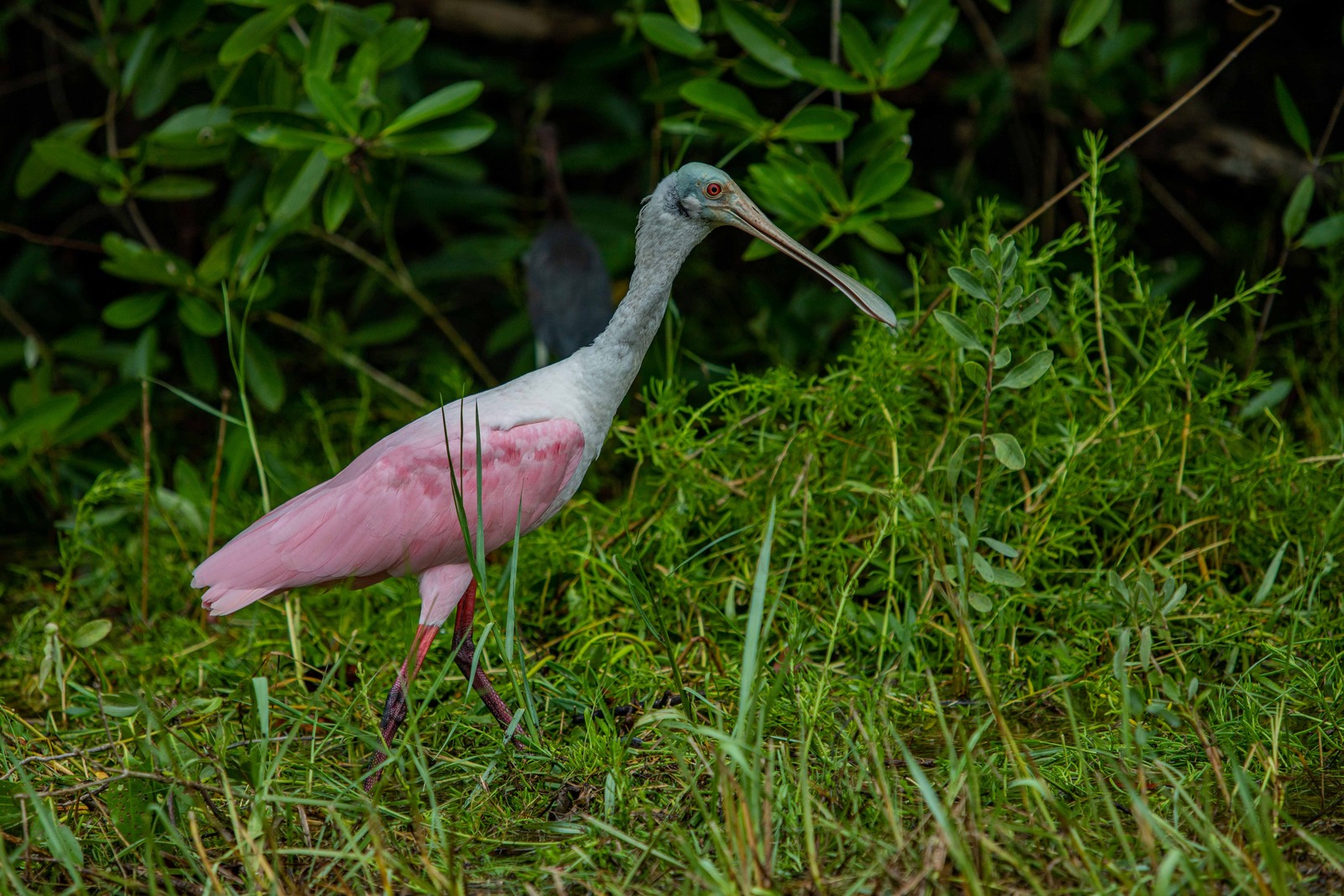
A five-year, $1,427,679 grant from the United States Army Corps of Engineers (USACE) will fund a project at Florida Atlantic University’s Charles E. Schmidt College of Science that will analyze data on aquatic prey and habitat conditions during the dry season across the freshwater Everglades. The researchers hope this will provide essential insight into one of the most important drivers of wading bird nesting success.
The project, titled “Dry Season Prey Concentrations in the Florida Everglades,” will directly support USACE’s Comprehensive Everglades Restoration Plan (CERP), a large-scale effort to restore South Florida’s ecosystem by modifying water management practices.
“This project is incredibly exciting because it allows us to quantify the link between water conditions, fish populations and wading bird nesting across the Everglades,” said Michelle L. Petersen, assistant research professor in the Department of Biological Sciences and one of the project leads. “By identifying when and where prey concentrations occur, we can better understand what drives nesting success and provide information that directly supports restoration efforts in this unique and vital ecosystem.”
Petersen explained that one of the main goals of the project is to understand how wading birds respond to changes in water levels, especially during the dry season when the concentration of prey can affect their nesting success. The health of wading bird populations are important because population declines have been linked to reductions in fish and other aquatic prey, particularly when these prey fail to concentrate in small patches that birds can efficiently exploit.
The project will measure prey concentrations across the Everglades landscape, including Everglades National Park, the Water Conservation Areas, and the C-111 Basin, a series of wide canal that serves to channel flood water away from western Miami-Dade County during the rainy wet season.
The research will help to strengthen predictive models and support USACE’s long-term adaptive management efforts under CERP by linking hydrologic patterns, prey availability and wading bird nesting success.
“We anticipate this project will greatly improve our understanding of the links between hydrology, prey availability, and wading bird nesting, providing crucial insight into how restoration efforts can most effectively achieve the goals of CERP,” said Petersen. “By combining long-term monitoring with innovative analysis, this work marks an important step forward in both the science and management of one of the world’s most iconic wetland ecosystems.”
Stories about:
Story Categories:
A copy of National Parks Traveler's financial statements may be obtained by sending a stamped, self-addressed envelope to: National Parks Traveler, P.O. Box 980452, Park City, Utah 84098. National Parks Traveler was formed in the state of Utah for the purpose of informing and educating about national parks and protected areas.
Residents of the following states may obtain a copy of our financial and additional information as stated below:
- Florida: A COPY OF THE OFFICIAL REGISTRATION AND FINANCIAL INFORMATION FOR NATIONAL PARKS TRAVELER, (REGISTRATION NO. CH 51659), MAY BE OBTAINED FROM THE DIVISION OF CONSUMER SERVICES BY CALLING 800-435-7352 OR VISITING THEIR WEBSITE. REGISTRATION DOES NOT IMPLY ENDORSEMENT, APPROVAL, OR RECOMMENDATION BY THE STATE.
- Georgia: A full and fair description of the programs and financial statement summary of National Parks Traveler is available upon request at the office and phone number indicated above.
- Maryland: Documents and information submitted under the Maryland Solicitations Act are also available, for the cost of postage and copies, from the Secretary of State, State House, Annapolis, MD 21401 (410-974-5534).
- North Carolina: Financial information about this organization and a copy of its license are available from the State Solicitation Licensing Branch at 888-830-4989 or 919-807-2214. The license is not an endorsement by the State.
- Pennsylvania: The official registration and financial information of National Parks Traveler may be obtained from the Pennsylvania Department of State by calling 800-732-0999. Registration does not imply endorsement.
- Virginia: Financial statements are available from the Virginia Department of Agriculture and Consumer Services, 102 Governor Street, Richmond, Virginia 23219.
- Washington: National Parks Traveler is registered with Washington State’s Charities Program as required by law and additional information is available by calling 800-332-4483 or visiting www.sos.wa.gov/charities, or on file at Charities Division, Office of the Secretary of State, State of Washington, Olympia, WA 98504.
INN Member

The easiest way to explore RV-friendly National Park campgrounds.

Here’s the definitive guide to National Park System campgrounds where RVers can park their rigs.
Our app is packed with RVing- specific details on more than 250 campgrounds in more than 70 national parks.
You’ll also find stories about RVing in the parks, tips helpful if you’ve just recently become an RVer, and useful planning suggestions.

