
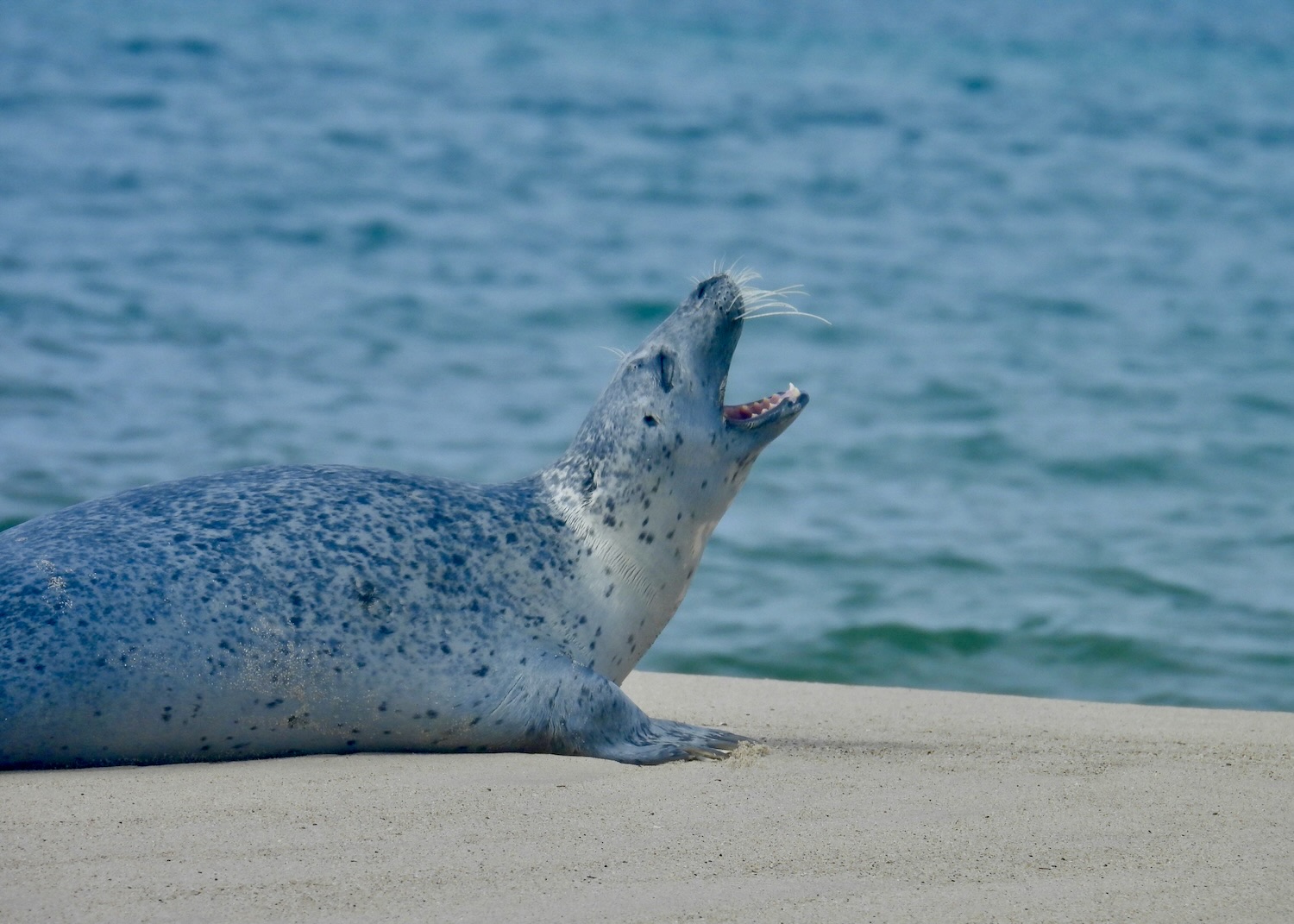
There she was, alone on the beach enjoying the late-summer summer. Blue-grey with beautiful speckling, the harbour seal had a dog-like snout and holes on either side of her head instead of ear flaps. These rather docile seals usually haul out in groups to avoid predators but this one was resting by herself in a shallow pool.
“Out of the 400,000 seals that call Sable Island home, there are four harbour seals,” said Fred Stillman, our guide that day. “There were six. Now there’s four. It’s rare to see them. Aww — she’s so cute.”
Mindful to stay at least 66 feet or 10 seal lengths away, we took photos from a distance and kept our voices low. She galumphed her way out of the pool and back onto the sand like a caterpillar, but stopped short of slipping into the North Atlantic where scores of grey seals bobbed in the sea watching us and where 18 shark species hunt for food.
“Would you all be comfortable if I ran back and got my camera?” asked Stillman. “You don’t have to wait here. You can stay here, check this out, take your shoes off, walk in the water a little bit, make your way towards those horses.”
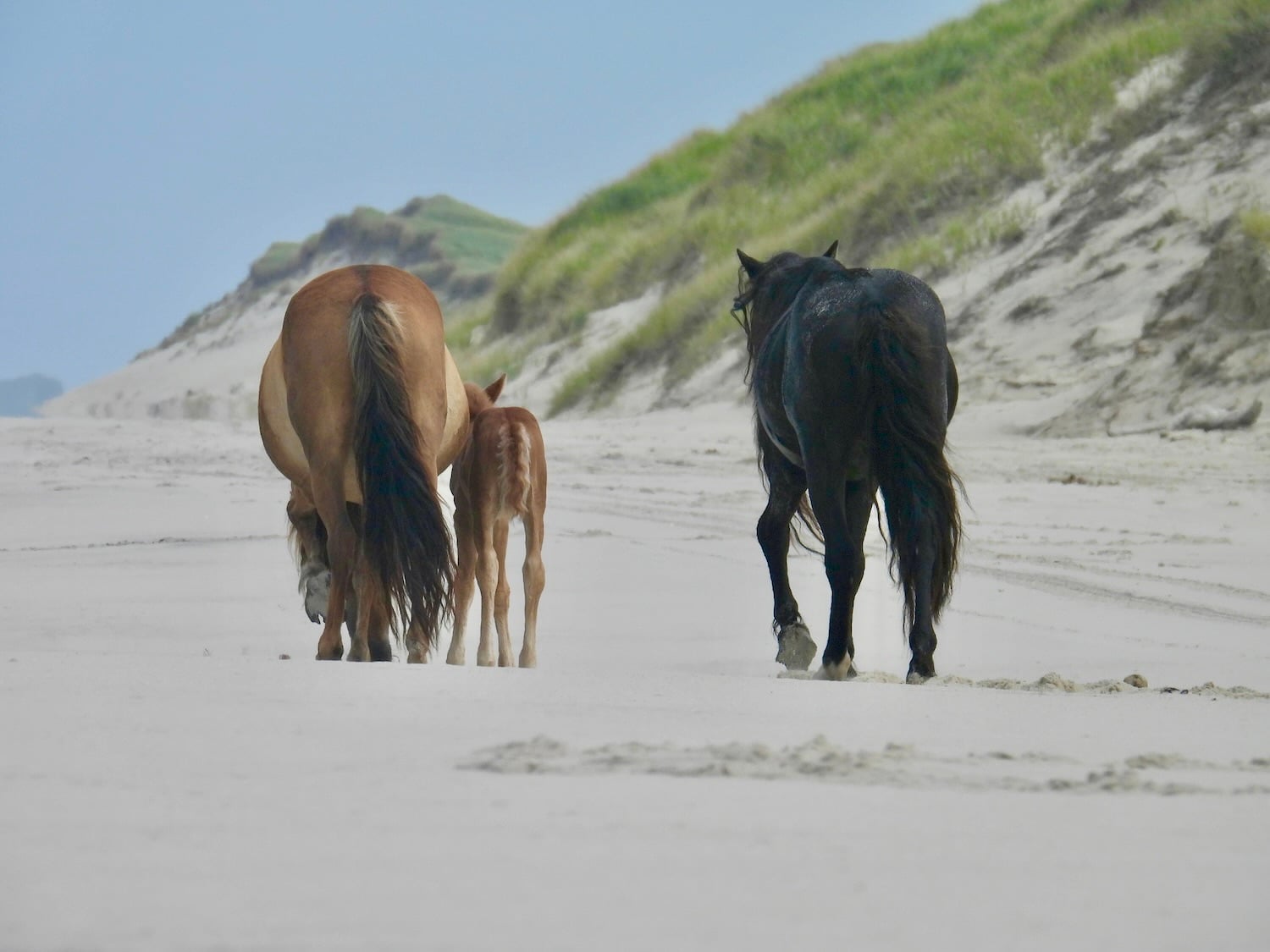
Ah, the famous horses of Sable Island National Park Reserve.
Descended from horses introduced to the island in the 1700s, the wild horses have lived here off the coast of Halifax, Nova Scotia without human interference since 1961 and are considered a naturalized species with natural and cultural heritage value.
There are about 400 of them right now, and they’ve put Sable Island on every nature lover’s bucket list. But getting to this “thin crescent of shifting sand” 180 miles from mainland Canada isn’t easy.
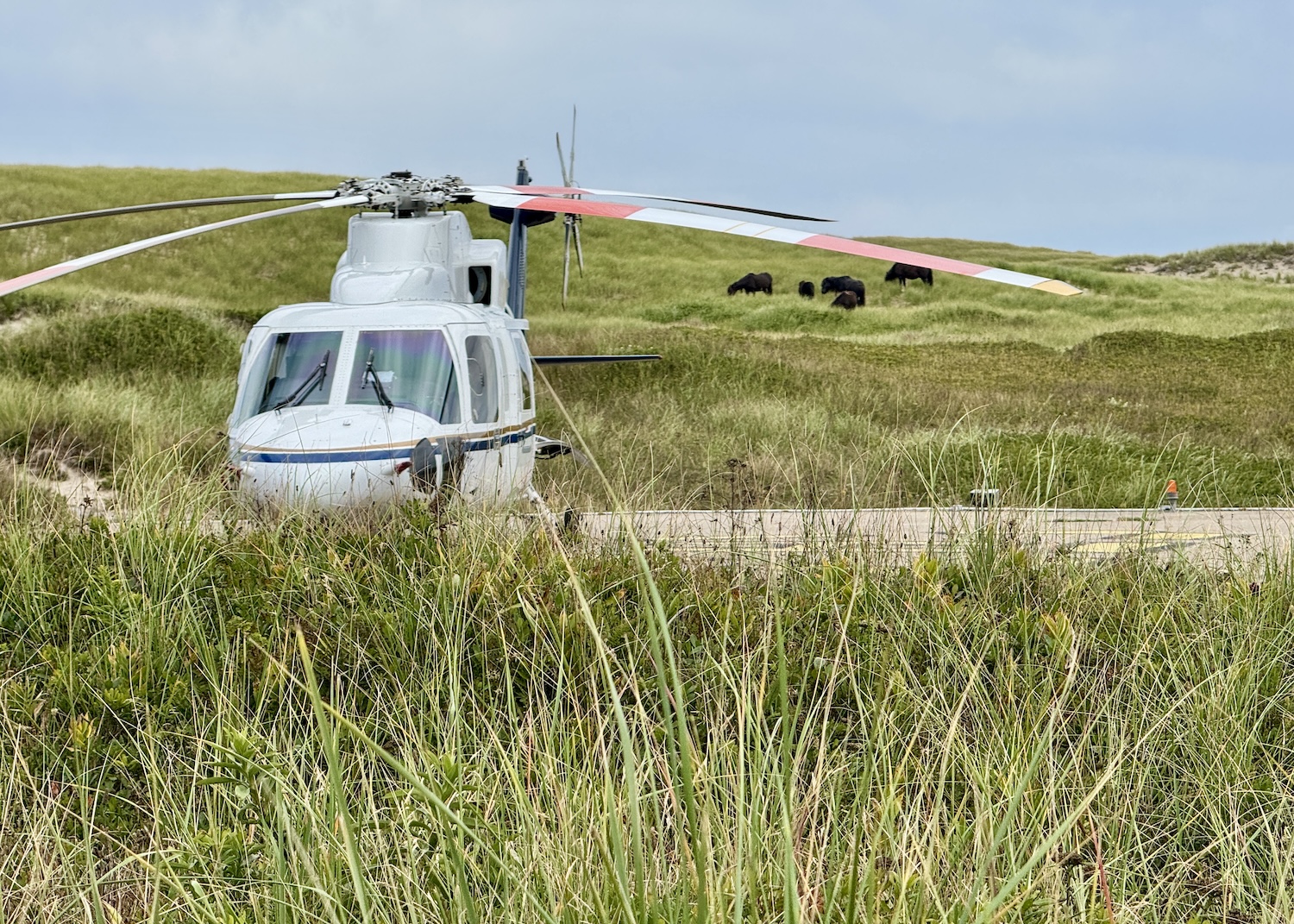
Only a few hundred people visit each year by helicopter and fixed-wing plane through tour operators and transporters licensed by Parks Canada. That number can climb as high as 600 if several small expedition cruise ships arrange stops. A new five-day sailing charter offers a four-day window to make landfall to visit Sable for up to three days with two nights on anchor. Visitors are only welcome from June to October, and in January and February.
Complicated, right? And if the prices don’t stop you ($2,400 and up for a day trip), then the unpredictable weather just might.
“As usual, we have been monitoring weather conditions for the mainland and Sable Island and my current estimation is that visibility could be too low on Tuesday and we may need to use the following backup day,” Stillman warned by email. “I will confirm with the pilot and park staff this evening and make the final decision then, so please hang tight and I'll follow up with you this evening.”
Sure enough, the seven of us who were bound for Sable that Tuesday in August with Stillman’s tour company, Kattuk Expeditions, were bumped to Wednesday. But that was the last of the snags.
We watched the mandatory Parks Canada video at the Vision Air office — learning that swimming is discouraged because of rip tides and sharks — and Stillman cleaned our footwear as a biosecurity measure to protect the horses from things like invasive seeds and insects.
There were sunny skies and a nice tailwind for the one-hour flight. Good thing we picked the helicopter that lands on one of Sable’s two helipads, because the fixed-wing planes that can only make beach landings were cancelled that week due to flooding.
My first thought was how much busier this storied place was than I imagined.
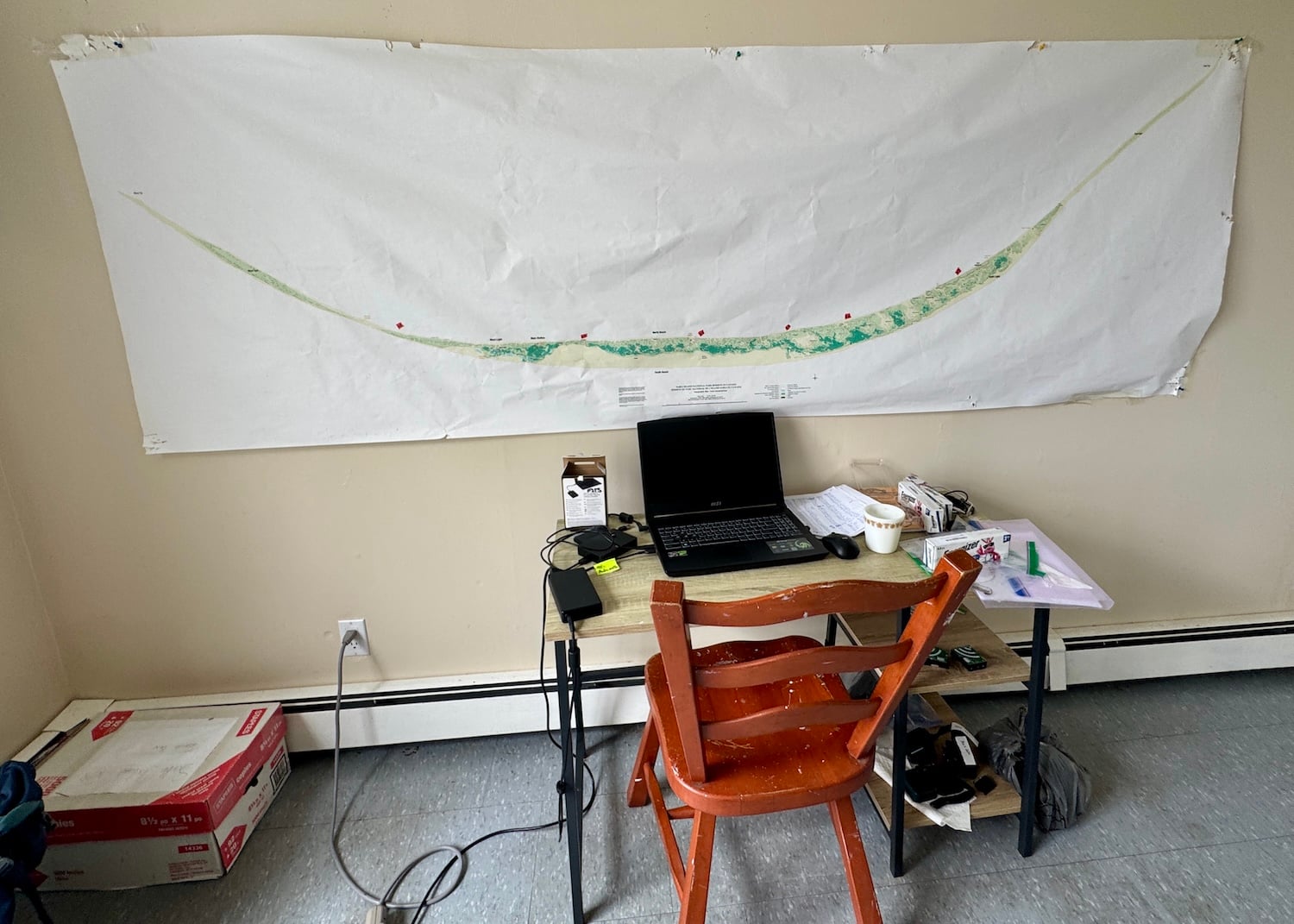
I knew that Sable, a crescent-shaped sandbar that’s just 26 miles long and 0.8 miles at its widest point, is home to hundreds of horses and the world’s largest breeding colony of grey seals. I didn't realize that Parks Canada greets visitors and has a compound called Main Station for its rotating staff and visiting researchers. There’s satellite TV, Wi-Fi and two tsunami pods that hold 14 people.
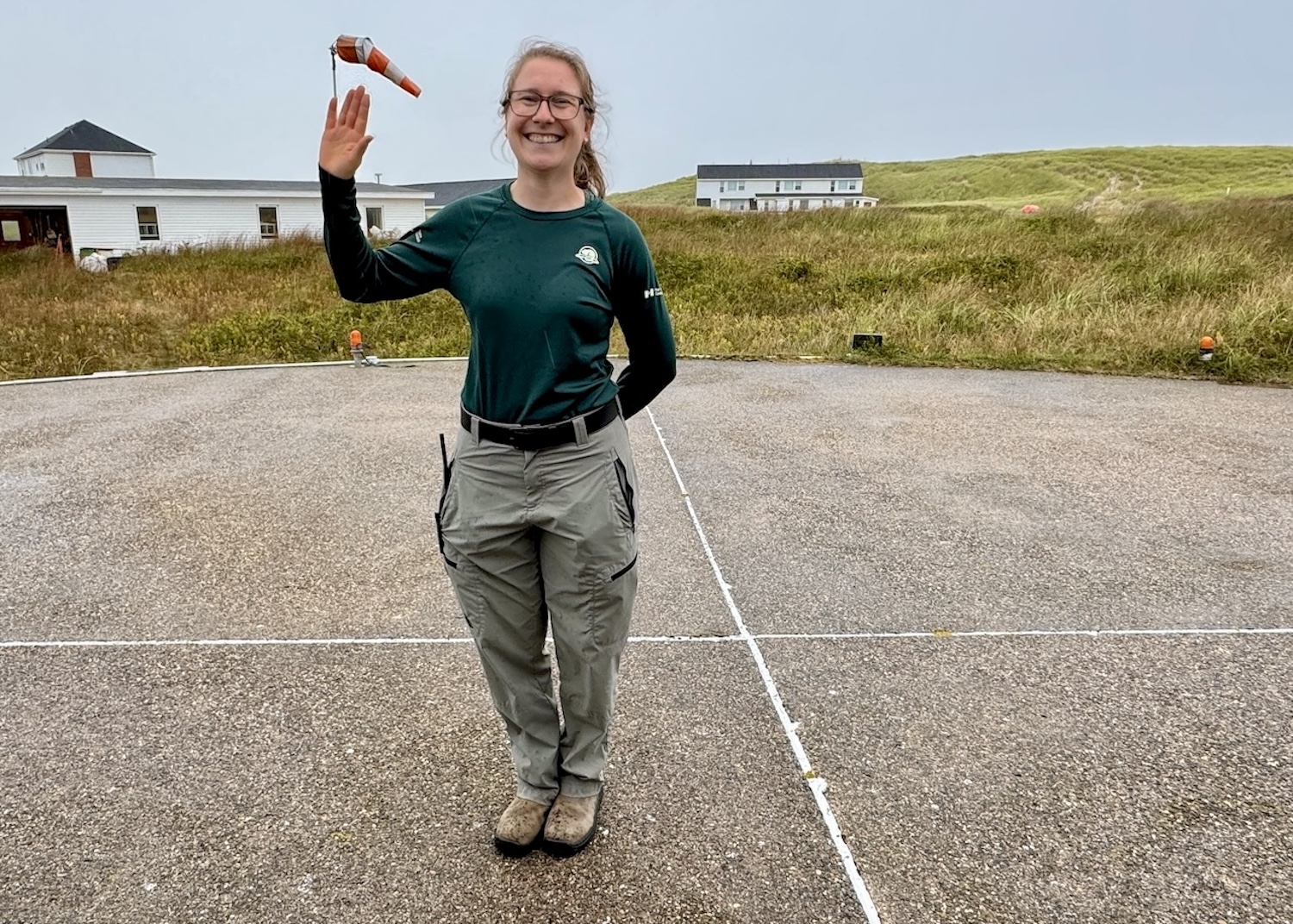
Operations coordinator Kristina Penn, who oversees landings, takeoffs and more, welcomed us with a briefing.
“If a horse starts walking towards you that’s not an invitation to interact,” she advised. “If a horse is charging, do protect yourself. Make yourself big, loud, tell it to go away. The best way to avoid that sort of interaction is to not get yourself between mom and foal, or bachelor and mare. We’re minimizing horse interactions. We want them to stay wild. That’s what makes them so special. That’s what makes Sable Island so unique.”

For two hours that morning, and three after lunch, we clocked more than five miles exploring Sable’s horse trails and beaches.
Silver washers marked some of the Sable Island Sweat Bee’s fragile ground-nesting spots, but I didn't have time to sit and wait to see the threatened endemic species itself.
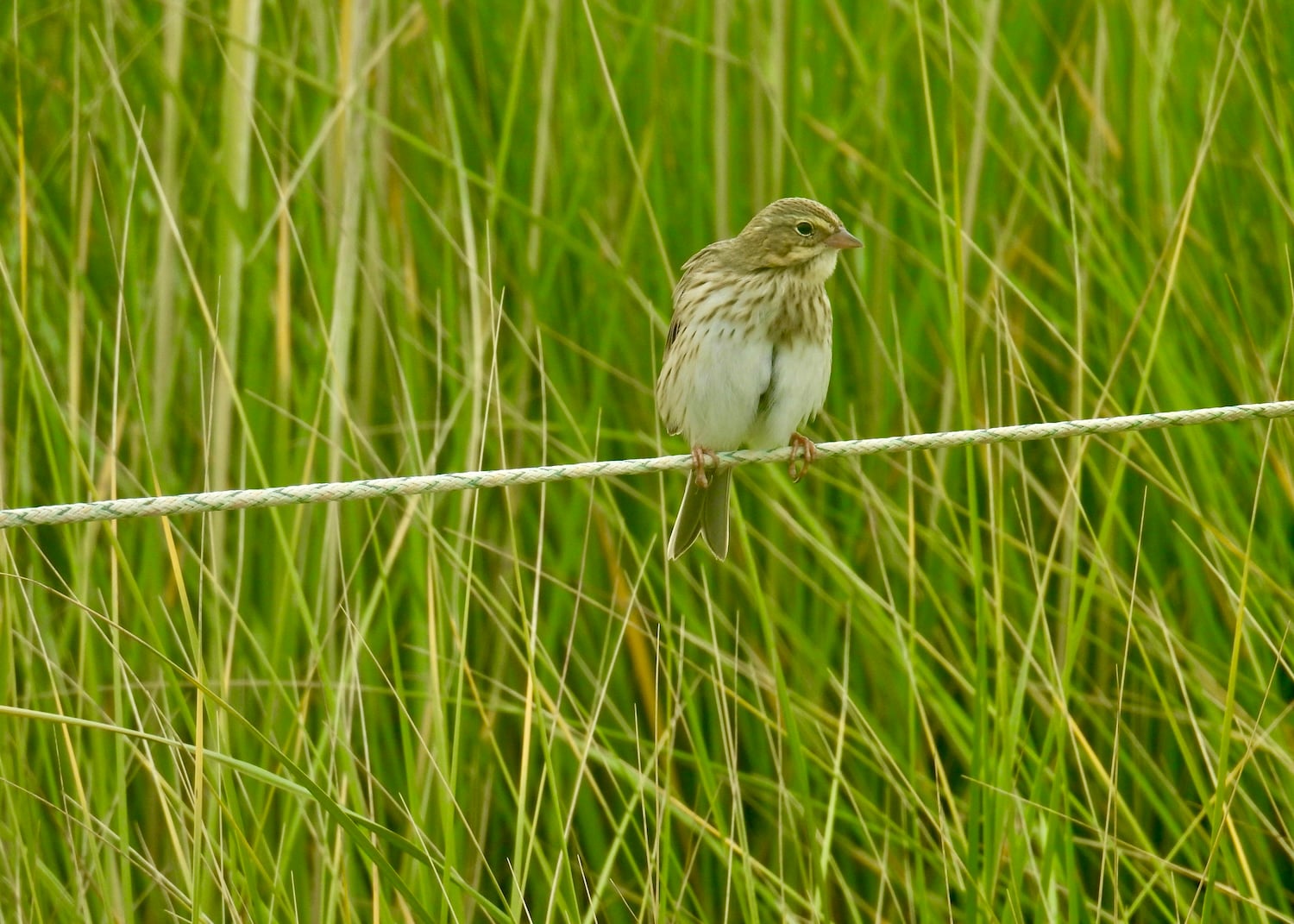
There were Ipswich Sparrows flitting about, a species of special concern that breeds exclusively on Sable. The sweet songbird loves resting on electric fences that exclude horses from small areas for a “Fences in the Sand” study that’s measuring the ecological impact of the horses.
Named for the French word sable (sand), the island has an overlooked human history.
Portuguese explorers were the first documented visitors in the 16th century. Shipwreck salvagers once came seasonally. Many have tried and failed to create permanent settlements. Life-saving stations were introduced in 1801. A meteorological station was erected in the 1890s and oil wells were drilled here in the 1960s.
Perhaps more tangible are Sable’s many cultural artifacts.
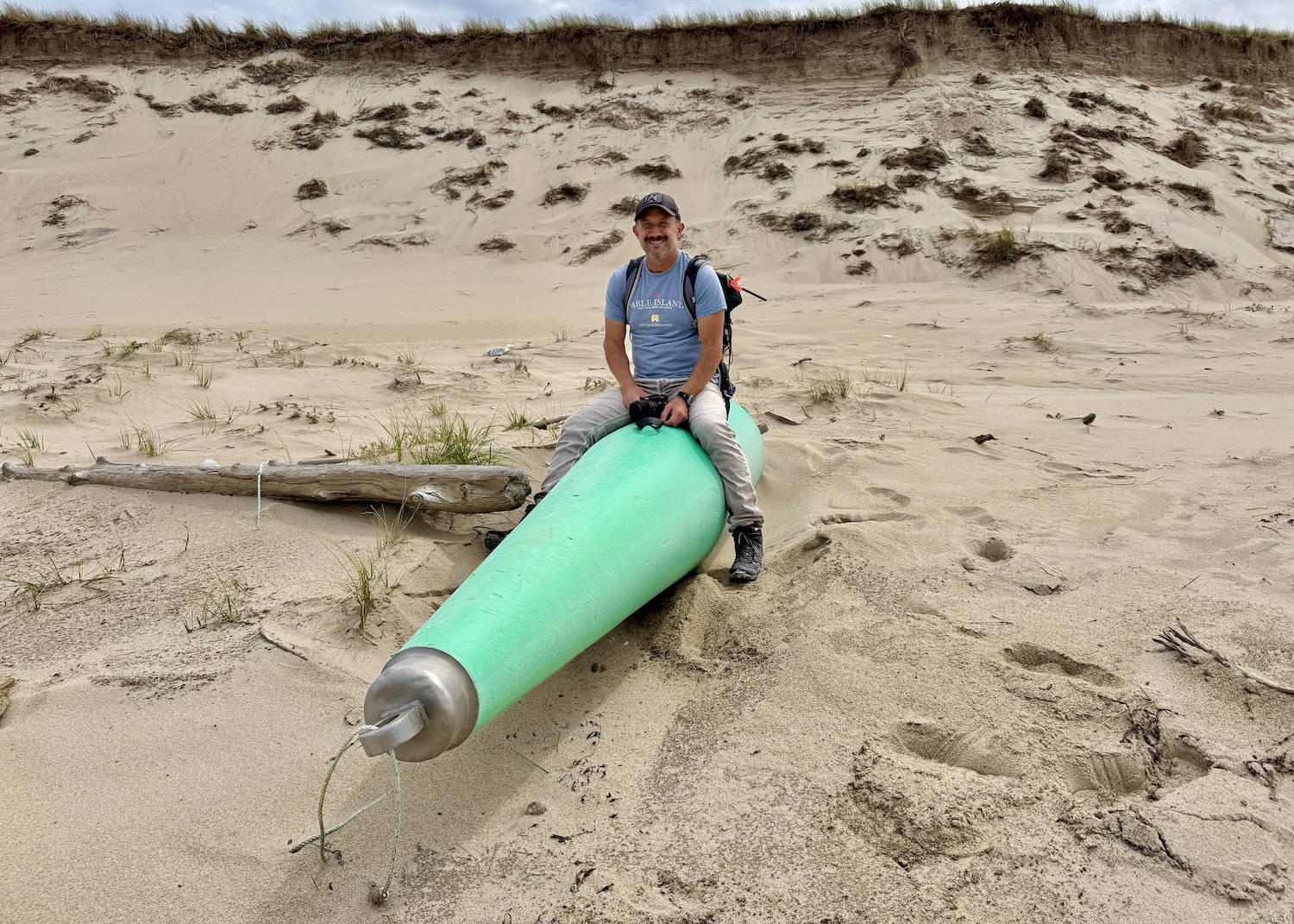
There was weathered fishing rope, decaying buoys and other marine debris to discuss but not pick up (beach plastics are also being studied). This being the “Graveyard of the Atlantic,” home to more than 350 recorded shipwrecks, there’s always the chance of stumbling upon one that’s newly exposed by the shifting sands.
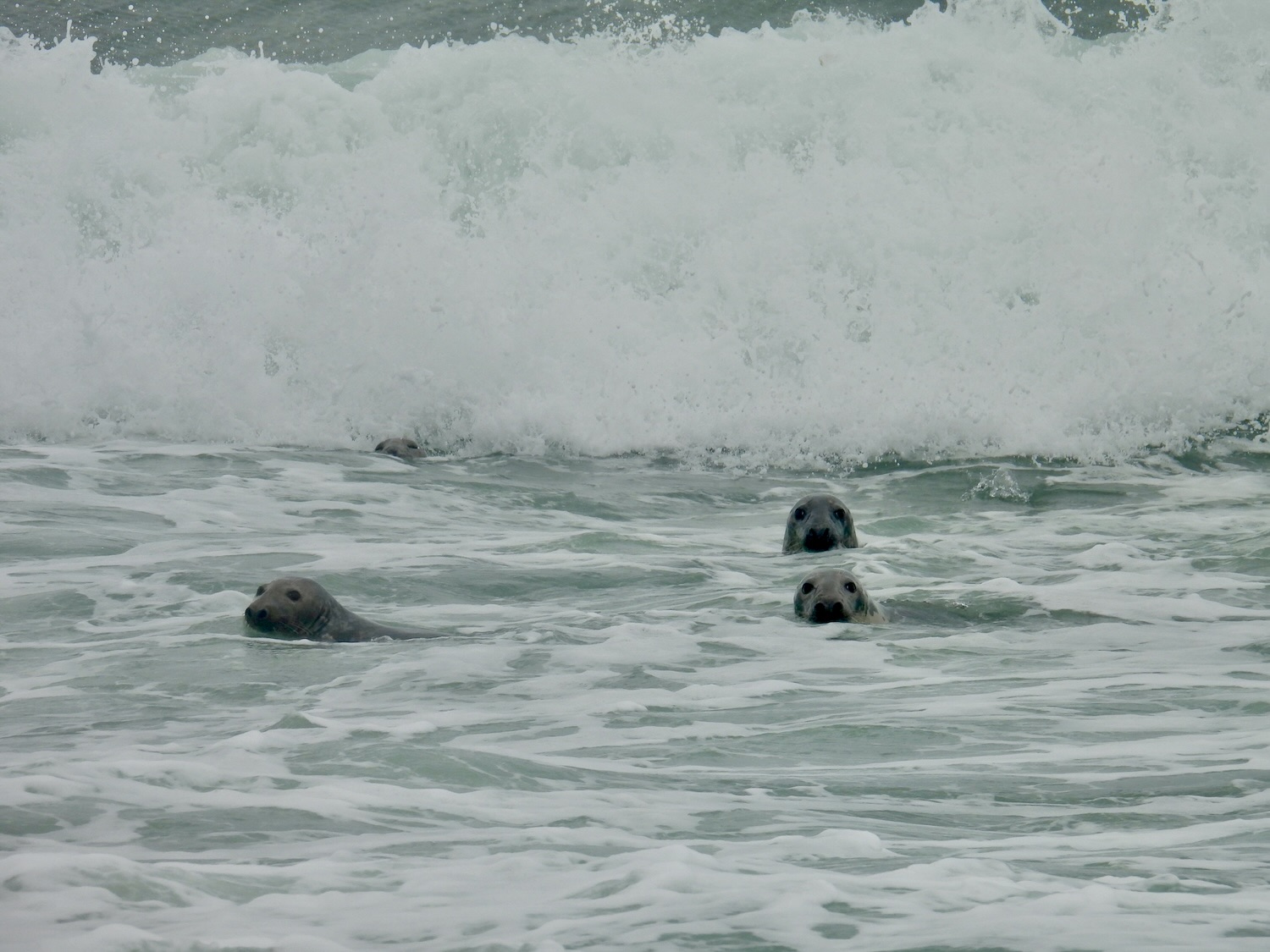
Wherever we went, grey seals seemed to keep tabs on us from the sea.
On one beach, however, there was the unmistakable stench of death. We paused to mourn two seals whose bloated carcasses bore puncture wounds that likely came from sharks.
“You can’t come here for a day and not smell that smell,” Stillman quietly confided.
Speaking of the cycle of life, we saw another corpse of sorts — Sable’s last tree, a gnarled Scot’s pine that was planted decades ago during a forestation attempt. Luckily, we didn’t come across any dead horses, which are left to “return into the environment” where they die.
Horse poop, on the other hand, was everywhere and there were more horses than we could possibly count. They were eating marram grass in the dunes, strolling along the beaches and drinking at freshwater ponds.

When Sable became a national park reserve in 2013, Parks Canada stepped in to manage the remote vegetated sandbar like a national park while it’s subject to an Indigenous land claim. The Mi’kmaq of Nova Scotia have asserted Aboriginal rights and title to the Province of Nova Scotia, and Canada and Nova Scotia continue to negotiate this complex claim.
On Parks Canada's watch, the horses aren’t fed, touched or treated by vets. They live on marram grass, whose long roots stabilize the dunes, but also devour plants like sandwort and beach pea. They’re protected under the Canada National Parks Act and the National Parks of Canada Wildlife Regulations.
“What you can’t do is clap or make noise or have an app on your phone that whinnies,” Stillman warned, which begs the question — who would do that?

It’s impossible to (respectfully) resist the lure of the wild horses even if, like me, you think you’re more excited by sparrows, seals and bees. I lingered so long with that charming harbour seal that I missed precious time watching a foal meander down the beach with its parents.
But I was there for the grand finale at Mummichug Ponds, which is named for its small mud minnows. From the top of a dune, I counted nearly 40 horses spread out across the landscape. It looked staged, like a film set, but it was real.
There were adorable foals, bossy lead mares and a charismatic but very disgruntled stallion — whinnying up a storm, nostrils flaring — who seemed to be trying and failing to join various bands of horses. Apparently Sable’s population divides itself into 30 to 40 bands that can be families, bachelors or even solitary horses.

From a Parks Canada binder that tackles common visitor questions, I learned that horses born on the east side of the island will never travel to the west side and vice versa. They carve out their own turf on Sable's 8,400 acres.
“You can look down 40 kilometres of beach and not see another person” is something Stillman likes to say. That isn't strictly true. We saw what seemed like a lone horse but turned out to be a lone researcher.
Then there are things you don’t want to see. On the way back to Main Station, Stillman quietly steered us away from the gruesome sight of gulls picking at a dying harbour seal. Hearing this, Penn reminded us that Sable is “unfiltered.”
That Wednesday in August was as long as it was short. It ended back in the sunroom at Main Station, where we gratefully used the flush toilet and bought t-shirts and other merch to help support Parks Canada.
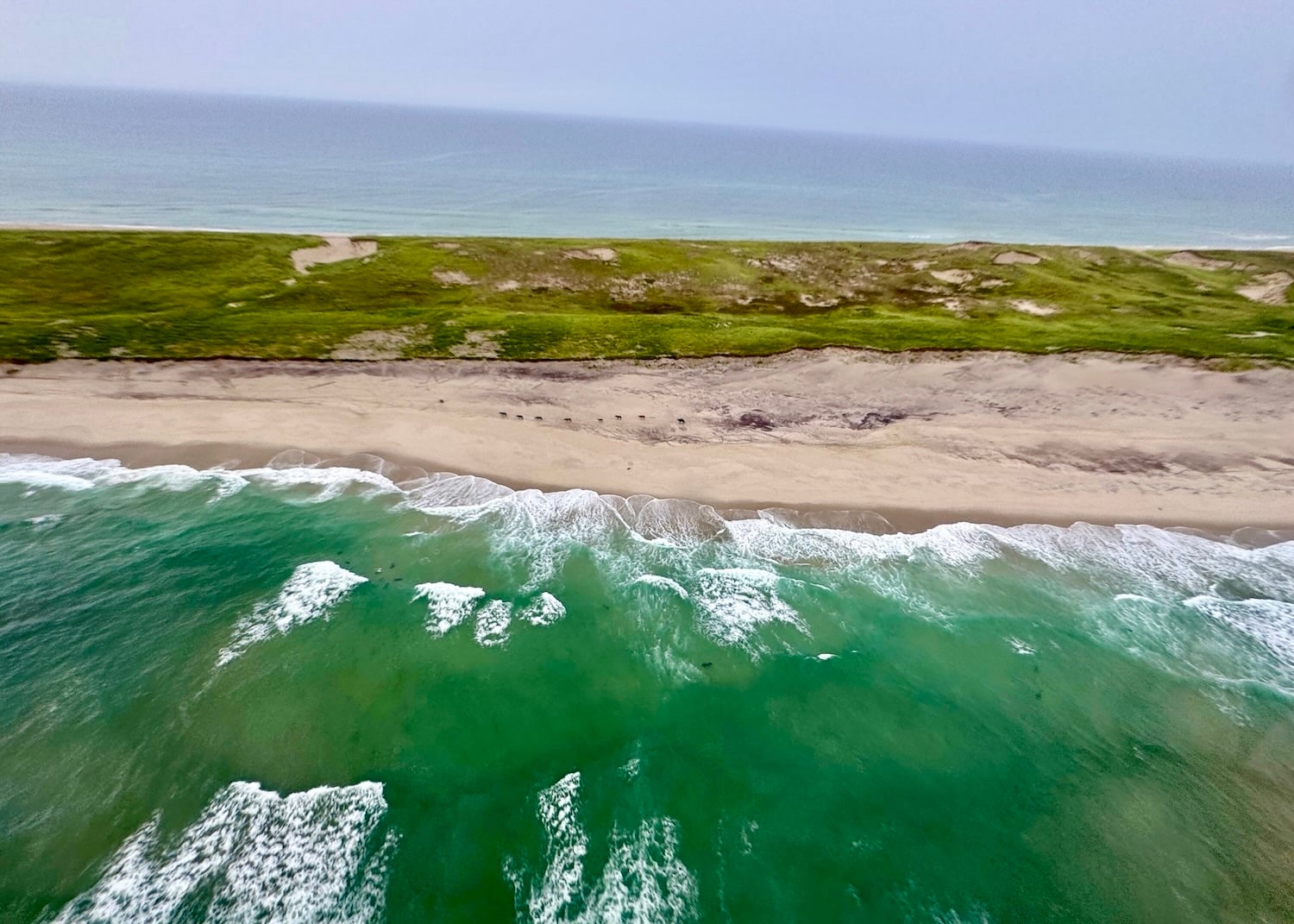
Pilots Dave and Michelle Johnston, who stayed by their helicopter, welcomed us back for the 70-minute return flight to Halifax. This time I had a window seat and as we flew over the sandbar in the sea, I could just make out a band of horses trudging single file down the empty beach.
“Sable was really showing off for us that day," Stillman mused a few days later when he shared a photo gallery. She really was, but I suspect she does that for all her guests.
Stories about:
Story Categories:
A copy of National Parks Traveler's financial statements may be obtained by sending a stamped, self-addressed envelope to: National Parks Traveler, P.O. Box 980452, Park City, Utah 84098. National Parks Traveler was formed in the state of Utah for the purpose of informing and educating about national parks and protected areas.
Residents of the following states may obtain a copy of our financial and additional information as stated below:
- Florida: A COPY OF THE OFFICIAL REGISTRATION AND FINANCIAL INFORMATION FOR NATIONAL PARKS TRAVELER, (REGISTRATION NO. CH 51659), MAY BE OBTAINED FROM THE DIVISION OF CONSUMER SERVICES BY CALLING 800-435-7352 OR VISITING THEIR WEBSITE. REGISTRATION DOES NOT IMPLY ENDORSEMENT, APPROVAL, OR RECOMMENDATION BY THE STATE.
- Georgia: A full and fair description of the programs and financial statement summary of National Parks Traveler is available upon request at the office and phone number indicated above.
- Maryland: Documents and information submitted under the Maryland Solicitations Act are also available, for the cost of postage and copies, from the Secretary of State, State House, Annapolis, MD 21401 (410-974-5534).
- North Carolina: Financial information about this organization and a copy of its license are available from the State Solicitation Licensing Branch at 888-830-4989 or 919-807-2214. The license is not an endorsement by the State.
- Pennsylvania: The official registration and financial information of National Parks Traveler may be obtained from the Pennsylvania Department of State by calling 800-732-0999. Registration does not imply endorsement.
- Virginia: Financial statements are available from the Virginia Department of Agriculture and Consumer Services, 102 Governor Street, Richmond, Virginia 23219.
- Washington: National Parks Traveler is registered with Washington State’s Charities Program as required by law and additional information is available by calling 800-332-4483 or visiting www.sos.wa.gov/charities, or on file at Charities Division, Office of the Secretary of State, State of Washington, Olympia, WA 98504.


National parks and their natural resources belong to you. The National Parks Traveler works to ensure you know how these essential places are being cared for.
Sign Up For Our Weekly Newsletter
Unsubscribe at any time.
INN Member

The easiest way to explore RV-friendly National Park campgrounds.

Here’s the definitive guide to National Park System campgrounds where RVers can park their rigs.
Our app is packed with RVing- specific details on more than 250 campgrounds in more than 70 national parks.
You’ll also find stories about RVing in the parks, tips helpful if you’ve just recently become an RVer, and useful planning suggestions.

