
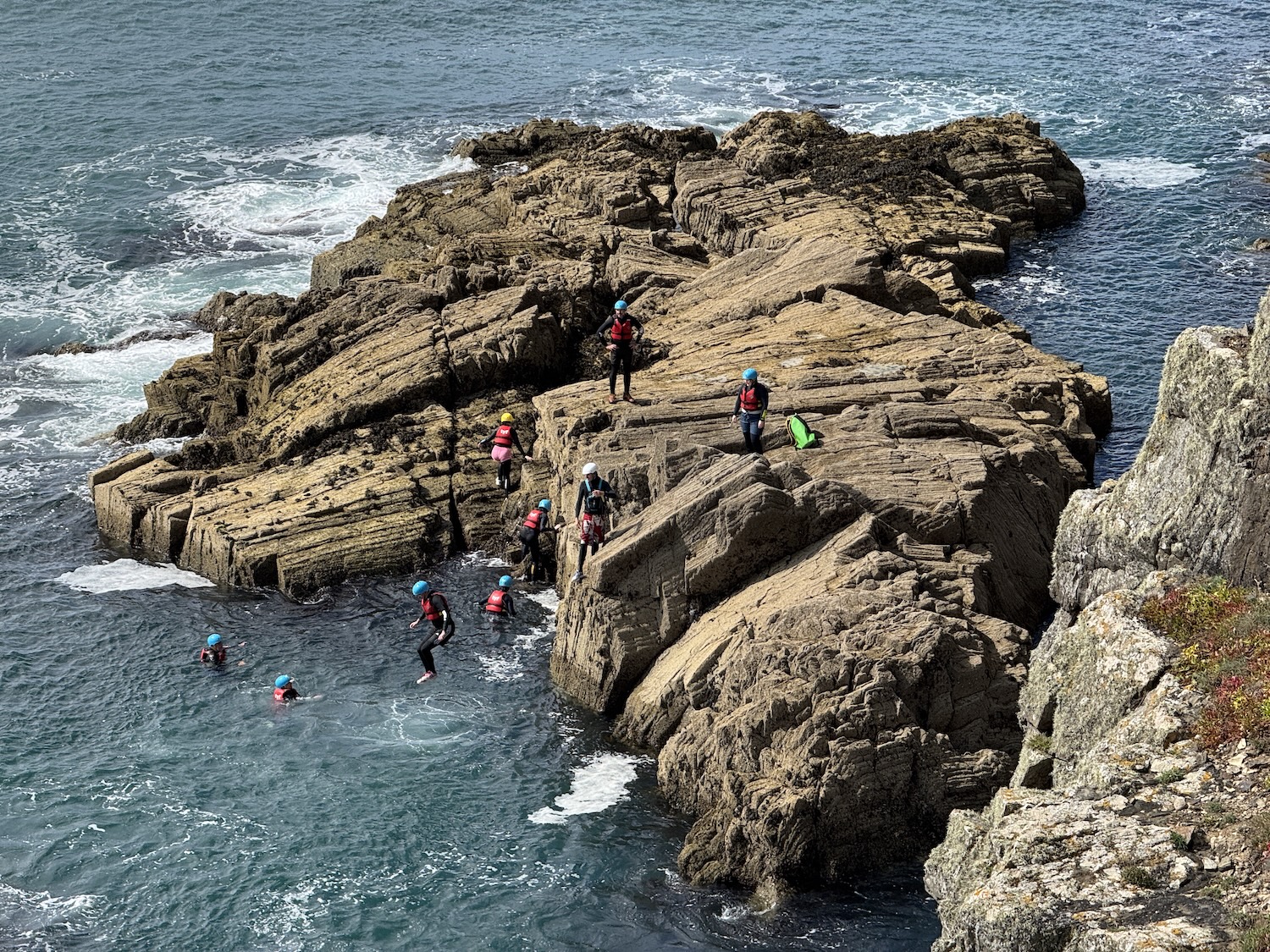
The craggy rocks are menacing, the ocean tempestuous, the cave enticing, the jump spots formidable. People looking down at us from cliffside walking paths must think we’ve lost our minds as we get tossed around the sea in our wetsuits, helmets and buoyancy aids. Oh, and sneakers to protect against barnacles and sharp edges.
But we’re not being reckless, we’re coasteering to get unusually intimate with the Wales coast.
“If there’s water and you’re mad enough, we’ll go in at any time of year,” promises Richard Carpenter. “We don’t want to scare anyone. We want you to have fun. We want you to have that adventurous experience but not come away terrified where you’ll never do this again, because we believe it’s the best activity you can do in wetsuits.”
It’s Carpenter’s job to keep six of us safe — and hopefully unscathed — for the next two hours.

Three national parks protect 20 per cent of the land area of Wales. Snowdonia is the oldest, biggest and best known, though it’s now called Eryri National Park. It’s all about mountains and castles. Bannau Brycheiniog (Brecon Beacons) National Park is “walking and thinking country.” This is Pembrokeshire Coast National Park and it boasts a “crinkled coast,” beaches, coves, cliffs, islands and wildlife like Skomer Island’s Atlantic puffins.
Established in 1952, this is the only park in the UK made up mainly of coastal landscapes. It’s home to the 186-mile Pembrokeshire Coast Path, a national trail launched in 1970 and now part of the 870-mile Wales Coast Path.
“The Pembrokeshire Coast isn’t what you might usually expect from a national park,” the National Park Authority acknowledges on its website.

Banish your North American conception of national parks that have entrance gates, admission fees and interpretive rangers. This park owns less than two per cent of the land it protects but has wrangled 600 miles of public rights of way. About 23,000 people live in communities within the park’s invisible (to visitors at least) boundaries. Wherever you go, you’re never more than 10 miles from the sea.
There is a national park visitor center in St Davids, Britain’s smallest city, but it’s a gift shop, gallery, café and information hub — not an interpretation center. Still, it’s a good place to pick up the free Coast to Coast visitor magazine. That’s O Lan i Lan in Welsh, a melodic language that’s promoted more than it’s spoken. My favorite thing at Twr y Felin Hotel, a converted windmill, is listening to bilingual elevator messages announcing the floors.

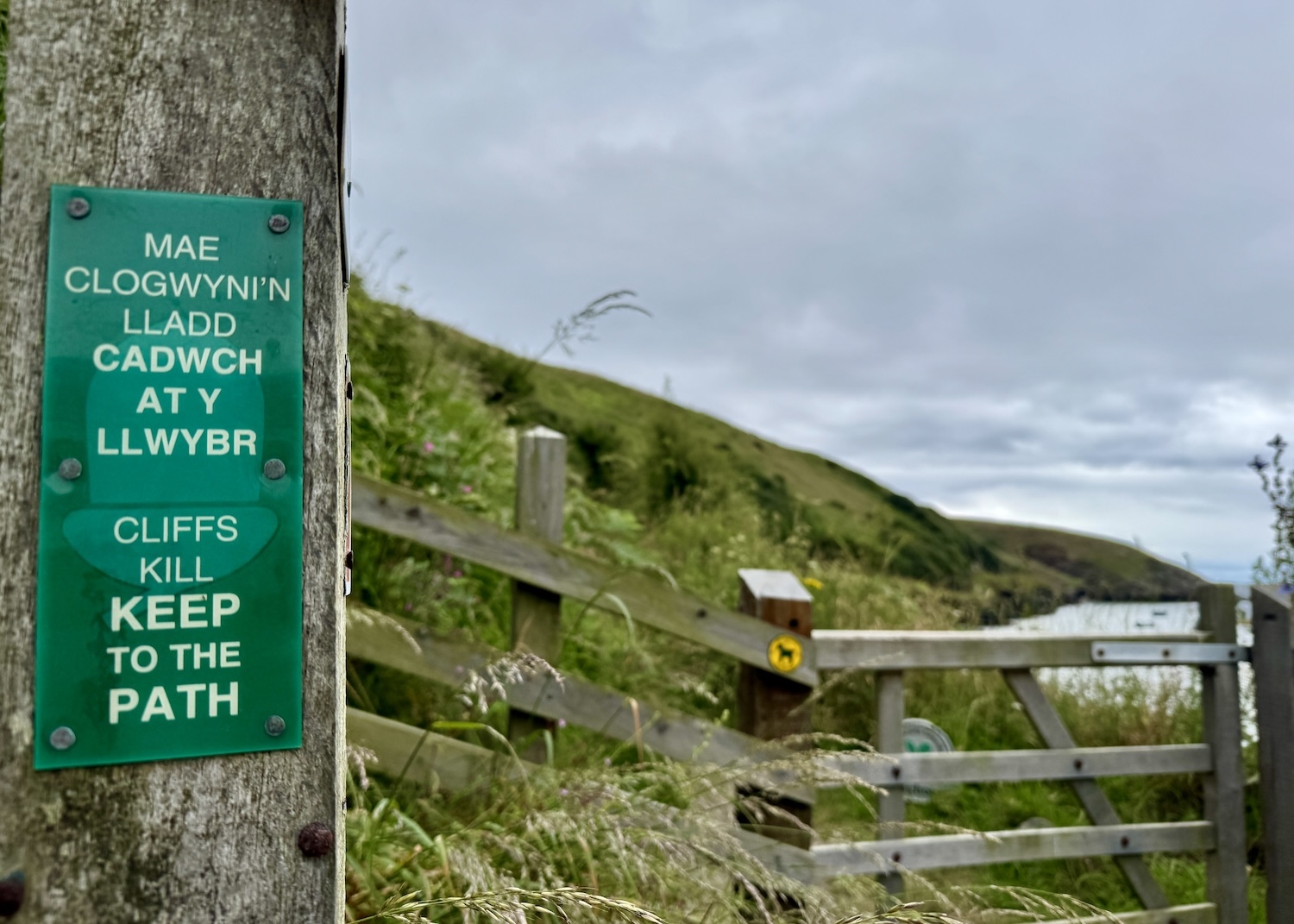
Just a short walk away, I hop on the Coastal Cruiser to tackle one wee chunk of the Wales Coast Path at Porthclais Harbour. There are “kissing gates” that let people but not livestock pass through, fields of sheep, chapel ruins and wildflowers. But part of the path has been moved landward because of coastal erosion and unstable cliffs, and signs warn “cliffs kill, keep to the path.” Some even show a silhouette of a person falling head first off a crumbling cliff.
Halfway along the path, we spot a school group coasteering beneath us. Using a somewhat flat rocky outcrop as their base, they take turns jumping into the sea in an area called St Nons. They make it look easy.
This could have been us but for high winds and turbulent seas the day before.

Our rendezvous point is TYF Adventure in St Davids where we share our fitness and confidence levels, talk about "our happiness in the sea," and listen solemnly to wind and weather reports. St Nons sounds too exposed and unruly so we opt to drive 20 minutes to the hamlet of Abercastle for a tamer experience in a sheltered bay. The plan — to circumnavigate a small island and swim through a cave in its center — sounds doable. The water is somewhere between 55F and 59F.
Wales considers itself the birthplace of coasteering. Edward C. Pyatt apparently coined the term coasteering, combining coast and mountaineer, in his 1973 book Sea Cliff Climbing. A Welsh fellow named Andy Middleton adopted the term here in 1985 and made it a business idea. His company, TYF, is now owned by Carpenter and Clare Thomas.
What’s in a name? This one started because the business was first based in an earlier incarnation of the Twr y Felin Hotel. Now the acronym mostly stands for “To Your Future” but could be “Test Your Fears” or other appropriate slogans.

“So, we’re looking for climbing, jumping, swimming, cannonballs, bellyflops, scrambling along the rocks. All the things that you’re told not to do in the swimming pool? That’s what we do and it’s just an adventure from A to B, and how you do that will be up to everyone’s different capabilities,” Carpenter explains. “We encourage everyone to work at their own level. If you want to go a little bit higher and more hardcore, then go for hardcore. If you want to go a bit more gentle, go gentle.”
On the drive over, I hear what it’s like to work with the National Park Authority. Companies must be licensed, send in risk assessments and sign up to the Pembrokeshire Coasteering Concordat to pledge to sustainable practices.
There are 13 approved venues, including some that may close to protect nesting choughs (a type of crow), falcons and other birds. Plans for powerboat coasteering can’t go ahead until the park does an environmental survey and gives its blessing. To those who try to blame the niche sport of coasteering for erosion, Carpenter suggests legions of coastal path walkers are a more serious threat.

TYF uses coasteering to chat with people about everyday fears, comfort zones and pushing themselves. It shows how jumping off cliffs can help you face school, work and life challenges while developing resilience, character, adaptability, teamwork and communication.
With one guide to every eight guests, outings start with a safety overview. We see Carpenter's first aid kit, mobile phone, personal locator beacon and VHF radio with a distress button and know he's ready for sudden changes in weather, tides and swell conditions.
No two coasteering outings are alike because of the changing mix of people and environment.
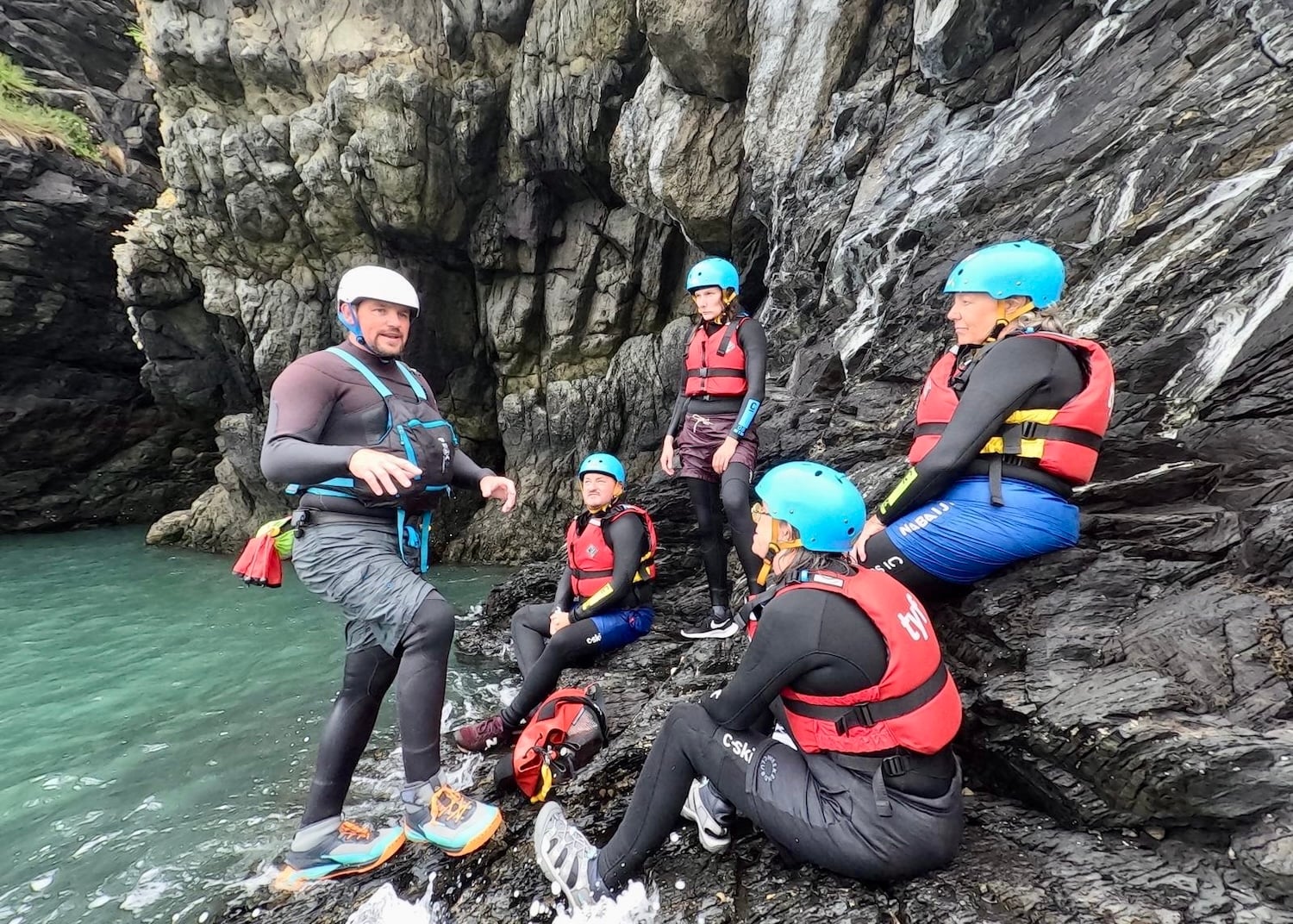
“There are two kinds of people,” Carpenter says to lighten the mood. “Those who pee in their wetsuits and those who lie about it.” This is a relief to hear, especially because something called immersion diuresis triggers the need to pee when you’re in cold water. (Don’t worry, wetsuits are rinsed and hand-washed with a special cleaner.)
Things start smooth as we wade out from shore to the rocky island and swim into the promised cave. Rough waves at the exit force us to retrace our steps.
Almost everyone else climbs those craggy rocks and jumps into the swirling sea from two different heights, but my legs are a little shaky and I have nothing to prove. Besides, I scraped my palms stumbling over some rocks and my goal is to avoid further injury. Honestly, I just love bobbing in the frigid ocean while staying warm because of a winter wetsuit.
Before you know it, it's time to head for shore. We swim across the bay to rocks that usually serve as a good place to climb out. But as I hang back watching the others attempt to do this, two of them (the men, actually) get swept off the rocks by a rogue wave. They don't complain but one winds up quite bruised despite the safety gear.

A safer spot it is. Once out, we flake out on a steep hillside before climbing to the top of a cliff to stroll down the Wales Coast Path. Back at the van, we change and reminisce about how many times our route changed. “That’s the whole point about adventure,” says Carpenter, “that it’s an unknown outcome.”
Like the rest of us, Paula Ellis is exhilarated. The semi-retired hotel manager thought coasteering meant going to the edge of a rock and jumping in the sea over and over again. "It’s so much more than that — it's exploration of the landscape, the seascape, just immersing yourself," she enthuses. "I’ve lived here in Pembrokeshire for 21 years and I’ve never felt so connected with this spot of utopia, nature. I really feel very grounded and at home — really at home, really connected with nature.”
Indeed, we've truly bonded with this coastal national park. Over the next few days, we will take all kinds of short, glorious walks but nothing compares to those wet and wild hours in the Irish Sea.
Stories about:
Story Categories:
A copy of National Parks Traveler's financial statements may be obtained by sending a stamped, self-addressed envelope to: National Parks Traveler, P.O. Box 980452, Park City, Utah 84098. National Parks Traveler was formed in the state of Utah for the purpose of informing and educating about national parks and protected areas.
Residents of the following states may obtain a copy of our financial and additional information as stated below:
- Florida: A COPY OF THE OFFICIAL REGISTRATION AND FINANCIAL INFORMATION FOR NATIONAL PARKS TRAVELER, (REGISTRATION NO. CH 51659), MAY BE OBTAINED FROM THE DIVISION OF CONSUMER SERVICES BY CALLING 800-435-7352 OR VISITING THEIR WEBSITE. REGISTRATION DOES NOT IMPLY ENDORSEMENT, APPROVAL, OR RECOMMENDATION BY THE STATE.
- Georgia: A full and fair description of the programs and financial statement summary of National Parks Traveler is available upon request at the office and phone number indicated above.
- Maryland: Documents and information submitted under the Maryland Solicitations Act are also available, for the cost of postage and copies, from the Secretary of State, State House, Annapolis, MD 21401 (410-974-5534).
- North Carolina: Financial information about this organization and a copy of its license are available from the State Solicitation Licensing Branch at 888-830-4989 or 919-807-2214. The license is not an endorsement by the State.
- Pennsylvania: The official registration and financial information of National Parks Traveler may be obtained from the Pennsylvania Department of State by calling 800-732-0999. Registration does not imply endorsement.
- Virginia: Financial statements are available from the Virginia Department of Agriculture and Consumer Services, 102 Governor Street, Richmond, Virginia 23219.
- Washington: National Parks Traveler is registered with Washington State’s Charities Program as required by law and additional information is available by calling 800-332-4483 or visiting www.sos.wa.gov/charities, or on file at Charities Division, Office of the Secretary of State, State of Washington, Olympia, WA 98504.
INN Member

The easiest way to explore RV-friendly National Park campgrounds.

Here’s the definitive guide to National Park System campgrounds where RVers can park their rigs.
Our app is packed with RVing- specific details on more than 250 campgrounds in more than 70 national parks.
You’ll also find stories about RVing in the parks, tips helpful if you’ve just recently become an RVer, and useful planning suggestions.

