

On a hill overlooking the North Atlantic Ocean, a fancy wooden clapboard house stands knee-high in the grass at the only authentic place that tells the story of Norse exploration of North America. But this is no mere doll house — it’s a fairy house that celebrates Norse and Newfoundland folklore and culture.
It provides “a whimsical way for young people (and the young at heart)” to engage with L’Anse aux Meadows National Historic Site, according to Visitor Experience Team Leader Stephanie Hedderson. And indeed, people have plunked rocks, shells and coins on the landing at the top of the curved outdoor staircase.
Parks Canada’s maintenance/asset team actually built seven fairy houses in 2020 during COVID-19 restrictions. They were made individually from natural materials such as twigs and plants and then placed on the landscape, but this is the only one I find today along Birchy Nuddick Trail.
“Some may have elaborate features like solar lights or small doors and windows, while others are of a simpler design,” Hedderson explains later by email. “This is a fun way to pay homage to something that both the Norse explorers of a thousand years ago, as well as the local residents of 50 years ago, would have believed in while inviting visitors to use their imaginations and connect with this special place.”
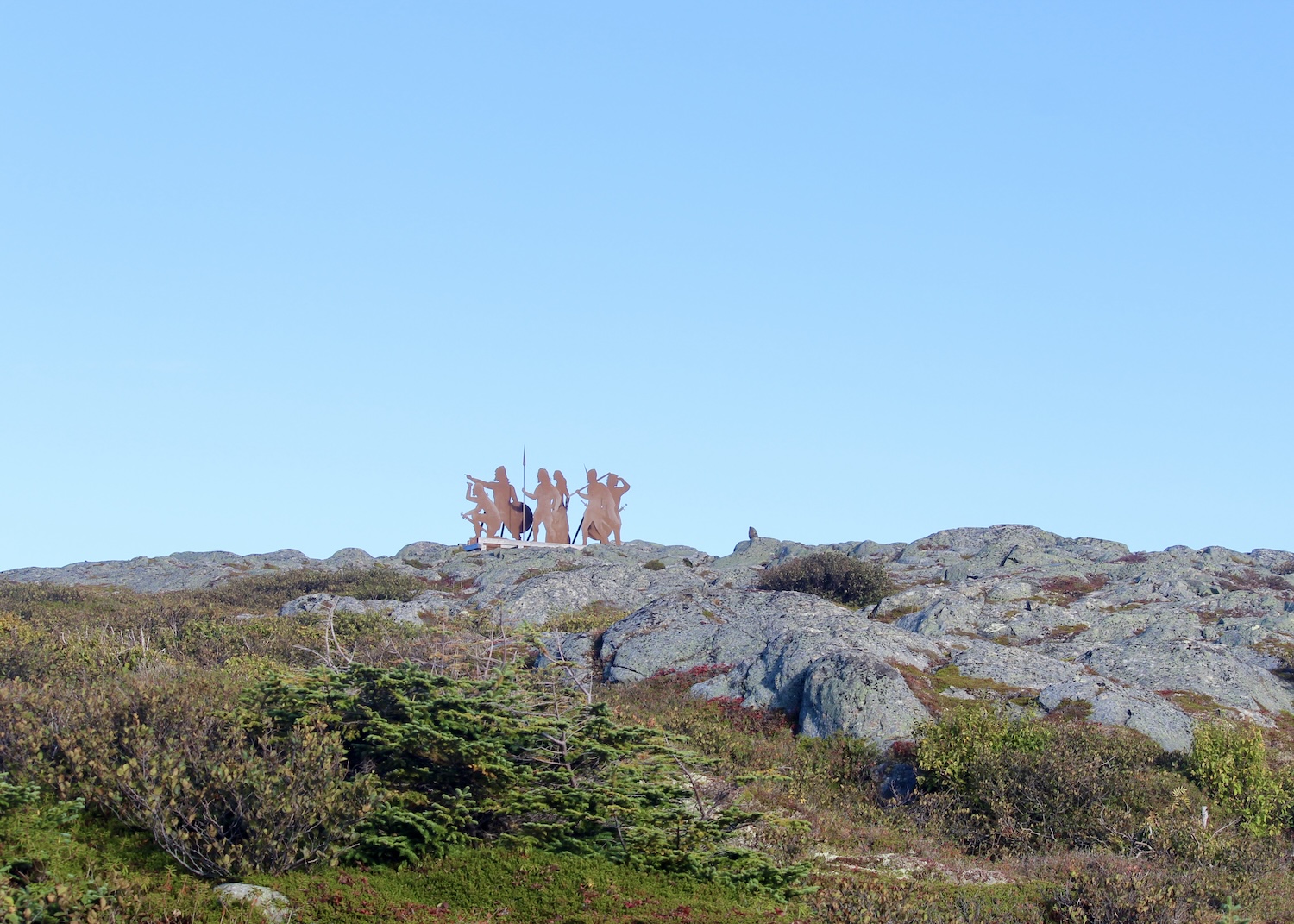
Here on the Great Northern Peninsula in Newfoundland and Labrador, L’Anse aux Meadows is the only authenticated Viking site in North America. Rediscovered in 1960, it’s also a UNESCO World Heritage Site that provides evidence of the first known Europeans to set foot on this continent.
It's June 1, opening day for a seasonal site that will welcome visitors until October 3. It’s my third time here and I’ve come just to hike Birchy Nuddick instead of the boardwalk that winds around the archaeological site between the visitor center and Viking encampment with its sod hut recreations.
Birchy Nuddick provides a quiet escape from the busy site that draws bus tours and cruise ships along with regular travelers. You can see all the way to Labrador on clear days, and sometimes watch seabirds nesting and diving along the shore.
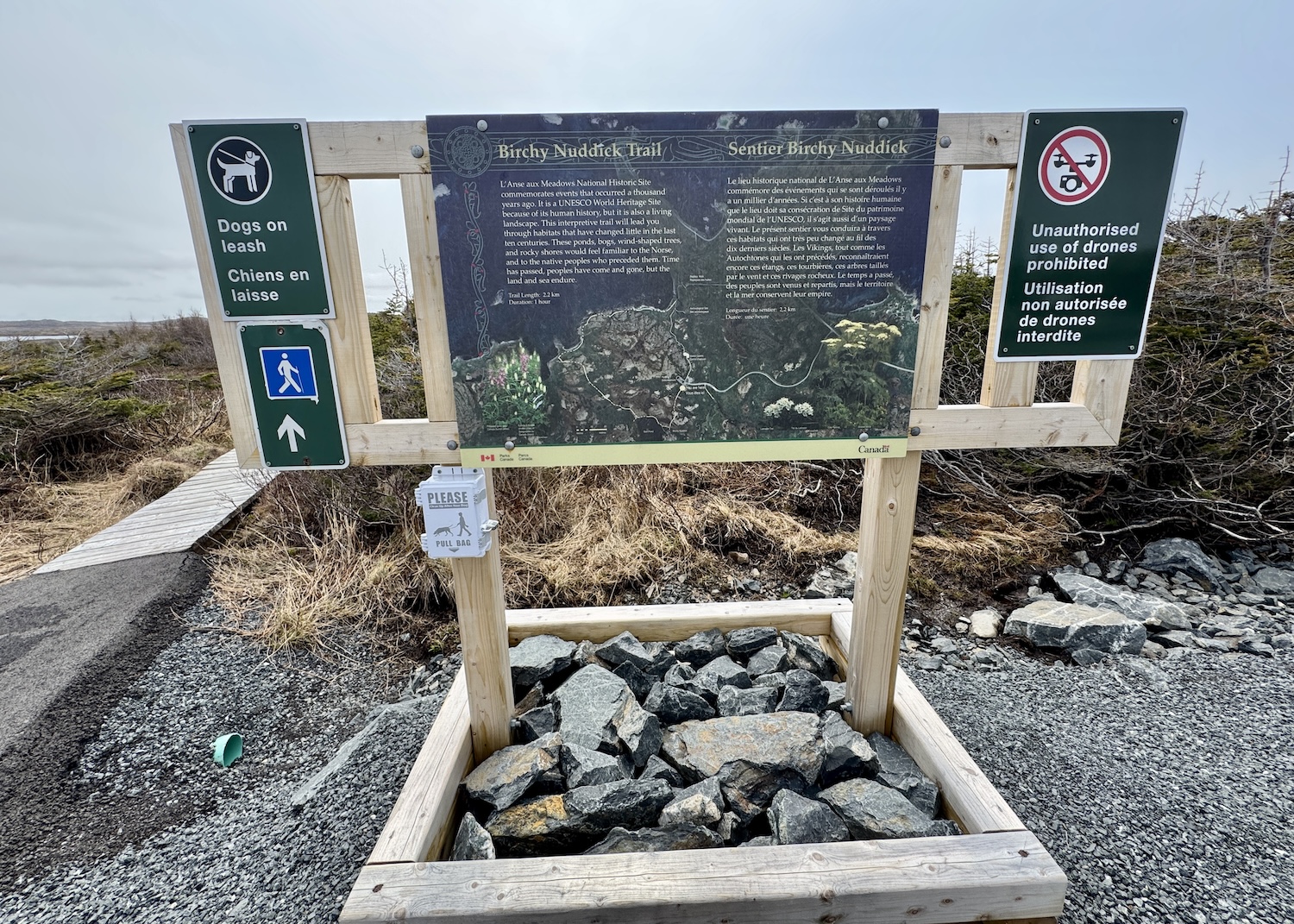
You might not even notice the trailhead at the south end of the parking lot, and it might feel counterintuitive to start here instead of following the crowds to the visitor center. There’s an honor system at play, so remember to pay your entry fee on the way out.
“L’Anse aux Meadows National Historic Site commemorates events that occurred a thousand years ago. It is a UNESCO World Heritage Site because of its human history, but it is also a living landscape,” the trailhead sign explains. “This interpretive trail will lead you through habitats that have changed little in the last ten centuries. These ponds, bogs, wind-shaped trees, and rocky shores would feel familiar to the Norse, and to the native peoples who preceded them. Time has passed, peoples have come and gone, but the land and sea endure.”
The weathered sign says it should take an hour to walk the 2.2-kilometre (1.4-mile) loop trail, but Parks Canada now says the trail to the visitor center is actually 3.4 kilometres (2.1 miles) and that you'll need about 40 minutes for it. There are no guided hikes, so study the trailhead map and four interpretive signs along the way for insight into what you’re seeing.

The Birchy Nuddick Trail was created in the 1980s, formalizing a community coastal route that had been in use for generations. Local residents have long used the trail to access Skin Pond and the barrens for subsistence activities like berry picking.
“The name of the trail reflects the name of a little hill next to Skin Pond,” Hedderson explains. “Birchy is a small brushy/birchy tree and nuddick is a name for a little hill or mound (sort of like the words hummock or hillock).”
I take a boardwalk across the bog, climb a small staircase to Birchy Nuddick, and look down on Skin Pond.
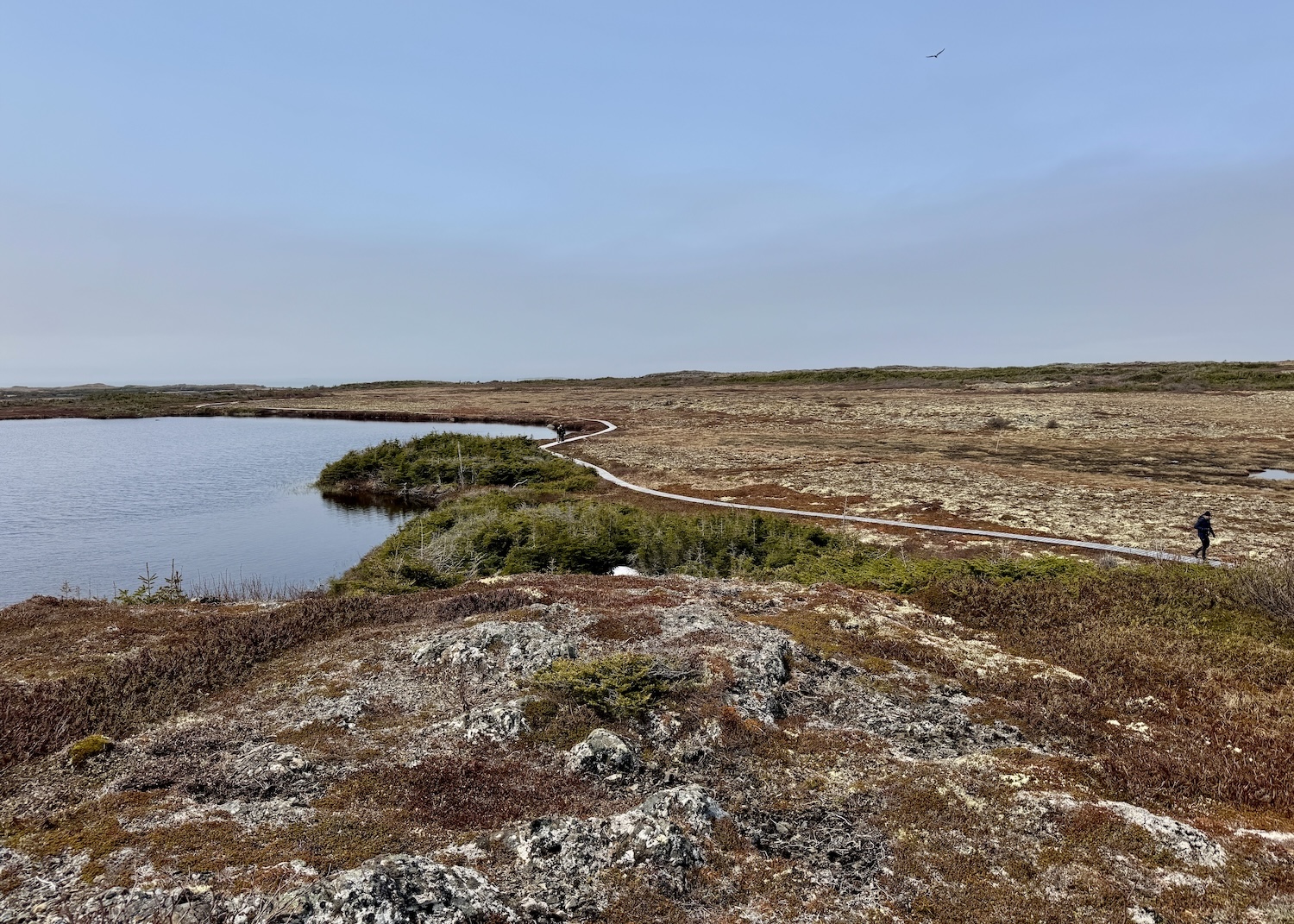
People once hunted seals and soaked their skins in this to loosen the hair before tanning. The skins — which became waterproof boots, mitts and other clothing — are gone, but the name has stuck.
Climbing back back down Birchy Nuddick, I stroll over to a second interpretive sign that says we’re surrounded by “traces of lifestyles of the past.”
Locals also hunted partridge (Willow ptarmigan) and seabirds, trapped, cut hay and wood, and fished for trout. They scoured the bogs for bakeapples, a tart yellow berry that’s delicious on cheesecake and ice cream. They collected partridgeberries (what IKEA calls lingonberries), blackberries (crowberries), marshberries (bog cranberries) and sweet hurts (blueberries).
I’ve eaten all these berries on my Newfoundland travels, usually in the form of homemade jams sold in craft and gift shops.

It’s too early for berries, but I spot Labrador tea growing along the boardwalk. I have a cup of this herbal elixir here and there, mindful that this shrub’s oblong leaves with hairy and rusty orange undersides must be briefly steeped, not boiled, because they contain a harmful toxin (adromedotoxin). "Pick leaves in early spring," writes Newfoundland's Shawn Dawson in The Forager's Dinner, noting these can also flavor soups and stews. "Pick only a few from each plant to ensure its best chance of survival."
Moving on along the boardwalk, it’s time for a lesson in predatory plants.
A third sign explains how poor soil forces some plants to trap “fast food” and absorb the nutrients from their prey. I vividly remember being on a guided hike of the Tablelands Trail in Gros Morne National Park (just a few hours away) when the interpreter stuck a “pitcher plant stomach pump” (pipette) into a water-filled leaf, sucked up the liquid and showed how it was full of ant heads, poop and writhing larvae.

Here I refresh myself on pitcher plants — the province’s official flower — and the equally carnivorous bladderwort and round-leaved sundews.
I learn that decomposing plants release acids that, carried by water, leach iron and other minerals from soil and bedrock. Iron oxide (rust) forms when this iron-rich water comes into contact with air, and can cement sand and peat particles together into nodules, producing a layer of bog iron.
This is the ore that the Vikings used to produce boat rivets.
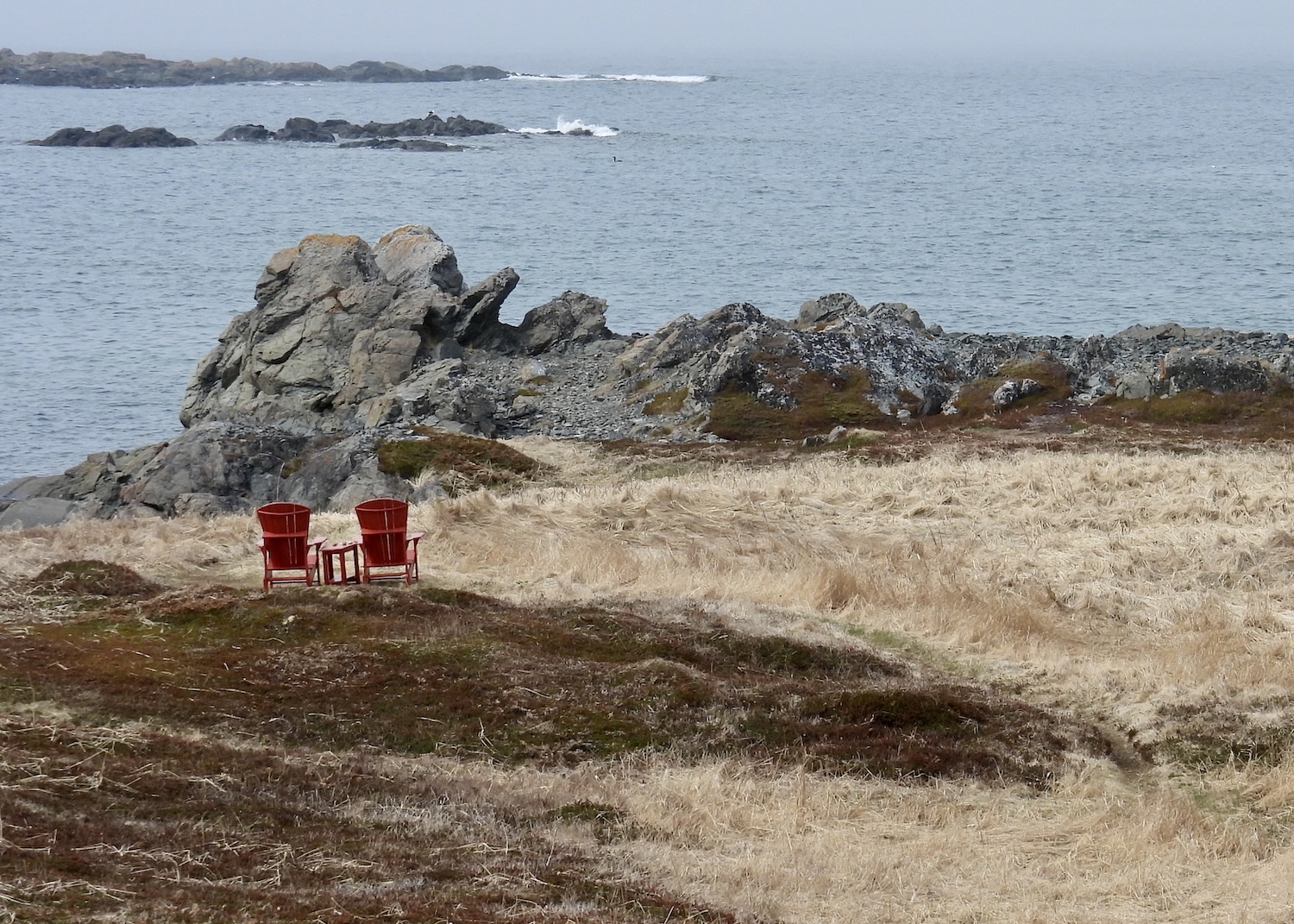
The bog finally gives way to coast, where I sit in one of Parks Canada’s famous red chairs. When you find these red Adirondack chairs around the country, you’re supposed to share photos on social media using the hashtag #ShareTheChair.
These two chairs are in a secluded cove overlooking Epaves Bay and Great Sacred Island. I watch a Common loon, grateful that it’s not a polar bear. We are, after all, in “Iceberg Alley,” where melting icebergs from Greenland and Nunavut pass by on their way south, and where polar bears using the sea ice to follow seals occasionally come to shore and spook people.
“There have been rare sightings of polar bears at the site from time to time (usually in the spring, before the site has opened),” allows Hedderson, “as well as an array of other wildlife including moose, geese, Eider ducks and gannets.” I’ve actually just seen three moose on the drive here, and I’m feeling grateful that these enormous and abundant mammals didn’t dash into the road and crash into my car.
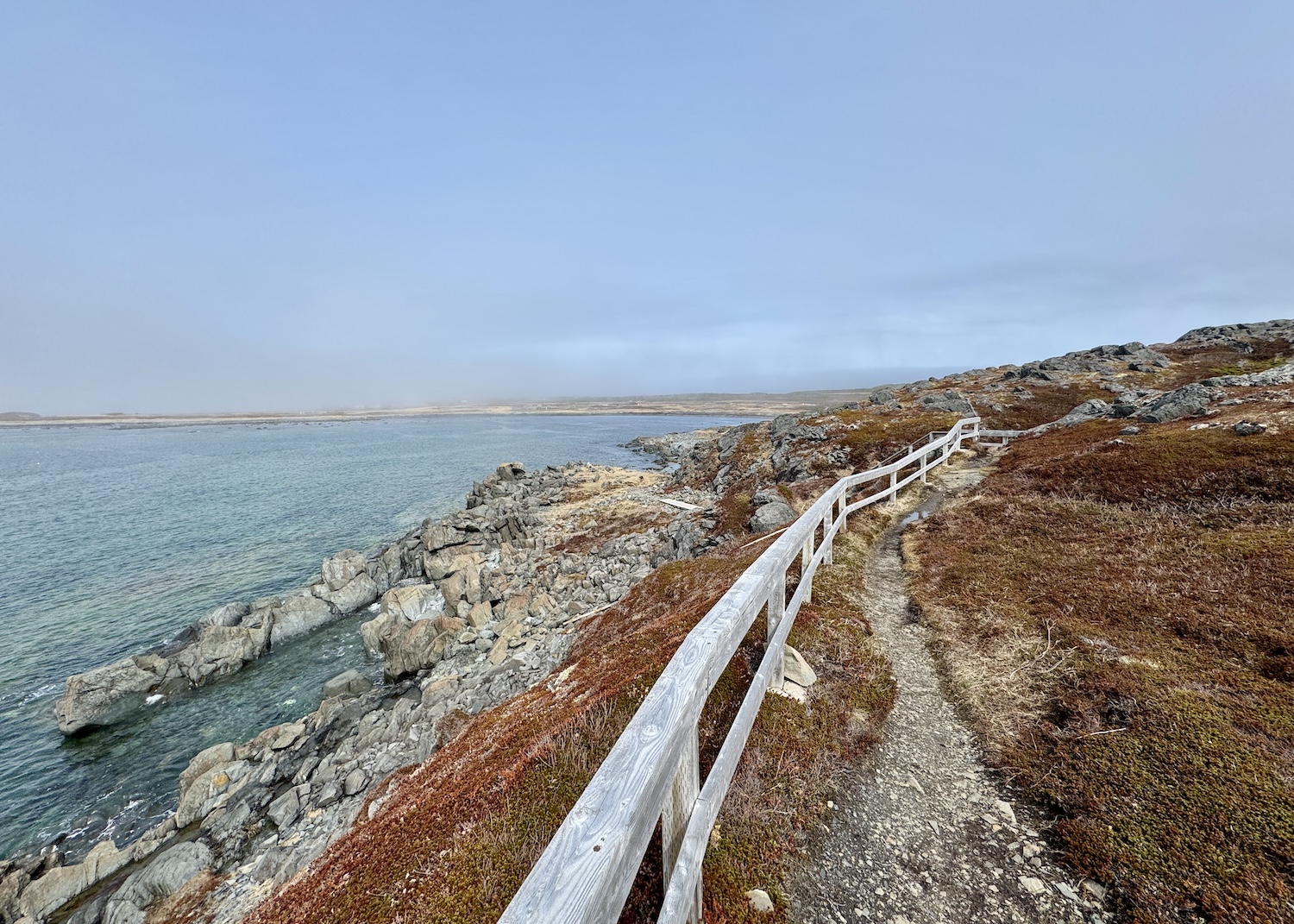
My time on Birchy Nuddick Trail is almost over.
From a final sign called “Rare Plants Live in Special Places,” I learn how this 20,000-acre national historic site— made up of land, offshore islands and marine environment — protects biodiversity as well as archaeological remains.
“Within this small area is a sample of subarctic tundra and 27 species of rare plants,” the sign reveals. “Cooled by the Labrador Current, the tip of the Great Northern Peninsula has vegetation and climate similar to Greenland, whence the Vikings sailed.”

Here in the subarctic coastal tundra, flora buffs may discover silver willow, large-flower bluegrass and alpine ragwort. But without a guide, all I can easily identify is a lobster trap decaying on a rocky beach near fishing rope and other marine debris.
Climbing shale cliffs, grateful for wooden railings, I find the final interpretive sign and learn how this area is part of the French Shore. The Treaty of Utrecht gave France the right to fish along this portion of the coast between 1713 and 1904 (before Newfoundland joined Canada), and many local place names date from that period.
L'Anse aux Meadows is probably from Greek mythology — L'Anse à Medée means Medea's Cove and many ships were once named Medea for the powerful sorceress. Then again, the name could come from L'Anse aux Méduses, meaning Jellyfish Cove.
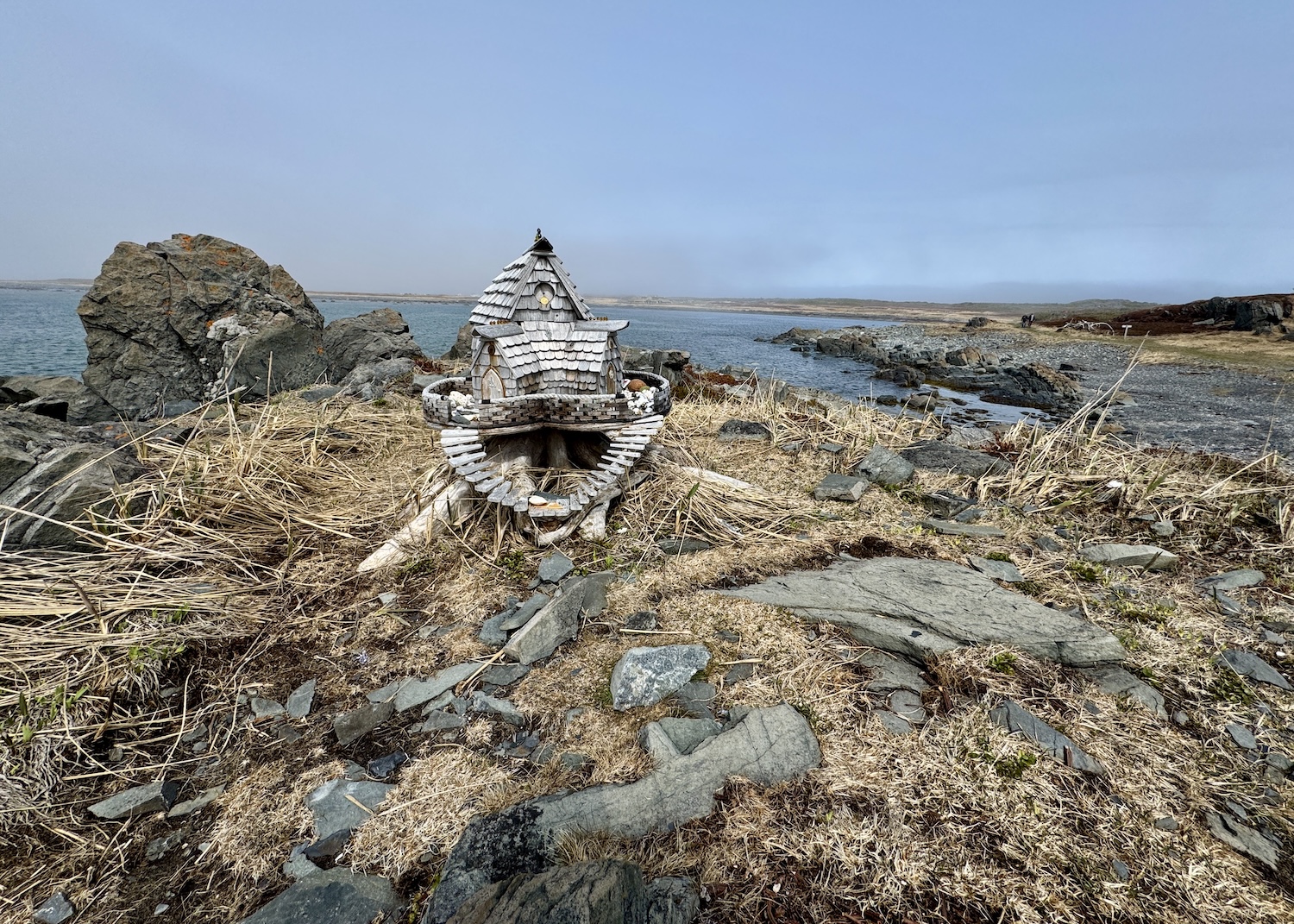
It's around here that I commune with that charming fairy house before crossing Harry Youden’s Cove, a spot I later learn is named for a local suspected of deserting the French fishing fleet. It wasn't uncommon for fishermen, forced into service, to marry locals and begin new lives here, deserting not just their ship and country but sometimes their first wives and families.
Passing through the visitor center, I belatedly flash my annual parks pass, and stop to admire the sculpture of a Norse man in the entranceway before returning to the parking lot.
My Birchy Nuddick hike — more of a gentle stroll, really — took just 44 minutes but has revealed all kinds of things about the people who walked this land before me.

Story Categories:
A copy of National Parks Traveler's financial statements may be obtained by sending a stamped, self-addressed envelope to: National Parks Traveler, P.O. Box 980452, Park City, Utah 84098. National Parks Traveler was formed in the state of Utah for the purpose of informing and educating about national parks and protected areas.
Residents of the following states may obtain a copy of our financial and additional information as stated below:
- Florida: A COPY OF THE OFFICIAL REGISTRATION AND FINANCIAL INFORMATION FOR NATIONAL PARKS TRAVELER, (REGISTRATION NO. CH 51659), MAY BE OBTAINED FROM THE DIVISION OF CONSUMER SERVICES BY CALLING 800-435-7352 OR VISITING THEIR WEBSITE. REGISTRATION DOES NOT IMPLY ENDORSEMENT, APPROVAL, OR RECOMMENDATION BY THE STATE.
- Georgia: A full and fair description of the programs and financial statement summary of National Parks Traveler is available upon request at the office and phone number indicated above.
- Maryland: Documents and information submitted under the Maryland Solicitations Act are also available, for the cost of postage and copies, from the Secretary of State, State House, Annapolis, MD 21401 (410-974-5534).
- North Carolina: Financial information about this organization and a copy of its license are available from the State Solicitation Licensing Branch at 888-830-4989 or 919-807-2214. The license is not an endorsement by the State.
- Pennsylvania: The official registration and financial information of National Parks Traveler may be obtained from the Pennsylvania Department of State by calling 800-732-0999. Registration does not imply endorsement.
- Virginia: Financial statements are available from the Virginia Department of Agriculture and Consumer Services, 102 Governor Street, Richmond, Virginia 23219.
- Washington: National Parks Traveler is registered with Washington State’s Charities Program as required by law and additional information is available by calling 800-332-4483 or visiting www.sos.wa.gov/charities, or on file at Charities Division, Office of the Secretary of State, State of Washington, Olympia, WA 98504.
INN Member

The easiest way to explore RV-friendly National Park campgrounds.

Here’s the definitive guide to National Park System campgrounds where RVers can park their rigs.
Our app is packed with RVing- specific details on more than 250 campgrounds in more than 70 national parks.
You’ll also find stories about RVing in the parks, tips helpful if you’ve just recently become an RVer, and useful planning suggestions.

