

If you have not yet visited White Sands National Park in New Mexico, you may initially assume there is nothing but white gypsum sand dunes to photograph. It might come as a bit of a surprise to see so much greenery growing atop the sand when you first enter the park. Oh, you will see those sparkling, bright white dunes a few miles past the fee booth.

And then what? Well, that depends entirely upon your photographic powers of observation. Noticing what is around you is how you improve upon your photography skills.
During my 2018 move from Texas to Washington State, I planned several different route options allowing me to visit several national parks. One route would have taken me to Carlsbad Caverns and White Sands national parks. I ultimately chose another route, but did recently visit Carlsbad back in March, my photo visit of which is chronicled in the Traveler’s April photo column.
This July photo column features White Sands, the other national park I finally visited during a more recent road trip. I learned a few things while photographing in this national park that I want to pass on to you, along with some photo tips and techniques for getting great shots.
How White Is White? That Depends Upon The Camera
One of the first things I noticed is that no two cameras are alike in correctly rendering that dazzling white sand. Photos captured with one camera brand produced a slightly warm (yellow-ish) tint to the sand, while other photos from another camera were almost-but-not-quite-spot-on. The yellow tint was probably helped along by the Singh-Ray warming polarizing filter I had affixed to the lens. Ah well. A circular polarizing filter (aka CPL) is a must for this brilliantly bright landscape, because it brings out textures, darkens and saturates the sky, and cuts through the windblown sand haze (a little).
Back to the whitness issue. It's similar with winter snow photos. Part of this issue is due to the color temperature at which your camera is set (yes, colors have a temperature and they are measured in degrees Kelvin). Also, your camera's light meter - which sees in shades of gray - wants to turn everything a nice middle gray - not to light, not too dark. I'm not going to get into the weeds about this. I'll just say for an easy fix, the ability to make the sand look as white as you can is readily resolved during the editing stage with the color balance sliders (rather than wasting valuable photo op time going into your camera's settings to change the color temp).

Make sure the highlights are selected and move your slider or other selection tool to the bluer side of the color range. Maybe apply a little more brightening to the composition, as well. You need to be careful how much brightening you apply, though, because those white sands will blow out (overexpose) easily.
Smartphone users won’t have as much of an issue with this. I found my iPhone photos and videos rendered the white sands well, although I still needed to make edits to the end photos.

It’s a work in progress even for me.
Tips, Techniques, Advice
As mentioned previously, it’s not all about the sand dunes. White Sands National Park is located within the far northern tip of the Chihuahuan Desert, the most diverse desert in the Western Hemisphere and one of the most diverse arid regions in the world. There is so much life out there – you just need to be observant.
Look at all that greenery you see in this park. Visit during early summer like I did, and you will still see wildflowers blooming. Maybe not as many, but some. The two most ubiquitous wildflowers you will see are purple sand verbena and greenthread.
With wildflower photos, you can do a couple of things:
- Use a telephoto lens or telephoto setting for a nice close-up of the flower itself
- Isolate the flower to a certain spot on the composition and give it plenty of “negative space” (blank space like blue sky or an otherwise monochrome background). This really focuses the viewer’s eyes on your photo subject.
For the purple sand verbena photo, I used my 100-400mm telephoto lens to capture a nice close-up, which I then cropped a little more to remove distractions from my subject.

For the greenthread, I admit to having issues trying to get a focused close-up due to the breeze (it’s almost always windy in the park), so I opted for a wide-angle shot against the white sand ground from which this solitary plant grew. I placed it just a little right of center because I wanted to include the entire plant shadow.

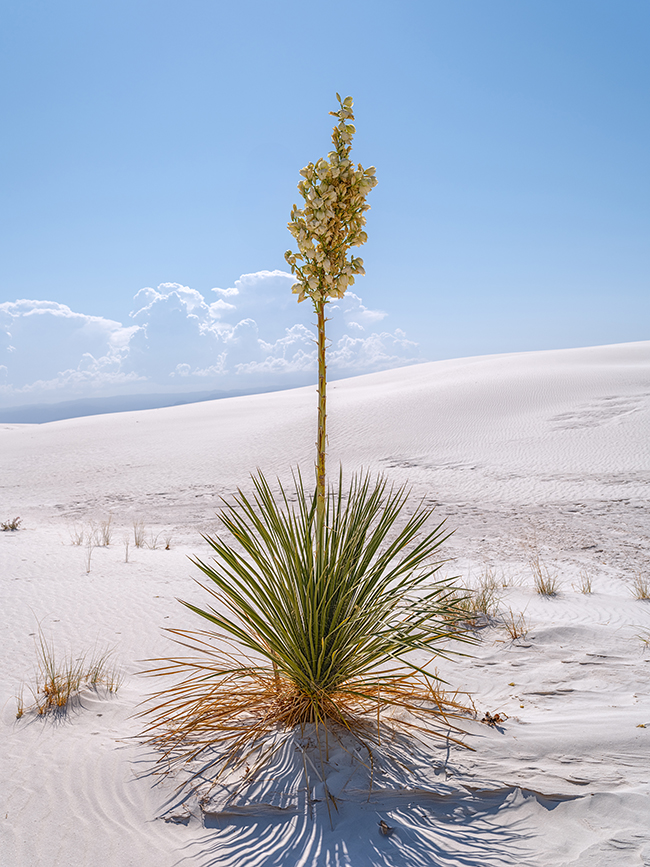
Speaking of shadows, this is something else you should think about when photographing a plant in the bright sun. If the sun is not directly overhead, your subject (in this case, the plant) will be casting a shadow like the soaptree yuccas in the photos below. When that occurs, try to include the entire shadow cast by that plant. It’s ok if you can’t, but if you can, it makes the image “complete,” for want of a better word.
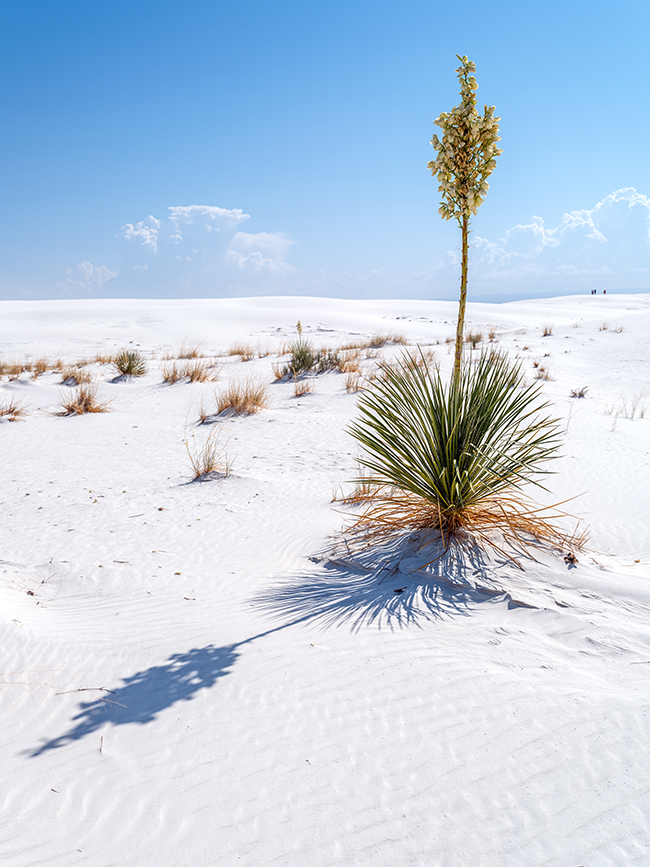

I couldn't always capture the entire shadow in compositions because of how I framed them, and that was ok, because the shots still worked, as they will for you.
If you are photographing the sensuous curves of the dunes, as well as the expanse of the dunefield itself (a dunefield that covers 275 square miles / 712.25 square kilometers, by the way), think about adding something familiar, or at least, recognizable, to break up the monotony and add a little reference and scale. Plants, footprints, even people - yes, footprints that mar the otherwise pristine sands, and people standing in that landscape shot.
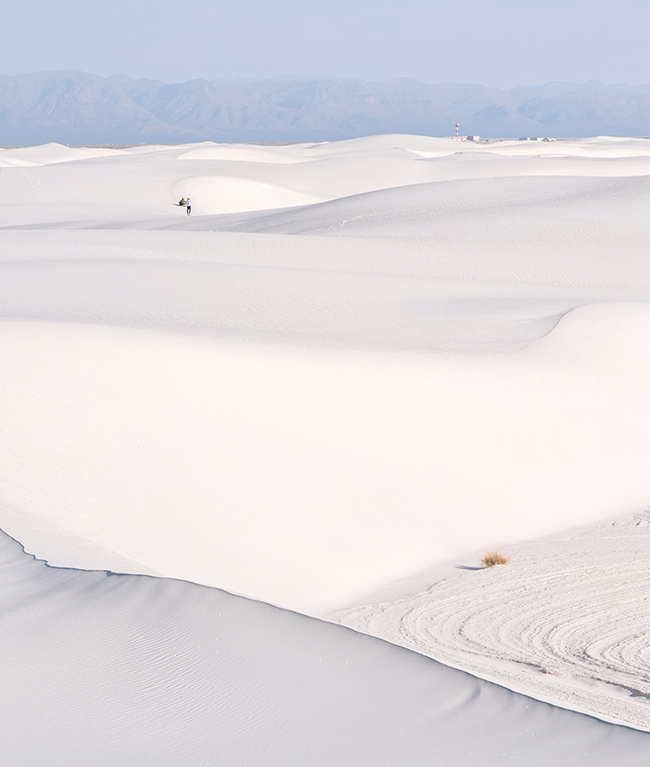
In this image here, several features break up an otherwise white background topped with blue mountains and sky. The flat, vegetative portion of an interdune (which is the flat area between dunes) attracts, then directs the eyes toward those two people on the sand, which in turn pushes the viewer’s gaze toward those buildings in the distance between sand and mountains. Yes, there are buildings at the edge of this park, since Alkali Flat Trail, where I was, is near the Cooperative Use Area Boundary between the National Park Service and the White Sands Missile Range.
In the image below, I isolated this one plant – part of a plant, really – to break up the white expanse of sand. Now, if you look long enough at the photo, you’ll see ripple marks on the curving dunes and even a set of non-human tracks. That part of a plant adds a little color to break things up, especially since the San Andres Mountains in the background are so hazy.

Regarding haze, you’ll get plenty of it out there except in the early morning when the park first opens up, and maybe in the late evening before it closes. It’s almost always windy – sometimes strong, sometimes just breezy. Regardless of strength, that wind picks up quite a bit of sand, in turn creating a gauzy veil against the background.
To remove at least a part of that “gauzy veil,” you need to “dehaze” it. Most photo editing software has some sort of dehaze slider or other analogous choice. The trick is to apply this application judiciously. Too much dehaze and the scene looks extremely overprocessed … unless, of course, that is what you seek.
Converting your color image into a black-and-white shot will highlight the shadows and textures. Sand ripple structures stand out, as do footprints and other things you might not notice when the image is color. When you decide upon trying black-and-white, my advice is to take a color image, make a copy of it, then apply your black-and-white setting to the copy. I do not advise changing the settings in-camera to capture a black-and-white shot because then you can't change it to a color image while editing. It's one thing, I suppose, if you intend to capture nothing but monochrome shots, but if you don't plan to do that, then get the color shot and convert later.


Oh, speaking of footprints, look for tracks in the sand. Much of the wildlife (including invertebrates like insects and arthropods) is nocturnal. You won’t see it during the daylight hours, but arrive in the morning and look down at your feet to discover all sorts of tracks ranging from those created by darkling beetles to the tracks of a sand scorpion.


Photograph the interesting formations, insects, and plants you see, then look them up later to learn something about them. The series of parallel curving sand formations, in the image below, for instance, is known as “scrollwork.”

According to The Geology of Southern New Mexico's Parks, Monuments, and Public Lands, this patterning is called "scrollwork." Those hard, curvy lines represent preserved "toes" of former barchan dunes that have been removed by the constantly-blowing wind. The "toes" remain because of capillary action of water moving upward in a dune between the sand grains. Gypsum is soluble to an extent, so the water acts as an adhesive to bind together the bottom portion of dune edges, hardening the gypsum and preventing that bottom edge portion of the dune from blowing away. Each scrollwork line shows you the last known position of that barchan sand dune. Now, that’s pretty cool and makes an interesting photo.
Sunrise, Sunset, Nighttime
I’m a sunrise kind of gal. I’ll get up during the wee hours of morning to arrive at and stake out a spot for a sunrise shot. But that’s not really possible at this park with its opening and closing hours. I have read that you can get a “Late Stay Permit” for afterhours, but it takes some digging on your part to figure out how to apply for this permit since the park doesn’t seem to call it that, as far as I can tell. Instead, it looks like you need to fill a Commercial Use Authorization Permit 21 days prior to your trip and fork over an application fee of $100. No guarantee they will approve your request, and that fee is not refundable.
So, in lieu of an actual sunrise, it is still possible to photograph some lovely landscape shots while the early morning light is conducive to nice soft lighting, good color saturation, and interesting shadows.


I never captured a sunset, either, but that’s my own fault. Just remember, the park closes its gates an hour after sunset. Don’t even think about lagging and letting the gates close with you still in the park. Rangers – even during this time of National Park Service employee reductions – want to ensure visitor safety as well as preservation of the park environment. They will find you and give you much hassle (or so I have read) about staying past closing time, not to mention you might even get fined. It’s not worth the trouble. Just get the sunset shot and skedaddle out of the park before those gates clang shut.
Night photography? Well, if you arrive in White Sands during a full moon, you can either take their ranger-led moonlight hike (which literally sells out within a minute of opening the reservations on recreation.gov – I’m serious), or you can wander around the dunes until about 11 p.m. during the park’s “Full Moon Night,” when entertainment or other presentations are offered. They only offer these programs once a month, so you need to keep checking the park’s website for those dates and then plan your trip around them.
I was in the park almost three days, and I look back now to what else I could have photographed. I’ll always feel that way, no matter how many days I spend at a national park. White Sands is more than just brilliant white sand dunes. It’s about the environment out there and the many different lifeforms – some of which are obvious, some of which you must train your eyes to look for, and some of which pop up in a moment of serendipity, like the bleached earless lizard in the photos below.


It’s not all about getting the awesome landscape shots worthy of a gallery. Sometimes, it's about those little/interesting/odd things that pique the curiosity and impress friends/family/colleagues when you can explain the why and how of your photo’s subject.
Stories about:
Story Categories:
A copy of National Parks Traveler's financial statements may be obtained by sending a stamped, self-addressed envelope to: National Parks Traveler, P.O. Box 980452, Park City, Utah 84098. National Parks Traveler was formed in the state of Utah for the purpose of informing and educating about national parks and protected areas.
Residents of the following states may obtain a copy of our financial and additional information as stated below:
- Florida: A COPY OF THE OFFICIAL REGISTRATION AND FINANCIAL INFORMATION FOR NATIONAL PARKS TRAVELER, (REGISTRATION NO. CH 51659), MAY BE OBTAINED FROM THE DIVISION OF CONSUMER SERVICES BY CALLING 800-435-7352 OR VISITING THEIR WEBSITE. REGISTRATION DOES NOT IMPLY ENDORSEMENT, APPROVAL, OR RECOMMENDATION BY THE STATE.
- Georgia: A full and fair description of the programs and financial statement summary of National Parks Traveler is available upon request at the office and phone number indicated above.
- Maryland: Documents and information submitted under the Maryland Solicitations Act are also available, for the cost of postage and copies, from the Secretary of State, State House, Annapolis, MD 21401 (410-974-5534).
- North Carolina: Financial information about this organization and a copy of its license are available from the State Solicitation Licensing Branch at 888-830-4989 or 919-807-2214. The license is not an endorsement by the State.
- Pennsylvania: The official registration and financial information of National Parks Traveler may be obtained from the Pennsylvania Department of State by calling 800-732-0999. Registration does not imply endorsement.
- Virginia: Financial statements are available from the Virginia Department of Agriculture and Consumer Services, 102 Governor Street, Richmond, Virginia 23219.
- Washington: National Parks Traveler is registered with Washington State’s Charities Program as required by law and additional information is available by calling 800-332-4483 or visiting www.sos.wa.gov/charities, or on file at Charities Division, Office of the Secretary of State, State of Washington, Olympia, WA 98504.


National parks and their natural resources belong to you. The National Parks Traveler works to ensure you know how these essential places are being cared for.
Sign Up For Our Weekly Newsletter
Unsubscribe at any time.
INN Member

The easiest way to explore RV-friendly National Park campgrounds.

Here’s the definitive guide to National Park System campgrounds where RVers can park their rigs.
Our app is packed with RVing- specific details on more than 250 campgrounds in more than 70 national parks.
You’ll also find stories about RVing in the parks, tips helpful if you’ve just recently become an RVer, and useful planning suggestions.

