
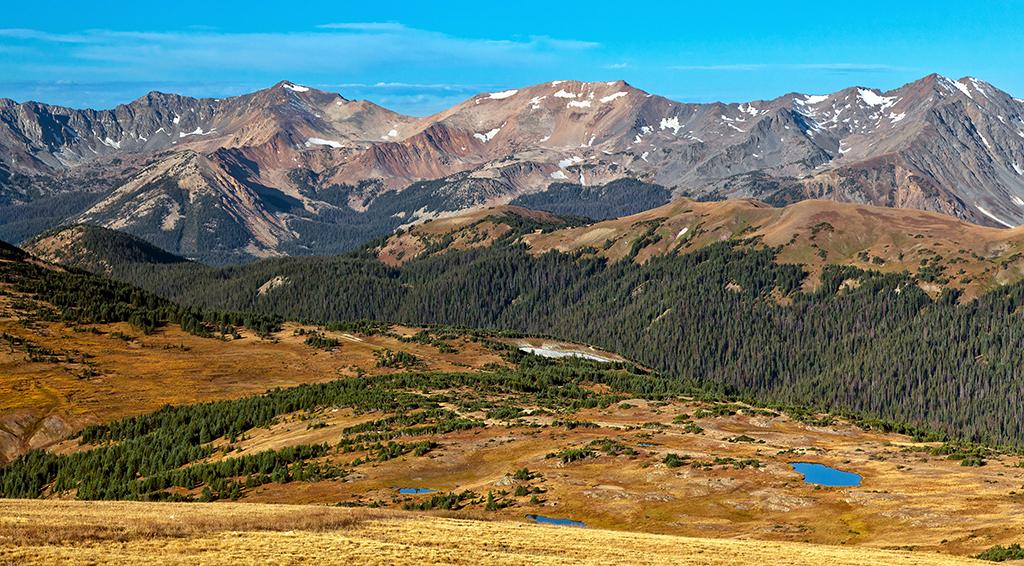
The popular 70s song Rocky Mountain High, written by John Denver and Mike Taylor, was inspired by Denver’s love for Colorado and is one of Colorado’s two state songs. A visit to Rocky Mountain National Park may have you singing that song, too, once you have experienced the splendid scenery of rugged mountains, alpine lakes, and montane meadows, viewed the spectacular sight of elk sparring for the right to control the harem, and heard the echoing sound of those same elk bugling during the mating season.
An easy drive from Denver International Airport, this 265,807-acre (>100,000-hectare) national park offers not only tall peaks, pristine lakes, and plenty of view areas, but also 300 miles (482.8 kilometers) of hiking trails and superb wildlife viewing. In the autumn, “leaf peepers” visit to view the golden aspen while listening to elk bugling in the meadows. Winter and spring provide opportunities for snowshoeing, skiing, and ice fishing. During the summertime horseback riding, bicycling, and fishing are popular activities, and from summer into early-to-mid fall, visitors can enjoy scenic driving on Old Fall River Road as well as Trail Ridge Road, the highest continuous paved road in the United States, cresting at an elevation of 12,183 feet (3,713.4 meters) above sea level. Trail Ridge Road is also one of ten America's Byways in Colorado and a national designated All American Road.
Within park boundaries, these jagged peaks and granite rocks ranging in elevation from 7,860 feet to over 14,000 feet (2,395.7 to more than 4,267 meters) have issued a siren song over the decades luring climbers to test their skills with traditional alpine climbing, big wall, bouldering, snow and ice, and mountaineering.
Pack your camera to capture grand vistas offered by the many view areas within the park, including Many Parks Curve, Gore Range and Rainbow Curve overlooks. In addition to your camera, bring along your binoculars for spotting elk, marmots, deer, bighorn sheep, and coyotes, plus any of over 270 species of birds either living within the park or migrating through.
Featured In The Traveler
Under The Willows: Beavers Partner With Rocky Mountain National Park
Centuries ago, nearly every stream in today’s Rocky Mountain National Park (and America) was home to Castor canadensis, the North American beaver. “If you go back thousands of years, this valley was a giant willow stand that supported lots of different animals,” said Professor David J. Cooper from the Warner College of Natural Resources at Colorado State University during a tour of beaver habitat on the western side of the park, in the Kawuneeche Valley. “They include beavers, amphibians and all kinds of animals. When I was here 30 years ago, there were beaver dams and active beavers here, and tall willows.”
To read more of this Traveler Feature Story, go to this page.
There is plenty of history attached to this national park too – especially women’s history.
According to park staff:
Women have held a special place in national park conservation from the early days of the idea. Women worked hard all over the country to teach Americans how valuable national parks would be to our children's education and to our identity as Americans. Women have been explorers and authors. Some frontier women worked hard to establish their own property rights over homesteads and became successful inn owners. In the 1920s and 1930s women came on the scene as park staff, leading visitors into the heights of the Rocky Mountains.
In the late 1800s, Anna E. Dickinson and Isabella Bird were the first two European women known to have ascended the lofty heights of Longs Peak. Mary Belle King Sherman used her influence with the Federated Women’s Club to gain public support for the establishment of Rocky Mountain National Park, and in the early 1900s, was one of the first advocates for the idea that children gain health benefits from spending time in the outdoors. Imogene Green MacPhearson fell in love with the landscape and purchased a homestead there in the early 1900s which later became a part of the national park. And, in the summer of 1928, Margaret Fuller Boos became Rocky Mountain National Park's first female ranger-naturalist.
While you can see much of the park along Trail Ridge Road in a single day, you’ll want to spend at least one extra day exploring outside the confines of your vehicle. For overnighting, there is no in-park lodging, but Estes Park, Colorado, at the park’s eastern entrance, and Grand Lake, Colorado, on the park’s western side, offer lodging and vacation rentals.
If pitching a tent or parking your RV beneath the starry sky is more your style, there are five campgrounds within the park accessible by vehicle, four of which are reservation-only through recreation.gov, and one of which is first-come, first-served. If you really want to get away from it all, you can heft a backpack and head out into the wilderness for a multi-day backcountry adventure. Embarking on a backcountry hike requires a physical permit and an overnight dash tag for your vehicle.
While Rocky Mountain National Park is open year-round, some roads will be closed due to winter weather and camping will be limited. You also need a timed-entry reservation to enter the park if visiting between May 23 and October 19. There are two reservation options from which to choose: a reservation for the park alone (no Bear Lake access), or a Timed Entry + Bear Lake Road reservation. Don’t wait until the last minute to reserve an entry time at this extremely popular national park.
Traveler’s Choice For: Hiking, photography, backpacking, climbing, scenic driving
Stories about:
Story Categories:
A copy of National Parks Traveler's financial statements may be obtained by sending a stamped, self-addressed envelope to: National Parks Traveler, P.O. Box 980452, Park City, Utah 84098. National Parks Traveler was formed in the state of Utah for the purpose of informing and educating about national parks and protected areas.
Residents of the following states may obtain a copy of our financial and additional information as stated below:
- Florida: A COPY OF THE OFFICIAL REGISTRATION AND FINANCIAL INFORMATION FOR NATIONAL PARKS TRAVELER, (REGISTRATION NO. CH 51659), MAY BE OBTAINED FROM THE DIVISION OF CONSUMER SERVICES BY CALLING 800-435-7352 OR VISITING THEIR WEBSITE. REGISTRATION DOES NOT IMPLY ENDORSEMENT, APPROVAL, OR RECOMMENDATION BY THE STATE.
- Georgia: A full and fair description of the programs and financial statement summary of National Parks Traveler is available upon request at the office and phone number indicated above.
- Maryland: Documents and information submitted under the Maryland Solicitations Act are also available, for the cost of postage and copies, from the Secretary of State, State House, Annapolis, MD 21401 (410-974-5534).
- North Carolina: Financial information about this organization and a copy of its license are available from the State Solicitation Licensing Branch at 888-830-4989 or 919-807-2214. The license is not an endorsement by the State.
- Pennsylvania: The official registration and financial information of National Parks Traveler may be obtained from the Pennsylvania Department of State by calling 800-732-0999. Registration does not imply endorsement.
- Virginia: Financial statements are available from the Virginia Department of Agriculture and Consumer Services, 102 Governor Street, Richmond, Virginia 23219.
- Washington: National Parks Traveler is registered with Washington State’s Charities Program as required by law and additional information is available by calling 800-332-4483 or visiting www.sos.wa.gov/charities, or on file at Charities Division, Office of the Secretary of State, State of Washington, Olympia, WA 98504.
INN Member

The easiest way to explore RV-friendly National Park campgrounds.

Here’s the definitive guide to National Park System campgrounds where RVers can park their rigs.
Our app is packed with RVing- specific details on more than 250 campgrounds in more than 70 national parks.
You’ll also find stories about RVing in the parks, tips helpful if you’ve just recently become an RVer, and useful planning suggestions.

