
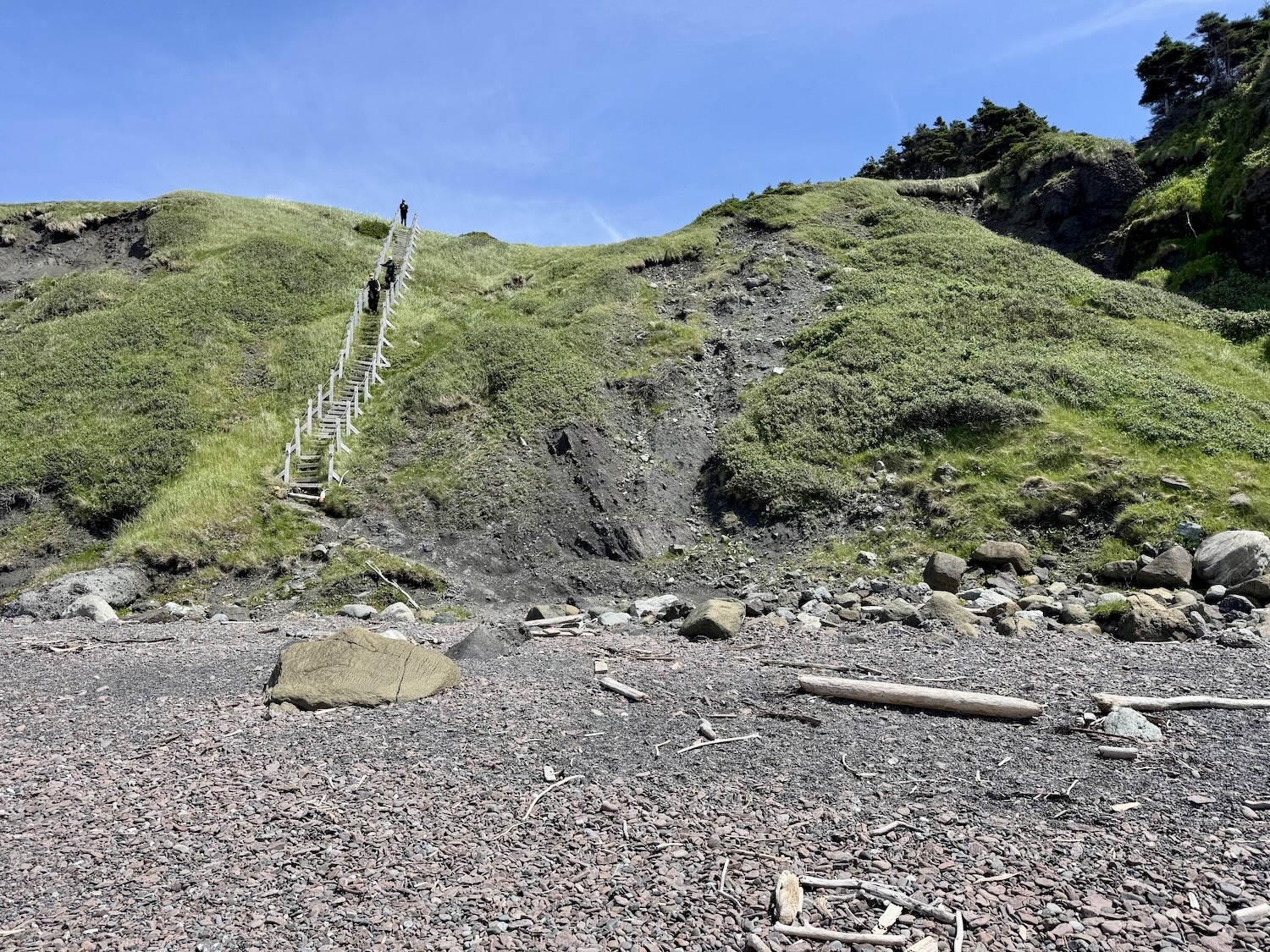
I almost psyched myself out of doing one of the most diverse hikes in Gros Morne National Park because I was worried about the climb between its coastal headland and ocean beach — and the seemingly daunting uphill return. That climb turned out to be an easy 86 steps. The return was a mostly pleasurable zigzag through the forest.
Now I get why people love this half-day hike in western Newfoundland and Labrador that provides a taste of serpentine barrens and boreal forest before giving way to a spectacular coastline of green meadows, cliffs, sea stacks and sea caves.
The nuts and bolts:

Distance: 9.5 km return (5.9 miles).
Terrain: Gently rolling with steep sections.
Elevation gain: 305 metres (1,000 feet) or 415 m (1,362 feet) depending on which Parks Canada sign you believe.
Time: 3 to 4 hours.
Trail rating: Moderate.
The trailhead: The Green Gardens parking lot, with an outhouse, is along Route 431 between Woody Point and Trout River in the south end of the park.
The serpentine barrens:

You’ll start out crossing the serpentine barrens of the Tablelands and walking on an exposed portion of the Earth’s mantle. Just like the nearby and perennially popular Tablelands Trail, this delighfully alien landscape is full of rust-colored peridotite and snakeskin-like serpentinite rocks that are normally found far below the Earth’s crust. The ancient volcanic rocks here help provide important geological evidence that contributes to Gros Morne’s UNESCO World Heritage Site designation for its illustration of plate tectonics.
The boreal forest:

After about 20 mostly flat minutes on the barrens, you’ll start descending into a boreal forest valley through a series of switchbacks, stepping over small creeks and crossing one short bridge. Closer to the coast, look for wind-swept, stunted evergreens that the locals call tuckamore. This is a great place for birding — woodpeckers and warblers the day I hiked — and admiring wildflowers and carnivorous pitcher plants. Picnic tables and a pit toilet are hidden in the forest, along with primitive campsites you must have a permit to use. Once you spot a distant waterfall in the forest, you're steps from the coast.
Old Man Cove:

Don’t let the lure of sea stacks, coves and beaches along the fertile volcanic sea coast draw you too close to the edge. As you finally leave the forest and arrive at a lush cliff-top meadow, a Green Gardens welcome sign suggests you take the stairs down to the Old Man Cove beach or keep walking to Steve’s Cove.
“Strange, bulbous, black rock make the headland to the right of the stairs to the beach,” the sign explains. “These are pillow basalts and were extruded underwater by a submarine volcano 550 million years ago as a new (but long gone) ocean was being birthed. Pillow basalts still form today undersea in places like the Red Sea and Hawaii.”
I didn’t spend much time exploring the shoreline on my own, but apparently if you walk south for 10 minutes to a brook you can scramble upstream to a series of small waterfalls. At low tide, you can walk north around the headland to a sea cave. Beware of slippery rocks, rocks falling from cliffs and rising tides.
Steve’s Cove:
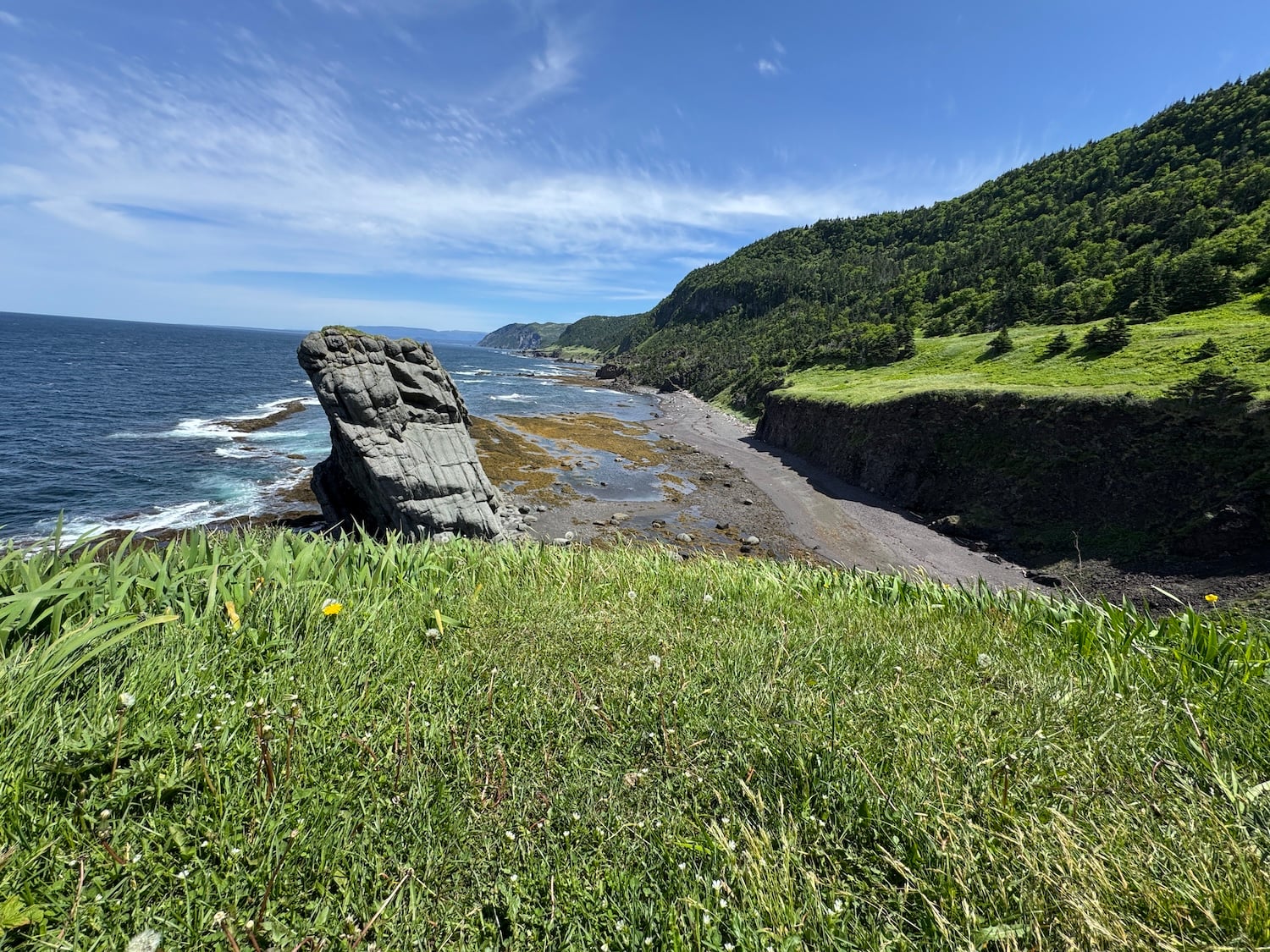
Don’t stop yet. Follow an extra bit of trail north along the headlands and through coastal meadows for 10 final minutes to Steve's Cove. Standing on windswept cliffs, you’ll get to ogle sea stacks and the park’s southern coastline. This is the official end of the trail since a section to Wallace Brook closed in 2017 because erosion made it dangerous.
The return:
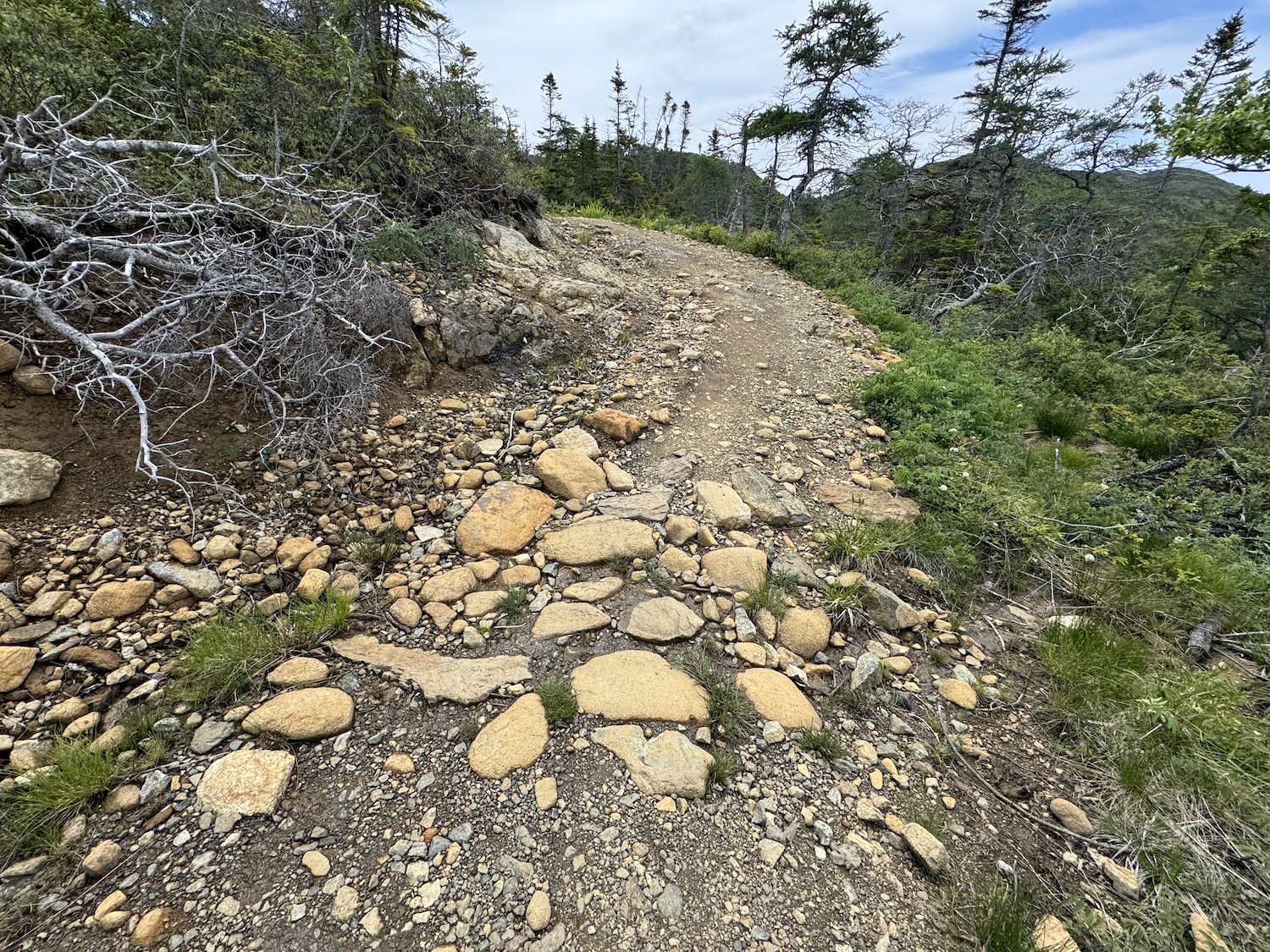
Do you have enough daylight to get back to the parking lot? Parks Canada signs will remind you that it’s a two-hour walk back from the shore (I'm not a particularly fast hiker but did it in 80 minutes). Since this is an out-and-back trail, you’ll have to return the way you came, going uphill most of the way. I’ll admit the last half hour of switchbacks was a tad tedious, but all was forgiven once I left the forest behind, crested a hill and caught sight of those rusty orange barrens (and the parking lot) once more.
By the way, some hikers delight in spotting grazing sheep in the meadows along this trail. All I saw was a few tufts of wool snagged in low-lying trees, but I sidestepped plenty of dung.

Stories about:
Story Categories:
A copy of National Parks Traveler's financial statements may be obtained by sending a stamped, self-addressed envelope to: National Parks Traveler, P.O. Box 980452, Park City, Utah 84098. National Parks Traveler was formed in the state of Utah for the purpose of informing and educating about national parks and protected areas.
Residents of the following states may obtain a copy of our financial and additional information as stated below:
- Florida: A COPY OF THE OFFICIAL REGISTRATION AND FINANCIAL INFORMATION FOR NATIONAL PARKS TRAVELER, (REGISTRATION NO. CH 51659), MAY BE OBTAINED FROM THE DIVISION OF CONSUMER SERVICES BY CALLING 800-435-7352 OR VISITING THEIR WEBSITE. REGISTRATION DOES NOT IMPLY ENDORSEMENT, APPROVAL, OR RECOMMENDATION BY THE STATE.
- Georgia: A full and fair description of the programs and financial statement summary of National Parks Traveler is available upon request at the office and phone number indicated above.
- Maryland: Documents and information submitted under the Maryland Solicitations Act are also available, for the cost of postage and copies, from the Secretary of State, State House, Annapolis, MD 21401 (410-974-5534).
- North Carolina: Financial information about this organization and a copy of its license are available from the State Solicitation Licensing Branch at 888-830-4989 or 919-807-2214. The license is not an endorsement by the State.
- Pennsylvania: The official registration and financial information of National Parks Traveler may be obtained from the Pennsylvania Department of State by calling 800-732-0999. Registration does not imply endorsement.
- Virginia: Financial statements are available from the Virginia Department of Agriculture and Consumer Services, 102 Governor Street, Richmond, Virginia 23219.
- Washington: National Parks Traveler is registered with Washington State’s Charities Program as required by law and additional information is available by calling 800-332-4483 or visiting www.sos.wa.gov/charities, or on file at Charities Division, Office of the Secretary of State, State of Washington, Olympia, WA 98504.
INN Member

The easiest way to explore RV-friendly National Park campgrounds.

Here’s the definitive guide to National Park System campgrounds where RVers can park their rigs.
Our app is packed with RVing- specific details on more than 250 campgrounds in more than 70 national parks.
You’ll also find stories about RVing in the parks, tips helpful if you’ve just recently become an RVer, and useful planning suggestions.

