
Editor's note: Yellowstone Caldera Chronicles is a weekly column written by scientists and collaborators of the Yellowstone Volcano Observatory. This week's contribution is from Jefferson Hungerford, Park Geologist, and Kiernan Folz-Donahue, Field Geologist, both with Yellowstone National Park.
Geologically speaking, things are always changing at Yellowstone—especially in the hydrothermal areas. It’s simply the nature of the complex hydrothermal system that overlies one of the planet’s largest magma reservoirs.
The summer of 2024 was a busy time, with July’s hydrothermal explosion at Biscuit Basin and the first hydrothermal explosion ever recorded by geophysical monitoring data in Norris Geyser Basin. In addition to these higher energy events, a new hydrothermal feature popped up right in front of our eyes—literally!
While driving south from Mammoth Hot Springs towards Norris Geyser Basin early on August 5 last summer, a park scientist noticed a billowing steam column through the trees and across a marshy expanse. The eagle-eyed scientist notified the park geology team to verify if this was indeed new activity.
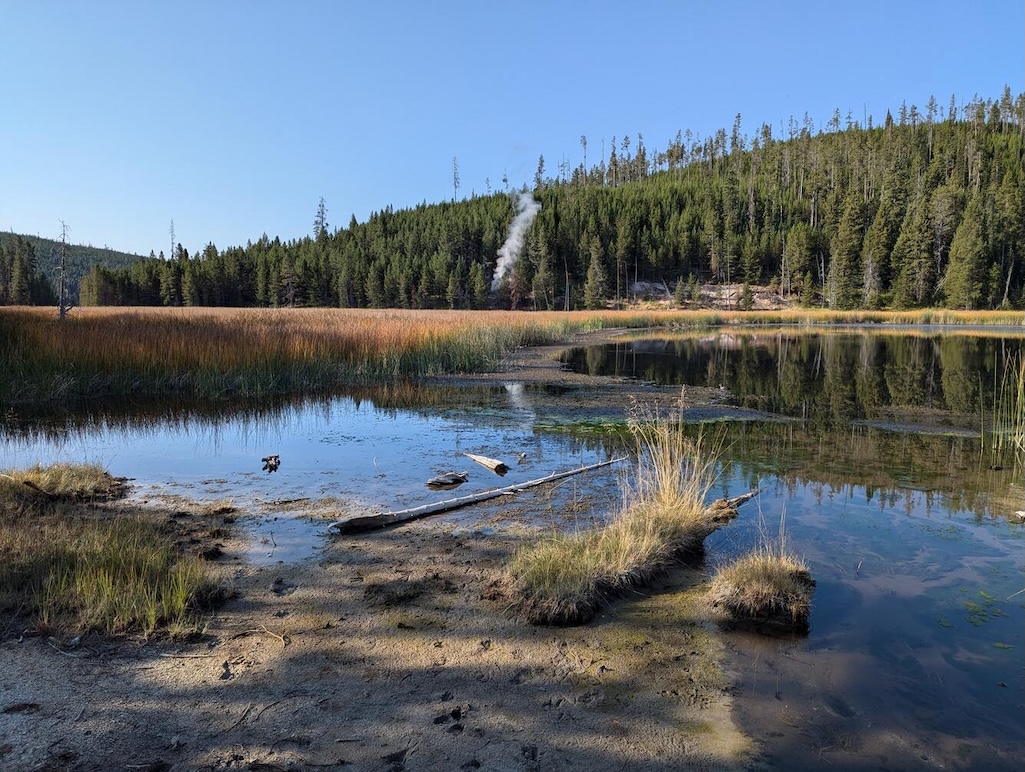
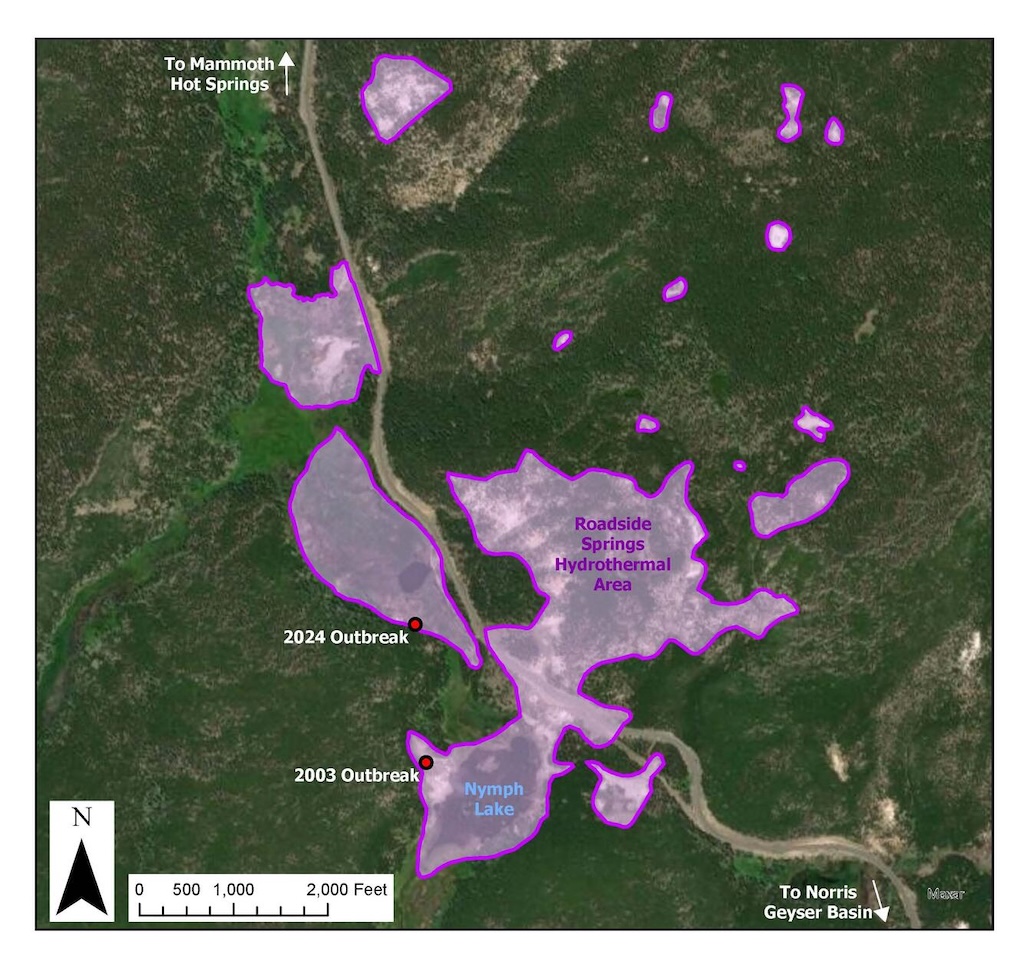
This new hydrothermal feature is within a region called the Roadside Springs thermal area, which is a collection of spatially distinct areas of altered rock and hydrothermal features (data for Yellowstone thermal areas is at https://data.usgs.gov/datacatalog/data/USGS:661d5eb7d34e7eb9eb7e3a41). This new feature is at the foot of a rhyolite lava flow about 3 meters above the marsh below, and it lies within a swath of warm, hydrothermally altered ground that is approximately 60 meters (about 200 feet) long.
Soon after it was identified, park geologists trudged through the marshy ground to get a closer look that the feature, which had a temperature of 77 °C (171 °F). A very thin veneer of grey silicious clay barely covered the surrounding surface, indicating its very young nature.
Although this hydrothermal activity may seem new to us, it may also just be just the latest manifestation of activity a short distance away that kicked into existence more than two decades ago. On March 10, 2003, a similar type of hydrothermal activity was first observed on the other side of the same rhyolite lava flow where the new feature is located, just west of Nymph Lake. This hydrothermal activity persists through this day but is much less energetic than when it first formed.
Are the new feature and the activity that started in 2003 hydrologically connected? Probably. One could run a line along the axis of the older active area and it would intersect the new feature. This line also follows the trend of faults that run from Norris Geyser Basin northward to Mammoth Hot Springs and beyond.
The new feature remained prominent into the fall of 2024, with a strong steam plume that was especially visible during chilly mornings. But as fall began to turn into winter, the steam plume gradually disappeared. The feature remains active, but there is some water in the vent, decreasing the amount of steam that is released. Whether or not the strong plume returns in the summer of 2025 remains to be seen.
Geologists have mapped more than 100 major hydrothermal areas in Yellowstone National Park, and there are many more than 10,000 hydrothermal features within its boundaries. The activity from these features waxes and wanes with time—you might even say that some of them pick up steam! Sorry…we couldn’t resist.
Stories about:
Story Categories:
A copy of National Parks Traveler's financial statements may be obtained by sending a stamped, self-addressed envelope to: National Parks Traveler, P.O. Box 980452, Park City, Utah 84098. National Parks Traveler was formed in the state of Utah for the purpose of informing and educating about national parks and protected areas.
Residents of the following states may obtain a copy of our financial and additional information as stated below:
- Florida: A COPY OF THE OFFICIAL REGISTRATION AND FINANCIAL INFORMATION FOR NATIONAL PARKS TRAVELER, (REGISTRATION NO. CH 51659), MAY BE OBTAINED FROM THE DIVISION OF CONSUMER SERVICES BY CALLING 800-435-7352 OR VISITING THEIR WEBSITE. REGISTRATION DOES NOT IMPLY ENDORSEMENT, APPROVAL, OR RECOMMENDATION BY THE STATE.
- Georgia: A full and fair description of the programs and financial statement summary of National Parks Traveler is available upon request at the office and phone number indicated above.
- Maryland: Documents and information submitted under the Maryland Solicitations Act are also available, for the cost of postage and copies, from the Secretary of State, State House, Annapolis, MD 21401 (410-974-5534).
- North Carolina: Financial information about this organization and a copy of its license are available from the State Solicitation Licensing Branch at 888-830-4989 or 919-807-2214. The license is not an endorsement by the State.
- Pennsylvania: The official registration and financial information of National Parks Traveler may be obtained from the Pennsylvania Department of State by calling 800-732-0999. Registration does not imply endorsement.
- Virginia: Financial statements are available from the Virginia Department of Agriculture and Consumer Services, 102 Governor Street, Richmond, Virginia 23219.
- Washington: National Parks Traveler is registered with Washington State’s Charities Program as required by law and additional information is available by calling 800-332-4483 or visiting www.sos.wa.gov/charities, or on file at Charities Division, Office of the Secretary of State, State of Washington, Olympia, WA 98504.
INN Member

The easiest way to explore RV-friendly National Park campgrounds.

Here’s the definitive guide to National Park System campgrounds where RVers can park their rigs.
Our app is packed with RVing- specific details on more than 250 campgrounds in more than 70 national parks.
You’ll also find stories about RVing in the parks, tips helpful if you’ve just recently become an RVer, and useful planning suggestions.

