
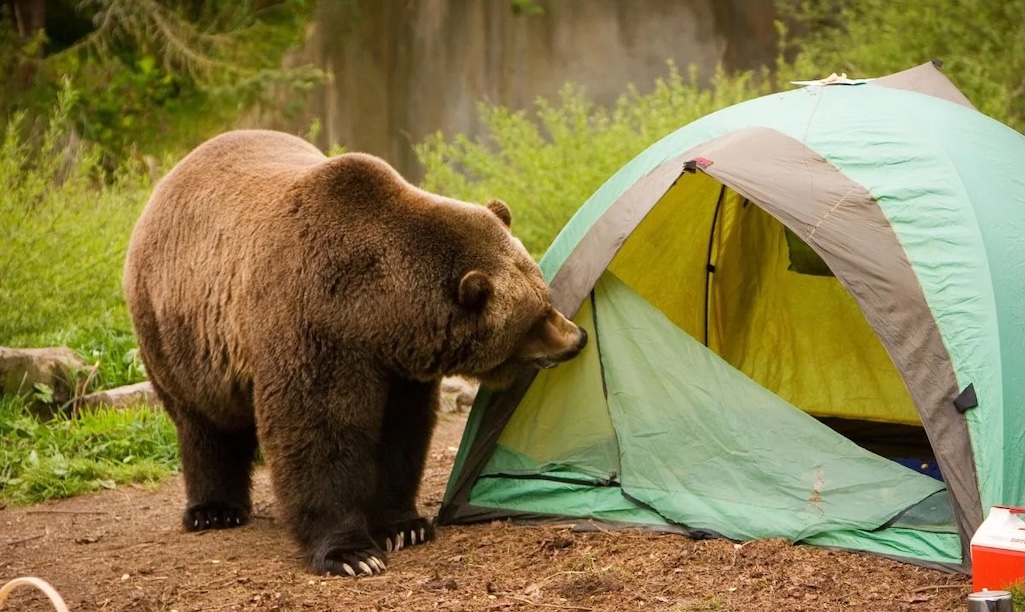
Bears across Wyoming's Teton County are becoming active with the spring transition. Adult male grizzly bears begin emerging from their winter dens in March, while females with young generally emerge between April and early May. March 19 marked the first confirmed grizzly bear sighting of the 2025 season in Grand Teton National Park. Bear Wise Jackson Hole reminds residents and visitors to secure attractants of any kind and be bear aware.
Seeing a bear in its natural habitat is an awe-inspiring experience. However, living and recreating in bear country requires awareness and actions to keep bears wild and people safe. As the grizzly bear population expanded within the Greater Yellowstone Ecosystem, bears dispersed across their historical range but also in proximity to more populated areas. All of Teton County is now in occupied grizzly bear habitat.
Last year was a challenging year for the human-bear interface in Jackson Hole, Wyoming. Wyoming Game and Fish Department and U.S. Fish and Wildlife staff responded to at least 168 human-bear conflicts in Teton County and the Town of Jackson, which is twice the long-term average.
Grand Teton National Park experienced a surge of incidents involving black bears, particularly around lakeshore areas, resulting in an above-average year of management actions. Similarly, the Bridger-Teton National Forest saw an increase in black bear activity around the Teton Pass trail system outside of Wilson. Wyoming Game and Fish Department and National Park Service staff lethally removed nine bears in this corner of the Greater Yellowstone Ecosystem last year, in addition to conducting numerous relocations and intensive hazing operations. Unsecured garbage in residential areas and unattended backpacks in the park remain the overwhelming cause of these conflicts.
Bears can be attracted to anything associated with human or domestic animal foods, including coolers, cooking equipment, bird feeders, and pet dishes when they are easily accessible. By properly storing these attractants, people can help to ensure that a bear does not obtain a food reward. Once a bear becomes conditioned to human foods, the bear is likely to exhibit increasingly bold behavior, which increases risks to the bear and humans and limits management options. Whether you have lived in Teton County for decades or are visiting for a day, please do your part to help prevent human-bear conflicts.
If you are visiting public lands, such as a national park or national forest:
- Never leave your food unattended unless it is properly secured.
- Keep a clean camp and adhere to all food storage orders. Store all attractants, including coolers, cooking gear, pet food, and toiletries, inside a bear-resistant food locker (i.e. bear box) or a hard-sided vehicle with the windows rolled up.
- Properly store garbage until you can deposit it into a bear-resistant dumpster.
- Do not eat or cook in your tent, and never keep food or other scented items in your tent.
- Please respect all wildlife closure areas.
- If you see a bear, give it space. Always stay at least 100 yards away. If you choose to watch the bear, use a spotting scope, binoculars, or telephoto lens to maintain an appropriate distance. Park in designated areas, and never block travel lanes. Follow the directions of staff in places where bears are sighted.
If you are exploring the backcountry:
- Be alert and aware of your surroundings. Avoid wearing earbuds.
- Make noise, especially in areas with limited visibility or when sound is muffled (e.g., near streams or when it is windy).
- Carry bear spray, know how to use it, and keep it readily accessible.
- Hike in groups of three or more people.
- Do not run. Back away slowly if you encounter a bear.
As interagency partners, Bear Wise Jackson Hole will continue its collective efforts to proactively prevent conflicts between bears and people across Teton County. Bear Wise Jackson Hole is a partnership between the Wyoming Game & Fish Department, Grand Teton National Park, Bridger-Teton National Forest, Jackson Hole Wildlife Foundation, U.S. Fish and Wildlife Service, Teton County, and Town of Jackson. Established in 2006, its mission is to ‘keep bears wild and people safe’ by minimizing bears’ access to unnatural attractants and educating residents and visitors about human-bear conflict prevention.
Stories about:
Story Categories:
A copy of National Parks Traveler's financial statements may be obtained by sending a stamped, self-addressed envelope to: National Parks Traveler, P.O. Box 980452, Park City, Utah 84098. National Parks Traveler was formed in the state of Utah for the purpose of informing and educating about national parks and protected areas.
Residents of the following states may obtain a copy of our financial and additional information as stated below:
- Florida: A COPY OF THE OFFICIAL REGISTRATION AND FINANCIAL INFORMATION FOR NATIONAL PARKS TRAVELER, (REGISTRATION NO. CH 51659), MAY BE OBTAINED FROM THE DIVISION OF CONSUMER SERVICES BY CALLING 800-435-7352 OR VISITING THEIR WEBSITE. REGISTRATION DOES NOT IMPLY ENDORSEMENT, APPROVAL, OR RECOMMENDATION BY THE STATE.
- Georgia: A full and fair description of the programs and financial statement summary of National Parks Traveler is available upon request at the office and phone number indicated above.
- Maryland: Documents and information submitted under the Maryland Solicitations Act are also available, for the cost of postage and copies, from the Secretary of State, State House, Annapolis, MD 21401 (410-974-5534).
- North Carolina: Financial information about this organization and a copy of its license are available from the State Solicitation Licensing Branch at 888-830-4989 or 919-807-2214. The license is not an endorsement by the State.
- Pennsylvania: The official registration and financial information of National Parks Traveler may be obtained from the Pennsylvania Department of State by calling 800-732-0999. Registration does not imply endorsement.
- Virginia: Financial statements are available from the Virginia Department of Agriculture and Consumer Services, 102 Governor Street, Richmond, Virginia 23219.
- Washington: National Parks Traveler is registered with Washington State’s Charities Program as required by law and additional information is available by calling 800-332-4483 or visiting www.sos.wa.gov/charities, or on file at Charities Division, Office of the Secretary of State, State of Washington, Olympia, WA 98504.
INN Member

The easiest way to explore RV-friendly National Park campgrounds.

Here’s the definitive guide to National Park System campgrounds where RVers can park their rigs.
Our app is packed with RVing- specific details on more than 250 campgrounds in more than 70 national parks.
You’ll also find stories about RVing in the parks, tips helpful if you’ve just recently become an RVer, and useful planning suggestions.

