
Editor's note: Yellowstone Caldera Chronicles is a weekly column written by scientists and collaborators of the Yellowstone Volcano Observatory. This week's contribution is from Michael Poland, geophysicist with the U.S. Geological Survey and Scientist-in-Charge of the Yellowstone Volcano Observatory, and Jake Lowenstern, Director of the USGS Volcano Disaster Assistance Program and former Scientist-in-Charge of the Yellowstone Volcano Observatory.
To mark the demise of the webcam that provided views of Yellowstone Lake since 2017, let’s take a look back the history of YVO webcams in Yellowstone National Park.
For over 20 years, webcams have provided critical volcano monitoring data around the world. In the USA, webcams are used extensively to track eruptive activity at places like Kīlauea, Hawaiʻi, and a webcam view of Mount St. Helens tracked the growth of a lava dome there during 2004–2008.
Webcams are also used in Yellowstone National Park. A quick scan of the park’s webcam page lists nine cameras operated by the National Park Service and its partners as of late 2024. In addition, the Yellowstone Volcano Observatory operates a single camera, which has a view of Yellowstone Lake from a cell tower between Lake Village and Fishing Bridge.
In October, the YVO lake camera failed, and it unfortunately cannot be revived. To mark this occasion, let’s have a look at the long history of YVO webcams, which have provided images from multiple locations around Yellowstone National Park.

The motivation for a YVO webcam was an earthquake swarm that occurred over an 11-day span in December 2008–January 2009 in the north park of Yellowstone Lake. The swarm had over 800 located earthquakes, with 111 events greater than M2 and the largest reaching M4.1. The intensity of the swarm attracted a significant amount of attention from the public, and it occurred at the dawn of social media (mostly blogs at that time). YVO scientists found it difficult to keep up with both the science of the event and the onslaught of public interest. It was clear that people were concerned by earthquakes happening under a lake (even though earthquake swarms in that area are not particularly unusual), and misinformation started to spread about explosions and underwater eruptions.
Given the timing of the swarm in the dead of winter, only a handful of park staff were stationed at Lake, and observations were limited. Based in part on the public buzz, the park actually considered (but did not implement) moving those employees until the earthquake swarm had passed.
YVO scientists realized that a camera with a view of Yellowstone Lake would be a powerful way to detect any anomalous activity and to show people that the lake was calm. The only webcams in Yellowstone National Park at that time were at Mount Washburn and Old Faithful, nowhere near Yellowstone Lake. Using funding provided by the American Reinvestment and Recovery Act and a permit granted by Yellowstone National Park, YVO was able to purchase a mobile, solar-powered webcam system and in 2010 installed it on top of Lake Butte, near an existing seismic station where there was a strong cellular signal to provide a telemetry link.
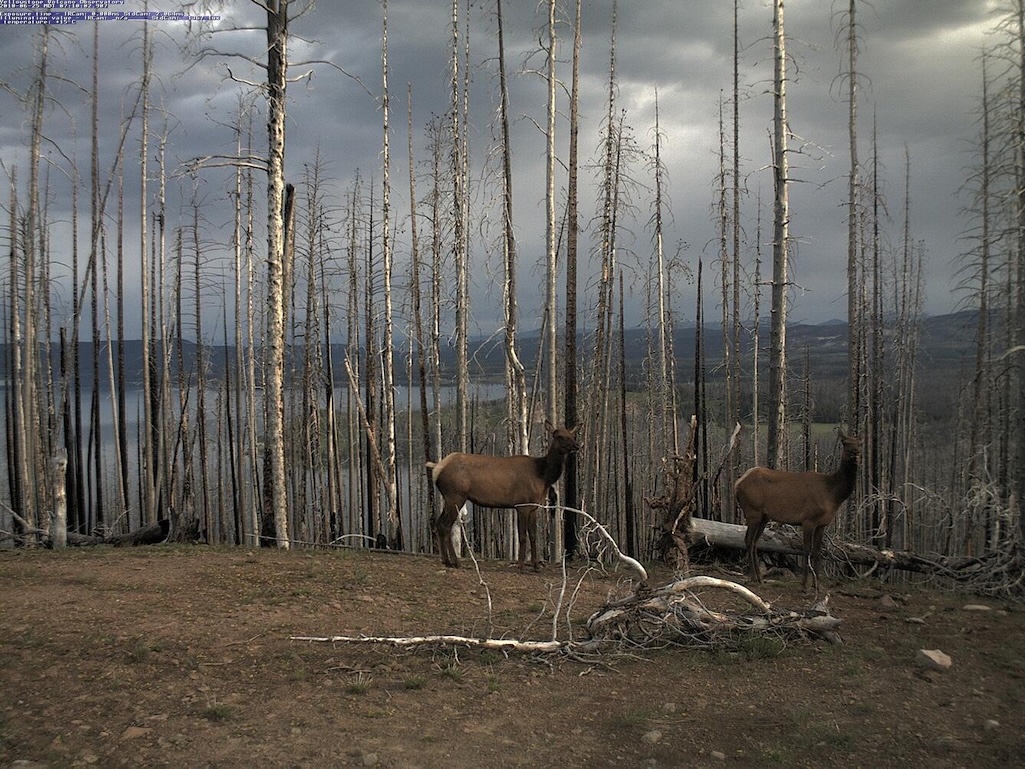
The camera remained in that location for two years, imaging the north part of Yellowstone Lake through a screen of burned trees. The camera often caught wildlife passing by—for example, bears, elk, and even an ermine running across the snow-covered landscape!
In 2012, the camera was moved to a hill east of Biscuit Basin. The goal of that deployment was to detect hydrothermal activity in that area, like the explosion that occurred in July 2024. The view was poor, however, being mostly obstructed by pine trees, and nothing noteworthy was ever observed.
In 2017, the mobile camera was retired and put into storage, and a new camera was purchased and installed on a cell tower overlooking the north part of Yellowstone Lake. The location provided an unobstructed view of the lake and howit changed over time, for example, with ice forming in winter and melting in the summer. Although the camera never detected any geological changes, it was helpful for monitoring other activity—for example, the Brimstone Fire, which burned 217 acres along the southeast part of the lake during August–September 2019 (the largest wildfire in Yellowstone National Park that year).
Although unfortunate, the recent demise of the YVO webcam after 7 years of continuous operation in various parts of Yellowstone National Park provides an opportunity for considering where YVO might position a new camera in the future. Technology has advanced considerably since the camera was initially installed in 2010, opening a new world of possibilities for webcam deployments!
Stories about:
Story Categories:
A copy of National Parks Traveler's financial statements may be obtained by sending a stamped, self-addressed envelope to: National Parks Traveler, P.O. Box 980452, Park City, Utah 84098. National Parks Traveler was formed in the state of Utah for the purpose of informing and educating about national parks and protected areas.
Residents of the following states may obtain a copy of our financial and additional information as stated below:
- Florida: A COPY OF THE OFFICIAL REGISTRATION AND FINANCIAL INFORMATION FOR NATIONAL PARKS TRAVELER, (REGISTRATION NO. CH 51659), MAY BE OBTAINED FROM THE DIVISION OF CONSUMER SERVICES BY CALLING 800-435-7352 OR VISITING THEIR WEBSITE. REGISTRATION DOES NOT IMPLY ENDORSEMENT, APPROVAL, OR RECOMMENDATION BY THE STATE.
- Georgia: A full and fair description of the programs and financial statement summary of National Parks Traveler is available upon request at the office and phone number indicated above.
- Maryland: Documents and information submitted under the Maryland Solicitations Act are also available, for the cost of postage and copies, from the Secretary of State, State House, Annapolis, MD 21401 (410-974-5534).
- North Carolina: Financial information about this organization and a copy of its license are available from the State Solicitation Licensing Branch at 888-830-4989 or 919-807-2214. The license is not an endorsement by the State.
- Pennsylvania: The official registration and financial information of National Parks Traveler may be obtained from the Pennsylvania Department of State by calling 800-732-0999. Registration does not imply endorsement.
- Virginia: Financial statements are available from the Virginia Department of Agriculture and Consumer Services, 102 Governor Street, Richmond, Virginia 23219.
- Washington: National Parks Traveler is registered with Washington State’s Charities Program as required by law and additional information is available by calling 800-332-4483 or visiting www.sos.wa.gov/charities, or on file at Charities Division, Office of the Secretary of State, State of Washington, Olympia, WA 98504.
INN Member

The easiest way to explore RV-friendly National Park campgrounds.

Here’s the definitive guide to National Park System campgrounds where RVers can park their rigs.
Our app is packed with RVing- specific details on more than 250 campgrounds in more than 70 national parks.
You’ll also find stories about RVing in the parks, tips helpful if you’ve just recently become an RVer, and useful planning suggestions.

