
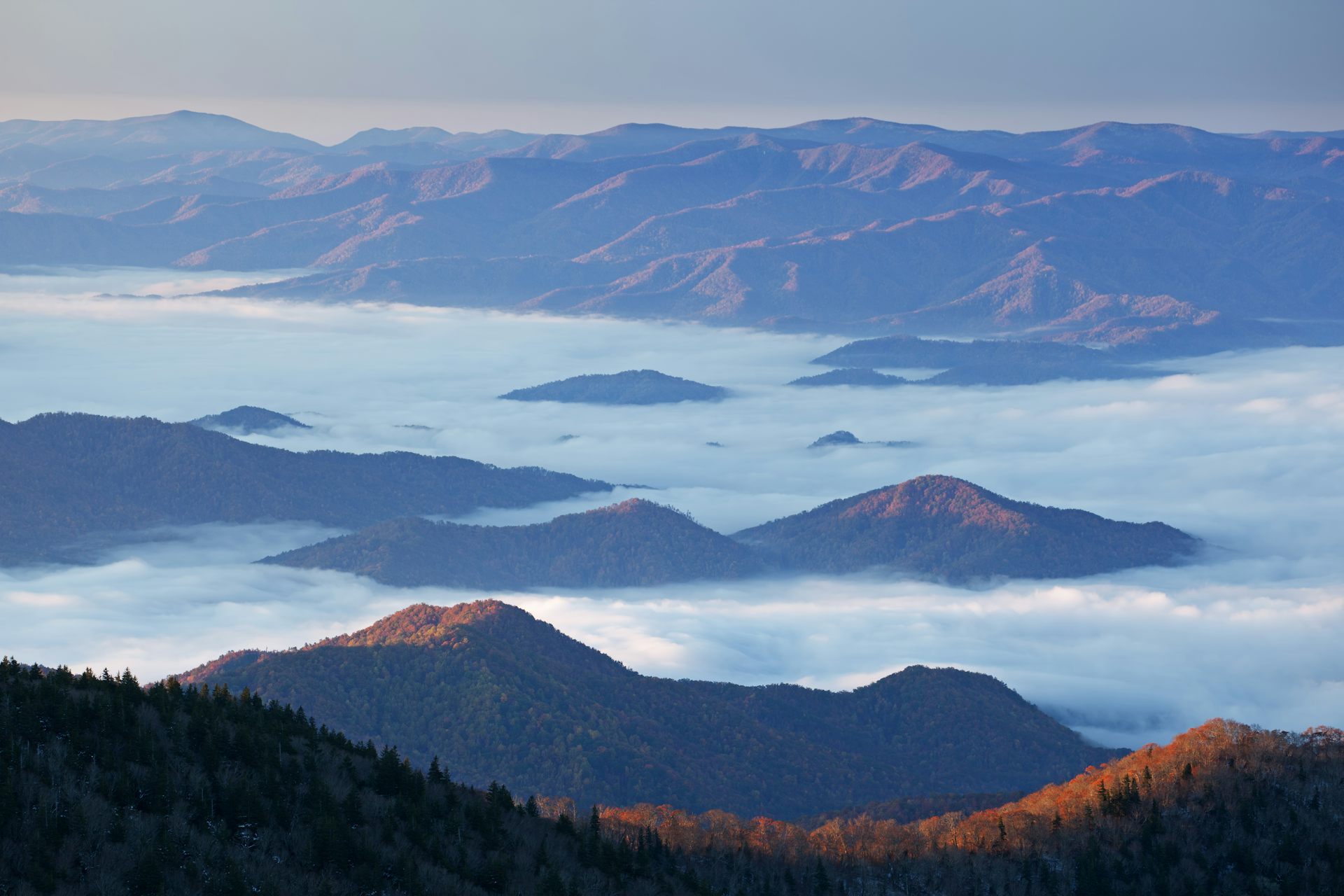
View from the overlook on Kuwohi of the mountain peaks and ridges of Great Smoky Mountains National Park.
Getty Images
By Seth T. Kannarr, University of Tennessee and , University of Tennessee
It’s not every day that the name of a mountain is restored to the one used by Indigenous peoples for centuries.
But after nearly two years of trying, the Eastern Band of Cherokee Indians finally convinced the U.S. Board on Geographic Names on Sept. 18, 2024, to formally agree to rename the highest point in the Great Smoky Mountains National Park of Tennessee to Kuwohi (koo-whoa-hee).
The mountain, known as “Clingmans Dome” since 1859, has been a sacred place for the Cherokee people, serving as a place of prayer, reflection and gathering of mulberries for medicine. In fact, the name Kuwohi translates to “the mulberry place” in Tsalagi, the Cherokee language.
Though known as Kuwohi by the Cherokee people for hundreds of years, explorer Arnold Guyot effectively ignored that history after he surveyed the mountain range in 1859. Guyot named the peak “Clingmans Dome” after his friend Thomas Lanier Clingman, a North Carolina U.S. senator and a Confederate brigadier general during the Civil War. Clingman never set foot on this mountain, but his name remained there for 165 years until now.
What is place name repatriation?
The government’s renaming of the mountain to Kuwohi is a significant example of place name repatriation, or the return of an original, Indigenous name to a particular place or landscape.
Sometimes the primary motivation for place renaming is to remove an offensive or irrelevant place name from the landscape, such as the renaming of Squaw Peak in Arizona to Piostewa Peak in 2008.
In other cases, such as the renaming of Mount McKinley in Alaska to Denali in 2016, the motivation was to create a more authentic and historically accurate name for a particular place.
In the case of Kuwohi, the return to its original name was a mixture of both. The government’s decision recognized the original Indigenous name and removed the name of a white man who defended the enslavement of African people. It is also about restoring a larger sense of respect and recognition of Indigenous identity across the landscape.
Just as important is the fact that it was individuals from the Eastern Band of Cherokee Indians who put forward this proposal and remained the lead throughout the process.
Place naming is only truly reparative if these processes truly reflect the agency and intent of these historically oppressed groups. Otherwise, it contributes to the long history of dismissing Indigenous claims to land and culture by not involving them.

View of observation tower on Kuwohi in Great Smoky Mountains National Park.
Joshua Moore/Getty Images
Why does place naming matter?
A name is one of the most fundamental ways to identify and give meaning to places. In other words, the name of the place makes a big difference in how people perceive it.
There is growing public recognition that place names can transmit harmful messages that misrepresent the history and identity of minority communities. Place names also can demonstrate how those in power have used them to disrespect and misrepresent ethnic and racial groups that have been historically discriminated against.
For those groups, the U.S. Department of the Interior’s Advisory Committee on Reconciliation in Place Names found in 2022 that derogatory place names are a source of recurring trauma.
If place naming did not matter, disputes over name changes would not occur. Some critics find place renaming to be an example of unnecessary political correctness, while others see it as a meaningful solution that will leave a lasting positive impact.
The elimination of names of Confederate generals from some U.S. military bases provides another example. Former President Donald Trump has pledged to restore the name “Fort Bragg” to the North Carolina Army base that’s known today as Fort Liberty if reelected. Originally named after Braxton Bragg, a slave-owning Confederate general, the fort was one of nine U.S. installations that the Defense Department ordered in 2023 to have their names changed to among 3,700 recommendations.
Trump’s stance exemplifies the wave of backlash that has occurred against local and state school officials across the country that have removed the names of Confederate generals and others from public buildings.

Lavita Hill (L) and Mary Crowe in 2022.
Cherokee One Feather
Despite such backlash, efforts by Indigenous people and civil rights advocates slowly move forward and are seen across the U.S. in places like streets, neighborhoods, college campuses and beyond.
For Lavita Hill and Mary Crowe, the two members of the Eastern Band of Cherokee Indians who took the lead on submitting the proposal, the renaming of Kuwohi was a moment of success. Their campaign was heavily inspired by the renaming of Mount Doane to First Peoples Mountain in Yellowstone National Park in 2022.
Crowe told reporters that she saw friends and relatives shed tears when they learned of the name change. “It was humbling,” she said. “It was beautiful.”
What comes next?
The success of the effort to restore the name Kuwohi may help other communities in their ongoing place renaming efforts.
One such proposal involves a 100-year-old fight to rename Mount Rainier in Washington state to “Tacoma,” the original name given to it by the Salish people of the Pacific Northwest.

View of the Great Smoky Mountains at sunset from Kuwohi.
Wolfgang Kaehler/LightRocket/Getty Images
This movement began in 1924 among the Salish and other groups because its namesake, Peter Rainier, was a British naval officer who was known as being “anti-American.”
Another example is a push by 20 different Indigenous tribes, including the Lakota Nation and the Oglala Sioux Tribe, to rename Devils Tower in Wyoming to Bear Lodge. The current name of this butte resulted from a poor English translation of the original Indigenous name of “bear lodge” to “bad god’s tower.” Over time, the name was simplified to “Devils Tower.”
As geographers who have studied the significance of place renaming, we have learned that it is important to engage the folks that these movements will benefit most in all conversations and decisions.
What is at stake is not just removing insulting names, but also ensuring that the process of changing place names is collaborative of all Americans, especially historically oppressed communities, to truly be restorative and meaningful for society.

Seth T. Kannarr, PhD Student in Geography, University of Tennessee and Derek H. Alderman, Chancellor's Professor of Geography, University of Tennessee
This article is republished from The Conversation under a Creative Commons license. Read the original article.





Comments
So. we're suppose to ignore the fact that many, if not most, Eastern Band Cherokees fought WITH or otherwise supported the Confederacy? Shall we alo consuider how the Five Civilized tribes supported the Confederacy?
Is this author aware of Stand Watie, a Cherokee and the last Confederate general to have surrendered?
Does place naming matter?
No. It changes nothing. History is history, and ones feelings cannot and will not change that.
Let's be better.
Enough.