
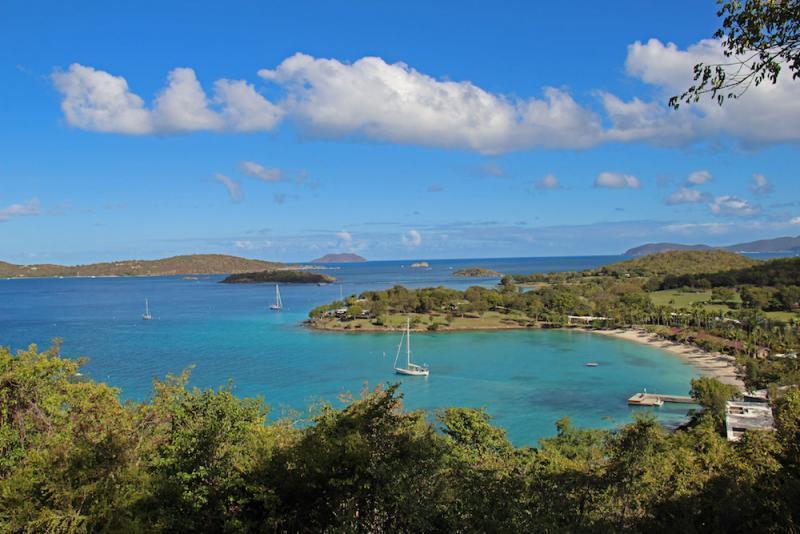
A legal action has been commenced to determine the extent and necessary cleanup of hazardous materials at Caneel Bay Resort in Virgin Islands National Park/Carolyn Sugg via Flickr
A 12-page filing tied to one of the nation's strongest environmental laws could succeed where the National Park Service so far has failed in trying to determine the extent of environmental contamination at the Caneel Bay Resort on the shores of Virgin Islands National Park and have it cleaned up.
David DiGiacomo, a Denver attorney who has a home on St. John in the U.S. Virgin Islands, last week sent a notice of intent to sue over environmental contamination at the once-idyllic resort to the U.S. Environmental Protection Agency, Interior Department, National Park Service, the governor of the U.S. Virgin Islands, and CBI Acquisitions, the firm that has operated the resort rent-free since 2004.
If the parties don't answer the filing within 90 days, DiGiacomo can follow with a lawsuit under the federal Comprehensive Environmental Response, Compensation, and Liability Act of 1980, also known as CERLCA, as well as the Resource Conservation and Recovery Act, in a bid to force them to investigate, and if needed mitigate, environmental contamination ranging from semivolatile organic compounds, arsenic, mercury, and hydrocarbons tied to fuel, to possibly asbestos and even DDT.
"My wife and I have been part of the community, invested in the community, since the day we got there," DiGiacomo said Wednesday during a phone call. "I got very concerned that this treasure (Caneel Bay), this remarkable piece of property, with a history going back perhaps 3,000 years, would have been so mistreated over the years by the various operators."
A 2014 environmental assessment of the property for the Park Service raised questions of contamination from SVOCs -- semivolatile organic compounds -- often related to pesticides, and arsenic, according to documents Traveler obtained through a Freedom of Information Act request.
"In addition, there are concerns for leachability of SVOCs, arsenic and mercury to groundwater," the consultant's report noted. The surveys also found concentrations of total petroleum hydrocarbons and diesel range organics above acceptable levels set by the Virgin Islands Department of Planning and Natural Resources.
While the assessment called for more extensive testing to determine the extent of these contaminants -- both across the ground surface and to determine depth of contamination -- Park Service records from 2017 indicated CBI refused to allow a contractor for the Park Service to access the grounds to perform further testing. Although Interior Department attorneys believe the Park Service has the right to go onto the property to do the requisite testing, the agency has continued to decline to say whether that access was ever granted.
The late Laurance S. Rockefeller built the resort after falling in love with St. John, and along with providing thousands of acres for creation of the national park he later signed an agreement with the Interior secretary in 1983 that called for the resort to be given to the Park Service in September 2023.
Since 2010 the Park Service has been in talks with CBI officials in an effort to craft a more typical concessions arrangement for the resort, but those talks so far apparently have been fruitless. Further complicating the situation were back-to-back hurricanes in September 2017, Irma and Maria, that devastated the resort and left it largely in shambles.
Since moving full-time to St. John about six years ago, DiGiacomo has gotten involved with various organizations on the island, including Friends of Virgin Islands National Park, where he's a member of the board. He's studied the preliminary environmental studies the Park Service was able to get done at Caneel Bay, and was frustrated that nothing was being done to clean up the wastes.
"The environmental reports tell us that there are a lot of areas of concern," said DiGiacomo, adding that he's heard that asbestos materials removed from lodging units might have been buried on the resort's grounds and that there was even DDT, a chemical insecticide with environmental impacts so troubling that it was banned from use in the United States in 1972, on the property.
"I talked to a former employee who said she actually witnessed barrels of DDT sitting out rusting below the catchment basin," he said. "In doing some further inquiries I found out that they bulldozed part or all of the (historic) slave quarters. And there may be actually remains of humans and archaeological remains. So, I think that it's wrong, that it's egregious, that a person entrusted with this remarkable site that actually I think should be a World Heritage site, would mistreat it this way.
"That's why I decided that I was going to give the notice and hopefully encourage the National Park Service, Department of Interior, EPA, to get busy to make sure that this is properly remediated," he said.
National Park Service staff did not immediate respond Wednesday to a request for reaction to the filing. A phone call to Gary Engle, the CEO of Stoneleigh Capital, a private equity concern based in Connecticut that has run Caneel Bay Resort, was not returned Wednesday.
DiGiacomo said he fears that DDT might have leaked from the barrels and flowed down to the Hawksnest shoreline.
"They haven't looked at this issue, the NEPA process; they started that sometime before the hurricanes. I don't believe that's ever been completed," he said. "The fact that the hurricanes may have in fact made this contamination issue much more signficant has never been addressed."
That the Park Service hasn't pushed harder on addressing the issues at Caneel Bay has been frustrating, said DiGiacomo.
"I've been doing a lot of the research on the Park Service regulations, from the director, including the CFRs (Code of Federal Regulations), and the statute. It is abundantly clear, absolutely clear to me, that the Park Service has a direction from Congress that they were supposed to be protecting this property," he said. "They've been negligent in ensuring that the operations at Caneel were done in accordance with all the environmental and archaeological requirements, whether it's the Antiquities Act or RCRA (Resource Conservation Recovery Act) or whatever."
Stories about:
Story Categories:
A copy of National Parks Traveler's financial statements may be obtained by sending a stamped, self-addressed envelope to: National Parks Traveler, P.O. Box 980452, Park City, Utah 84098. National Parks Traveler was formed in the state of Utah for the purpose of informing and educating about national parks and protected areas.
Residents of the following states may obtain a copy of our financial and additional information as stated below:
- Florida: A COPY OF THE OFFICIAL REGISTRATION AND FINANCIAL INFORMATION FOR NATIONAL PARKS TRAVELER, (REGISTRATION NO. CH 51659), MAY BE OBTAINED FROM THE DIVISION OF CONSUMER SERVICES BY CALLING 800-435-7352 OR VISITING THEIR WEBSITE. REGISTRATION DOES NOT IMPLY ENDORSEMENT, APPROVAL, OR RECOMMENDATION BY THE STATE.
- Georgia: A full and fair description of the programs and financial statement summary of National Parks Traveler is available upon request at the office and phone number indicated above.
- Maryland: Documents and information submitted under the Maryland Solicitations Act are also available, for the cost of postage and copies, from the Secretary of State, State House, Annapolis, MD 21401 (410-974-5534).
- North Carolina: Financial information about this organization and a copy of its license are available from the State Solicitation Licensing Branch at 888-830-4989 or 919-807-2214. The license is not an endorsement by the State.
- Pennsylvania: The official registration and financial information of National Parks Traveler may be obtained from the Pennsylvania Department of State by calling 800-732-0999. Registration does not imply endorsement.
- Virginia: Financial statements are available from the Virginia Department of Agriculture and Consumer Services, 102 Governor Street, Richmond, Virginia 23219.
- Washington: National Parks Traveler is registered with Washington State’s Charities Program as required by law and additional information is available by calling 800-332-4483 or visiting www.sos.wa.gov/charities, or on file at Charities Division, Office of the Secretary of State, State of Washington, Olympia, WA 98504.
INN Member

The easiest way to explore RV-friendly National Park campgrounds.

Here’s the definitive guide to National Park System campgrounds where RVers can park their rigs.
Our app is packed with RVing- specific details on more than 250 campgrounds in more than 70 national parks.
You’ll also find stories about RVing in the parks, tips helpful if you’ve just recently become an RVer, and useful planning suggestions.


Comments
does this mean if the contamination study shows that the site has been contaminated since the '70s or '80s , the Rockefeller estate or Rockresorts will be liable ?
DiGiacomo for President!
Good news! Thank you David Digiacamo for initiating this process. We need factual discovery to occur and real testing to understand the degree of contamination. And not to cow tow to the concessioner
I commend Mr. Di Giacomo's efforts in trying to clean and protect one of the Caribbean's jewels, St. John's north coast. I condemn CBI and the Department of the Interior and the Park Service for ignoring these red flags on pollution of such beautiful beaches and land.
Congratulations and thanks to Mr. Di Giacomo ... and to the Friends ... for getting the ball moving on this. Caneel Bay is a national treasure that warrants oversight and protection - things that has been lacking for too long.
Why is it that the Dept of Interior is allowing CBI to continuing operating at Caneel?
It's actually far worse than that, Gerard Londergan. As the article above states, decades before CBI ever arrived on the scene, the late Laurance S. Rockefeller built the resort at Caneel Bay, gave the federal government thousands of acres for creation of Virgin Islands National Park, and set the Caneel Bay resort aside under a retained use estate provision to enable it to continue operating, for the public and on the behalf of the NPS, until 2023, when full formal ownership of the property is supposed to be turned over to the NPS.
Knowing all of this, CBI assumed the twenty or so years remaining on this lucrative, rent-free, temporary use agreement in 2004. Under the terms of agreement, the facilities at Caneel Bay were supposed to be kept in operation, again for the public and on the behalf of the NPS, until 2023, when, again, full formal ownership of the property is supposed to be turned over to the NPS. CBI never acquired any ownership stake in the property; it only acquired temporary operating rights; but, given the usual lazy passivity of NPS contract oversight, if CBI had done anything close to a decent job, CBI would have surely been a contender to continue in the almost equally lucrative role of a standard concessionaire.
The trouble is CBI was greedy, cheap, and cavalier about the way in operated and, by 2014, the careless way it handled toxic chemicals and wastes, allowing them to spill into the soil and very probably the groundwater and bay; the lawless way it ignored historic preservation requirements, bulldozing ruins to cut costs for walkways and the installation of tennis courts; and the way it cut corners on building maintenance were all major issues.
CBI was admittedly trying to address some of those building maintenance issues as part of an expansion of operations when, in 2017 and in the aftermath of hurricanes that "devastated the resort and left it largely in shambles," it turned out that CBI had also cut corners on its insurance, buying two inadequate policies and then trying to get both of them to pay out the maximum for the same damage. It didn't work and the process of rebuilding the resort would have revealed the hazardous materials violations, the historic preservation violations, and the maintenance problems anyway. So, after collecting ~$34 million in insurance money and not really fully resolving what it still owed its workers (she's so fine, there's no telling where the money went), CBI told the Department of the Interior that it needed to indemnify CBI for all of its violations and then cough up the full $70 million required to rebuild the resort. CBI went on to threaten that, if the Department of the Interior didn't meet those demands, CBI would unilaterally declare the lucrative, rent-free, temporary use agreement that it had been operating under for nearly a decade to be null and void, assert itself as full owner of the property, and continue to block DOI, NPS, EPA, and Virgin Islands officials from entering the property to inspect any of the contamination or damage and it wouldn't leave.
You ask why the Department of the Interior is allowing CBI to continue operating at Caneel Bay. Well, CBI tecnically isn't being allowed to continue much of anything... because hardly anything is operating at Caneel Bay. But, you're also correct that everybody in our federal government seems to be just standing around waiting, scratching their heads and wondering why the Whitehouse cafeteria ran out of peach ice cream. Why is that? Well, especially during this administration, everybody in our federal government is marching in lockstep and taking their cues from the president and his henchmen. And, if they don't take their cues from the president and his henchmen, well, you could ask highly decorated combat veteran and former Lieutenant Colonel Alexander Vindman how that turns out.
You see; the guy who runs CBI is a fast talking real estate promoter who operates a confusing shell game of front companies and bounces assets from one to another in order to bewilder both those who might try to keep track of his twisted dealings and those who might want to untangle his taxes. The way the guy who runs CBI handled toxic chemicals and wastes at Caneel Bay, the way he couldn't be bothered with historic preservation requirements, the way his operations cut corners on building maintenance, and the way what he still owes his workers has really never been fully resolved all point to the fact that he really doesn't pay much attention to what might be legal and what might not. He does what he wants and what is good for him at the time. His boldness in threatening the United States Department of the Interior and, through them, the American taxpayers shows that he really practices the arts of intimidation and bluff as much or more than the art of the deal. And, his approaches to his detractors tend to reveal that he can be petty and vindictive.
Does any of this sound familiar? Do birds of a feather flock together? Is loyalty important in the mob? Yes, I think so. Now, do you have some better notion of why the Department of the Interior might want to do their best (Be Best) to find some excuse for allowing CBI to continue operating at Caneel Bay?
Thank you