
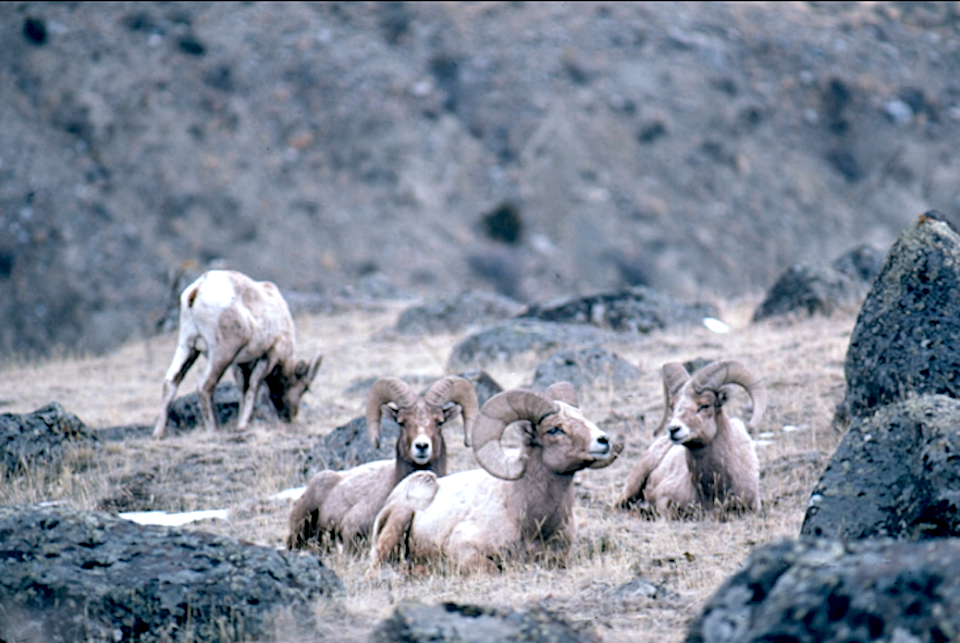
Nonnative mountain goats are to be removed from Grand Teton National Park to protect native bighorns/NPS
Parts of Grand Teton National Park will be temporarily closed January 5-12 to the public so crews can remove nonnative mountain goats.
The closure area is bounded on the south by South, Middle and Grand Tetons, Mount Owen and Teewinot Mountain peaks; bounded on the west by the park boundary; bounded on the east by the western shores of Jackson, Leigh, String and Jenny Lakes; and bounded on the north by Rolling Thunder Mountain and Eagle Rest Peaks. No public access will be allowed in the area during this time. Signs will be posted at main access locations and a map of the temporary closure area can be viewed at this page.
In order to aid in the conservation of a native and vulnerable population of Rocky Mountain bighorn sheep in the Teton Range, the National Park Service is implementing a recently finalized management plan to remove nonnative mountain goats from the park via lethal and nonlethal means.
The National Park Service has a responsibility to protect native species and reduce the potential for local extinction of a native species and therefore intends to reduce the number of nonnative mountain goats in the park as quickly as possible. Mountain goats threaten the native Teton Range bighorn sheep herd through increased risk of pathogen transmission and the potential for competition.
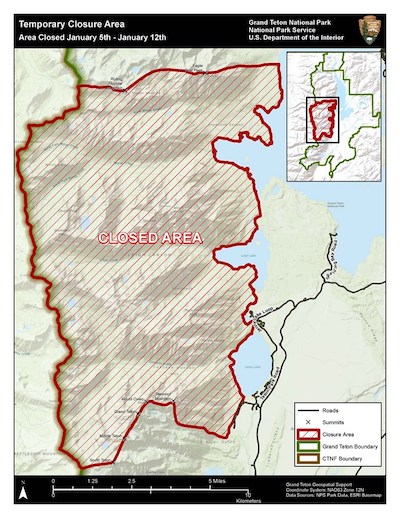
Parts of Grand Teton National Park are to be closed next week for mountain goat culling/NPS
Aerially-based lethal activities are the most efficient and effective methods to remove nonnative mountain goats. Beginning Monday, January 6, helicopter-based lethal removal efforts will be initiated, as weather conditions and mountain goat distribution allow. Removal activities will be performed by a qualified contractor.
Timing of the activities is planned when park visitation is low, and will be concentrated in the area between Cascade and Snowshoe Canyons where the majority of the mountain goats are located.
Without swift and active management, the mountain goat population is expected to continue to grow and expand its distribution within the park. The mountain goat population is currently at a size where complete removal is achievable in a short time; however, the growth rate of this population suggest that complete removal in the near future may become unattainable.
The Teton Range is home to a small herd of native bighorn sheep currently estimated at approximately 100 animals. This herd is one of the smaller and most isolated in Wyoming, and has never been extirpated or augmented.
The Teton Range herd of native bighorn sheep is of high conservation value to the park, adjacent land and wildlife managers, and visitors. Currently the nonnative mountain goat population within the park is estimated at approximately 100 animals. Resident mountain goats within the park are likely descended from a population that was introduced outside the park.
Stories about:
Story Categories:
A copy of National Parks Traveler's financial statements may be obtained by sending a stamped, self-addressed envelope to: National Parks Traveler, P.O. Box 980452, Park City, Utah 84098. National Parks Traveler was formed in the state of Utah for the purpose of informing and educating about national parks and protected areas.
Residents of the following states may obtain a copy of our financial and additional information as stated below:
- Florida: A COPY OF THE OFFICIAL REGISTRATION AND FINANCIAL INFORMATION FOR NATIONAL PARKS TRAVELER, (REGISTRATION NO. CH 51659), MAY BE OBTAINED FROM THE DIVISION OF CONSUMER SERVICES BY CALLING 800-435-7352 OR VISITING THEIR WEBSITE. REGISTRATION DOES NOT IMPLY ENDORSEMENT, APPROVAL, OR RECOMMENDATION BY THE STATE.
- Georgia: A full and fair description of the programs and financial statement summary of National Parks Traveler is available upon request at the office and phone number indicated above.
- Maryland: Documents and information submitted under the Maryland Solicitations Act are also available, for the cost of postage and copies, from the Secretary of State, State House, Annapolis, MD 21401 (410-974-5534).
- North Carolina: Financial information about this organization and a copy of its license are available from the State Solicitation Licensing Branch at 888-830-4989 or 919-807-2214. The license is not an endorsement by the State.
- Pennsylvania: The official registration and financial information of National Parks Traveler may be obtained from the Pennsylvania Department of State by calling 800-732-0999. Registration does not imply endorsement.
- Virginia: Financial statements are available from the Virginia Department of Agriculture and Consumer Services, 102 Governor Street, Richmond, Virginia 23219.
- Washington: National Parks Traveler is registered with Washington State’s Charities Program as required by law and additional information is available by calling 800-332-4483 or visiting www.sos.wa.gov/charities, or on file at Charities Division, Office of the Secretary of State, State of Washington, Olympia, WA 98504.
INN Member

The easiest way to explore RV-friendly National Park campgrounds.

Here’s the definitive guide to National Park System campgrounds where RVers can park their rigs.
Our app is packed with RVing- specific details on more than 250 campgrounds in more than 70 national parks.
You’ll also find stories about RVing in the parks, tips helpful if you’ve just recently become an RVer, and useful planning suggestions.


Comments
Meanwhile, not many miles away, another government bureaucracy is trying to reduce the number of mountain goats killed while seeking salt from winter highway maintenance:
https://www.idahopress.com/news/state/wyoming-winter-traffic-hazard-salt...
Seems as though the NPS 'removal' might have to be repeated regularly as goats migrate back in from outside the park.
It is a reasonable solution to relocate the mountain goats to other regions rather than exterminating them.
The photo is of sheep, not goats. What a rookie mistake.
No rookie mistake, Jim. The nonnative mountain goats are to be removed to protect the native bighorns pictured.
They could have a legal hunt at least they wouldn’t all be slaughtered. The meat could be distributed to people who could use it i don’t believe they will remove any of them to other areas. They have the area closed down so protesters can’t get in there it,s going to be a slaughter house from the sky
I want to see how their data was established.