
A golden eagle whose carcass was found near Phantom Lake in December died from lead poisoning/NPS
Lead poisoning, most likely acquired from eating carrion left behind by hunters, killed a golden eagle whose carcass was found in Yellowstone National Park just months after she had been fitted with a radio transmitter.
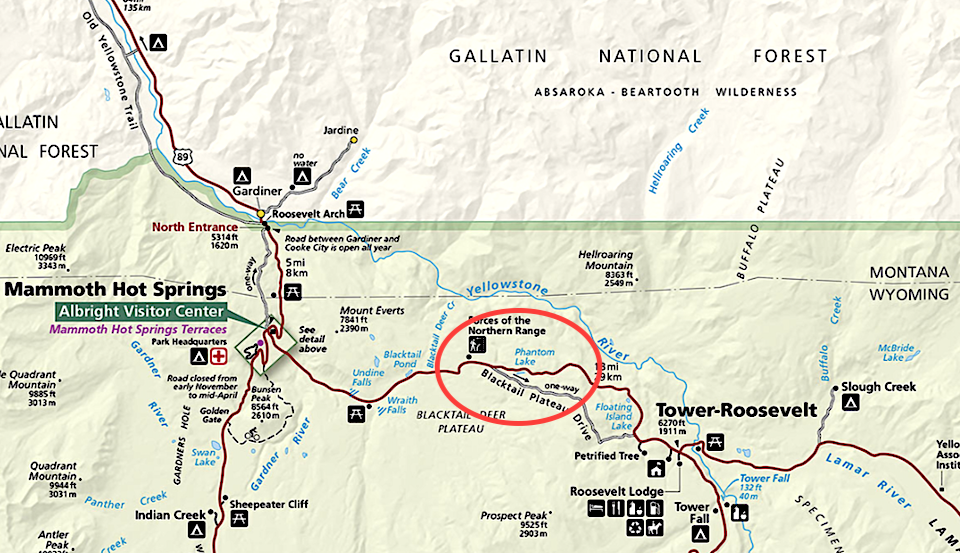
Biologists were able to recover the carcass near Phantom Lake on the Blacktail Plateau in December by following the last location indicated by the transmitter, which had been placed on the eagle in the park last August. A recent lab necropsy indicated the cause of death was lead poisoning. Levels found in the golden eagle were extremely high and well over lethal toxicity, a park release said.
The marked raptor was part of a study to understand productivity, movements, survival, and cause of death in Yellowstone. The study is being conducted and funded by Yellowstone National Park, the University of Montana, Yellowstone Forever, and the U.S. Geological Survey.
Transmitter data revealed that the eagle ranged extensively north of the park during the 2018 autumn hunting season before it died. Hunter-provided carrion, especially elk gut piles, is an important food resource for golden eagles and other avian scavengers. The lead levels in the marked eagle indicated it likely ate carrion that contained lead fragments.
If carrion contain lead fragments, they can be deadly to scavengers. Lead is an environmental toxin well known for its capability to directly impact wildlife. Studies by Craighead Beringia South, a non-profit research institute based in Kelly, Wyoming, have shown that fragmented bullets often stay in the discarded remains of wild game and subsequently enter the food chain as they are consumed by other animals. Lead poisoning can result when wildlife species ingest the toxic materials.
In November of 2011 and March 2015, Craighead Beringia South researchers from Livingston, Montana, also documented mortalities from elevated lead levels of two golden eagles that ranged north of the park.
Non-lead ammunition is safer for birds. While the Obama administration banned lead shot and lead fishing tackle, former Interior Secretary Ryan Zinke overturned the ban in March 2017 on his first day in office, saying it "was issued without significant communication, consultation or coordination with affected stakeholders."
Lead shot long has been considered the No. 1 killer of condors in the wild.
You can read more about non-lead ammunition programs at The National Elk Refuge and Grand Teton National Park.
Golden eagles are large, long-lived raptors that feed on many medium-sized mammals, birds, and carrion. Yellowstone considers golden eagles a species of concern. Learn more.
Stories about:
Story Categories:
A copy of National Parks Traveler's financial statements may be obtained by sending a stamped, self-addressed envelope to: National Parks Traveler, P.O. Box 980452, Park City, Utah 84098. National Parks Traveler was formed in the state of Utah for the purpose of informing and educating about national parks and protected areas.
Residents of the following states may obtain a copy of our financial and additional information as stated below:
- Florida: A COPY OF THE OFFICIAL REGISTRATION AND FINANCIAL INFORMATION FOR NATIONAL PARKS TRAVELER, (REGISTRATION NO. CH 51659), MAY BE OBTAINED FROM THE DIVISION OF CONSUMER SERVICES BY CALLING 800-435-7352 OR VISITING THEIR WEBSITE. REGISTRATION DOES NOT IMPLY ENDORSEMENT, APPROVAL, OR RECOMMENDATION BY THE STATE.
- Georgia: A full and fair description of the programs and financial statement summary of National Parks Traveler is available upon request at the office and phone number indicated above.
- Maryland: Documents and information submitted under the Maryland Solicitations Act are also available, for the cost of postage and copies, from the Secretary of State, State House, Annapolis, MD 21401 (410-974-5534).
- North Carolina: Financial information about this organization and a copy of its license are available from the State Solicitation Licensing Branch at 888-830-4989 or 919-807-2214. The license is not an endorsement by the State.
- Pennsylvania: The official registration and financial information of National Parks Traveler may be obtained from the Pennsylvania Department of State by calling 800-732-0999. Registration does not imply endorsement.
- Virginia: Financial statements are available from the Virginia Department of Agriculture and Consumer Services, 102 Governor Street, Richmond, Virginia 23219.
- Washington: National Parks Traveler is registered with Washington State’s Charities Program as required by law and additional information is available by calling 800-332-4483 or visiting www.sos.wa.gov/charities, or on file at Charities Division, Office of the Secretary of State, State of Washington, Olympia, WA 98504.
INN Member

The easiest way to explore RV-friendly National Park campgrounds.

Here’s the definitive guide to National Park System campgrounds where RVers can park their rigs.
Our app is packed with RVing- specific details on more than 250 campgrounds in more than 70 national parks.
You’ll also find stories about RVing in the parks, tips helpful if you’ve just recently become an RVer, and useful planning suggestions.


Comments
We can do better.
No hunting should be allowed within our National Parks!!!
Yes, it is detrimental that we do Much Better for Our World & the Living Creatures on this Earth.
I believe, as well, that hunting in National Parks should be illega.
Goodness gracious, right here in this very article by the NPT staff it says, plain as day, "Non-lead ammunition is safer for birds. While the Obama administration banned lead shot and lead fishing tackle, former Interior Secretary Ryan Zinke overturned the ban in March 2017 on his first day in office" and "Lead shot long has been considered the No. 1 killer of condors in the wild." Yes, well, there it is, isn't it? Ousted former Interior Secretary Ryan Zinke, who I hear is in the cryptocurrency business now, remains under a criminal cloud due to his unethical behavior while in office, not yet being prosecuted because Attorney General Barr controls the DOJ. Are you starting to see a pattern here? Non-lead ammunition is not just far safer for birds; it's far safer around. Lead causes many health problems, including diminished mental capabilities, which explains a lot I guess. Furthermore, non-lead ammo is just as usable and effective as lead ammo. If you finished high school and thereby have a job (see the previous discussion of the effects of lead), you should be able to afford the minor extra cost of the good tungsten alternatives and, if you can't, then you probably really can't afford the lead versions either. It seems only the NRA strongly objects to non-lead ammo and only as one of the "principles" they tout; but, then, given the recent news about Maria Butina, Paul Erickson, and corruption within the NRA, I guess we've come full circle to our discussion of former Interior Secretary Ryan Zinke and Attorney General Barr. It seems they all have "principles" to tout; but, it sure doesn't look like any of their "principles" really mean much.
National Parks belong to the taxpayers and there should be NO hunting, grazing, logging or mining on our public lands!
There is no hunting in national parks. The lead shot comes from area outside parks -- eagles and condors don't recognize park boundaries.