
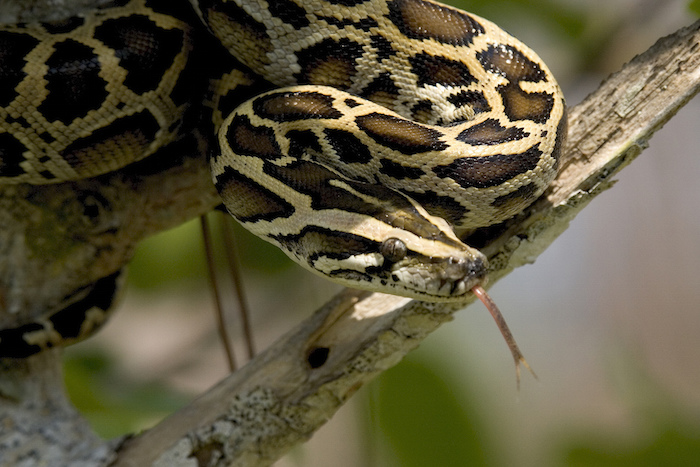
Evidence that Burmese pythons and Indian pythons crossbred somewhere down the line could spell greater problems for Everglades National Park wildlife/NPS
Burmese pythons have made a huge dent on wildlife in Everglades National Park, and now a determination that some have crossbred with Indian pythons means the constricting snakes could slither out of the swamps and onto higher ground in search of their meals.
Past studies have attributed huge declines in raccoons, opposums, and even bobcats to Burmese pythons, which can easily grow beyond 10 feet in length and weigh 250 pounds.
"Numerous lines of evidence implicate introduced Burmese pythons as the primary cause of dramatic declines of several species of once-abundant mammals in (Everglades National Park)," said the authors of a 2011 study examining the prey-predator dynamic. "The timing of the python proliferation in ENP coincides with reductions in mammal abundances."
"The most severe declines, including a nearly complete disappearance of raccoons, rabbits and opossums, have occurred in the remote southernmost regions of the park, where pythons have been established the longest," U.S. Geological Survey researchers said at the time. "In this area, populations of raccoons dropped 99.3 percent, opossums 98.9 percent and bobcats 87.5 percent. Marsh and cottontail rabbits, as well as foxes, were not seen at all."
Now adding to the concern over what damage the snakes might do to the park's wildlife is a finding that some of the Burmese pythons have interbred with Indian pythons. Just 13 of 426 snakes sampled were found to have genes traced to both species, but that could be enough to alter the habits, and habitat preferences, for the progeny. The concern over that is that the Burmese variety tends to favor swamps for their habitat, while the Indian variety seeks out drier ground.
“If the Indian pythons have a wider range, perhaps these Everglades snakes now have that capability,” USGS geneticist Margaret Hunter, who was the lead author on the paper discussing the hybridization, told the Miami Herald.
Because Burmese pythons pose a significant threat to the Everglades ecosystem, along with state, federal, tribal, and local partners, Everglades National Park and the Florida Wildilfe Commission have invested millions of dollars and countless hours in developing and testing ways to remove pythons from the Everglades. Currently, the approach to try to dent the population is to contract with snake hunters.
The park used volunteers for removal in the past, and while it will continue to do so, the addition of FWC contractors will allow greater numbers of skilled people to engage in removals than ever before.
Stories about:
Story Categories:
A copy of National Parks Traveler's financial statements may be obtained by sending a stamped, self-addressed envelope to: National Parks Traveler, P.O. Box 980452, Park City, Utah 84098. National Parks Traveler was formed in the state of Utah for the purpose of informing and educating about national parks and protected areas.
Residents of the following states may obtain a copy of our financial and additional information as stated below:
- Florida: A COPY OF THE OFFICIAL REGISTRATION AND FINANCIAL INFORMATION FOR NATIONAL PARKS TRAVELER, (REGISTRATION NO. CH 51659), MAY BE OBTAINED FROM THE DIVISION OF CONSUMER SERVICES BY CALLING 800-435-7352 OR VISITING THEIR WEBSITE. REGISTRATION DOES NOT IMPLY ENDORSEMENT, APPROVAL, OR RECOMMENDATION BY THE STATE.
- Georgia: A full and fair description of the programs and financial statement summary of National Parks Traveler is available upon request at the office and phone number indicated above.
- Maryland: Documents and information submitted under the Maryland Solicitations Act are also available, for the cost of postage and copies, from the Secretary of State, State House, Annapolis, MD 21401 (410-974-5534).
- North Carolina: Financial information about this organization and a copy of its license are available from the State Solicitation Licensing Branch at 888-830-4989 or 919-807-2214. The license is not an endorsement by the State.
- Pennsylvania: The official registration and financial information of National Parks Traveler may be obtained from the Pennsylvania Department of State by calling 800-732-0999. Registration does not imply endorsement.
- Virginia: Financial statements are available from the Virginia Department of Agriculture and Consumer Services, 102 Governor Street, Richmond, Virginia 23219.
- Washington: National Parks Traveler is registered with Washington State’s Charities Program as required by law and additional information is available by calling 800-332-4483 or visiting www.sos.wa.gov/charities, or on file at Charities Division, Office of the Secretary of State, State of Washington, Olympia, WA 98504.
INN Member

The easiest way to explore RV-friendly National Park campgrounds.

Here’s the definitive guide to National Park System campgrounds where RVers can park their rigs.
Our app is packed with RVing- specific details on more than 250 campgrounds in more than 70 national parks.
You’ll also find stories about RVing in the parks, tips helpful if you’ve just recently become an RVer, and useful planning suggestions.


Comments
If you want these snakes hunted to extinction then enlist some famous chefs to turn their meat into a restaurant dlicacy. The price of the meat will sky rocket and everybody will be trying to capture these snakes.
Establish a Pest Hunt which pays $100. for each Python killed and brought in. Use some of the millions of dollars and countless hours to fund the program.