
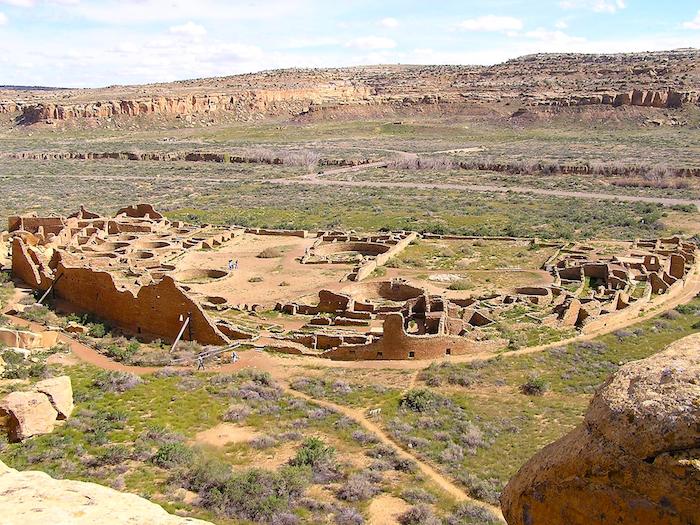
A proposed auction of oil and gas parcels near Chaco Culture National Historical Park in New Mexico has been put off for now, though it could come back to life, and there are other proposed leases in the region that are of concern to some environmental groups.
The U.S. Bureau of Land Management canceled the sale last week, with Interior Secretary Ryan Zinke explaining that there was a need for more consultation with tribes to understand their concerns over how the sale could impact cultural sites. The leases would have auctioned off an additional 4,434 acres in the Greater Chaco region for industrialized fracking.
“My job is to make sure that the local voices are heard, and the state and national interests are reflected. In this case, there is some concern about the proximity to Chaco of some of the leases and the uncertainty about cultural impacts,” Secretary Zinke said Thursday.
Some groups, including the Sierra Club and area tribes, maintained the BLM was basing the sale on an outdated Resource Management Plan that was written before new fracking methods were feasible in the region, and without meaningful tribal consultation or consent from Navajo Nation and Pueblos who consider Chaco sacred.
There has been considerable opposition to the sale, with more than 450 administrative protests filed against it. The Navajo Nation and All Pueblo Council of Governors, National Congress of American Indians, 15 Navajo Chapter Houses, the New Mexico Legislature, and more than 400,000 citizens have requested a moratorium on drilling until health, cultural, and environmental impacts can be analyzed, according to a Sierra Club release.
National Parks Conservation Association officials, while happy with the withdrawal, say there are other controversial lease auctions planned for the region. The New Mexico lease sale is one of three March lease sales that NPCA has protested. Other sales set for this month include parcels near Hovenweep National Monument in southeastern Utah, and Fort Laramie National Historical Site in Wyoming.
There has been a substantial increase in leases offered for sale near national parks since 2017, including parcels near Dinosaur National Monument, Zion National Park, Rocky Mountain National Park, Great Basin National Park, and others, NPCA said in a release.
"The secretary's decision is the right one for Chaco Culture National Historical Park and the important cultural resources it protects,” said Ernie Atencio, NPCA's New Mexico program manager. “National Parks Conservation Association, area tribes and other conservation groups have long advocated for the BLM to take a focused look at potential impacts to Chaco from new oil and gas development and plan for the protection of the important cultural and natural resources in the area. As evidence by the BLM’s postponement, such a collaborative plan is still badly needed."
Stories about:
Story Categories:
A copy of National Parks Traveler's financial statements may be obtained by sending a stamped, self-addressed envelope to: National Parks Traveler, P.O. Box 980452, Park City, Utah 84098. National Parks Traveler was formed in the state of Utah for the purpose of informing and educating about national parks and protected areas.
Residents of the following states may obtain a copy of our financial and additional information as stated below:
- Florida: A COPY OF THE OFFICIAL REGISTRATION AND FINANCIAL INFORMATION FOR NATIONAL PARKS TRAVELER, (REGISTRATION NO. CH 51659), MAY BE OBTAINED FROM THE DIVISION OF CONSUMER SERVICES BY CALLING 800-435-7352 OR VISITING THEIR WEBSITE. REGISTRATION DOES NOT IMPLY ENDORSEMENT, APPROVAL, OR RECOMMENDATION BY THE STATE.
- Georgia: A full and fair description of the programs and financial statement summary of National Parks Traveler is available upon request at the office and phone number indicated above.
- Maryland: Documents and information submitted under the Maryland Solicitations Act are also available, for the cost of postage and copies, from the Secretary of State, State House, Annapolis, MD 21401 (410-974-5534).
- North Carolina: Financial information about this organization and a copy of its license are available from the State Solicitation Licensing Branch at 888-830-4989 or 919-807-2214. The license is not an endorsement by the State.
- Pennsylvania: The official registration and financial information of National Parks Traveler may be obtained from the Pennsylvania Department of State by calling 800-732-0999. Registration does not imply endorsement.
- Virginia: Financial statements are available from the Virginia Department of Agriculture and Consumer Services, 102 Governor Street, Richmond, Virginia 23219.
- Washington: National Parks Traveler is registered with Washington State’s Charities Program as required by law and additional information is available by calling 800-332-4483 or visiting www.sos.wa.gov/charities, or on file at Charities Division, Office of the Secretary of State, State of Washington, Olympia, WA 98504.


National parks and their natural resources belong to you. The National Parks Traveler works to ensure you know how these essential places are being cared for.
Sign Up For Our Weekly Newsletter
Unsubscribe at any time.
INN Member

The easiest way to explore RV-friendly National Park campgrounds.

Here’s the definitive guide to National Park System campgrounds where RVers can park their rigs.
Our app is packed with RVing- specific details on more than 250 campgrounds in more than 70 national parks.
You’ll also find stories about RVing in the parks, tips helpful if you’ve just recently become an RVer, and useful planning suggestions.


Comments
Nice to read some good news once in awhile.
Staff, could you identify what constitutes "industrialized" fracking?
Well, it's not like there is anything at all under the heading of environmentally friendly local family farm fracking.
I have a question for the group of commenters here.
Is there a place where you feel drilling for oil is acceptable?
The reason I ask is although I value our environment as much as the next person I am also practical about the fact we could not live without petroleum products in our lives.
Has the Sierra Club ever given a green light to ANY drilling or exploration project? I can’t remember reading a single article where the Sierra Club gave a green light to a project related to mining or oil and gas. Quite honestly my first reaction is a big yawn when I read about opposition to drilling, fracking, mining these days because it is inevitable that someone or multiple someone’s will be lined up to sue. This is a shame because I am sure there are projects that do pose a real concern. But just as many things in politics today it has become like that old fable of the boy who cried wolf.
I am convinced that there will never be another mining or drilling proposal that some group somewhere doesn’t try to stop and can’t help but wonder how much of this is little more than a poorly disguised ransom demand.
So back to my question, where would people here support drilling or mining?
Not on any federal lands? Just not on or near national park sites? Not on the North American continent? Or nowhere at all?
Wild, I think you're asking the wrong question. The more pertinent one, one that my good friend Dr. Runte and others have raised, is when are we going to start living within our means?
By that I mean when will we realize uncontrolled population growth and urban sprawl are unsustainable problems? Shouldn't there be a more sustainable approach to how we live on this rock?
Beyond those questions, if you believe The Wilderness Society:
With all that in mind, let's flip the question: Is there any place you wouldn't approve of energy exploration?
There is also the question of technique. Fracking is a rather destructively nihilistic attempt at things, as opposed to more traditional methods.
Seems to be something wrong with the Wilderness Society numbers Kurt. There are 640 million acreas of public land. If oil and gas leases are "locking up 36 mil, then only about 6% not 90% would be leased to oil and gas developers. Also, National Parks take up 85 million acres, 240% of the land "locked up" by leases.
“Shouldn't there be a more sustainable approach to how we live on this rock?”
Yes we definitely should and that may provide some marginal relief but certainly doesn’t come close to eliminating the need for petroleum products which will continue to grow for some time. China and India alone have a long long way to go before they are on par with our standard of living and that will continue to greatly drive demand.
I believe EC is right that the numbers you quoted are wrong, (although I saw the article you quoted from).
I respect that you would rather not answer my question but I will answer yours. Yes, there are many places I wouldn’t allow drilling. Inside the National Park boundaries, same for State and local parks unless the people of that state chose otherwise. Anywhere there is a REAL threat to a major waterway or aquifer and yes I think it is important to preserve a certain percentage of our wetlands. And yes, there are also many places that I would allow drilling, fracking and exploration.
I am tired of environmental groups that fight absolutely everything and constantly exaggerate the impacts. I also tire of people who condem the petroleum industry and mining without realizing or acknowledging they are driving the demand. As I said, they have cried wolf and told me the sky is falling far too many times which is sad because I would join in their fight on occasion if they were honest.