
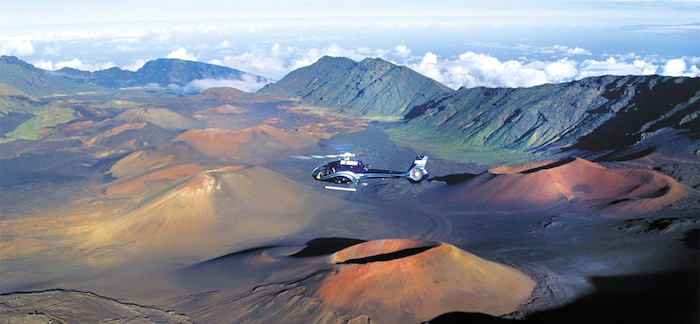
Last October, while marveling over the gushing Riverside Geyser in Yellowstone National Park, I happened to look up and saw a small jet making circles overhead. Obviously, the pilot and his passengers wanted to watch the eruption as well. According to the National Park Service, that was the only authorized overflight for the month in Yellowstone, but across the National Park System there were tens of thousands of overflights last year that, while providing a bird's eye view of spectacular scenery, can be an annoyance to those on the ground.
In a bid to bring some better management of park overflights into being, Public Employees for Environmental Responsibility, along with Hawaii Island Coalition Malama Pono, has sued the Federal Aviation Administration. According to the lawsuit filed last week, "nearly 65,000 air tours, most concentrated over a few parks, took off last year without limit on the number, routes, or timing of flights."
The filing asks that the FAA be ordered to "develop an Air Tour Management Plan or voluntary agreements as directed by statute for Hawaii Volcanoes National Park, Haleakalā National Park, Lake Mead National Recreation Area, Muir Woods National Monument, Glacier National Park, Great Smoky Mountains National Park, and Bryce Canyon National Park."
“The Park Service is supposed to protect parks for present and future generations but its jurisdiction in essence ends at the treetops,” said PEER Executive Director Jeff Ruch, noting that several parks, such as Glacier, have tried to end helicopter and fixed-wing air tours but are powerless without action by the FAA. “Our lawsuit is designed to curb damaging overflights and require the FAA to finally manage what is now basically a flying free-for-all.”
The overflights create a number of problems, and not just for park visitors, the lawsuit claims, citing a number of incidents, including:
* A recorder of soundscapes in Haleakalā National Park whose work product, which includes assisting national parks with soundscape studies and identifying wildlife species, has been interrupted by over 4,500 annual overflights which mask the natural ambience and negatively affect the behavior of wildlife, thus making soundscape recording and wildlife identification significantly more difficult to obtain;
* A retired ecologist who now leads tours and birding expeditions through the Lake Mead National Recreation Area, as well as camps and hikes in the area himself—who has found that the aircraft diminish the natural quiet he enjoys, reduce the quality of his tours, and make it harder to listen for birds;
* A tour company operator and an environmental educator in Muir Woods National Monument who have experienced disturbances, every few minutes, from over 1,000 annual overflights. The tour operator’s business is negatively affected by diminishing customer experience when customers are forced to cover their ears constantly. The environmental educator, who lives near the National Monument, experiences decreased quiet enjoyment of her own property by having to keep all windows closed to maintain concentration.
* In Glacier National Park, a nearby resident’s weekly all day hikes have been ruined by the constant noise of over 750 annual overflights. These overflights are also heard from his property from 7 a.m. to 7 p.m. PEER members also include three former public employees at Glacier National Park – a former backcountry ranger and wildlife biologist, a former backcountry ranger and water systems operator, and a former state and national park management employee – whose professional experiences with nature in Glacier National Park have been altered by the overflights.
* In Great Smoky Mountains National Park, the owner of a tour guide company whose work and personal life have been disrupted by over 800 annual overflights which interrupt silent walks and destroy a key purpose of the guided tours - positive experiences with nature - by causing employees and customers to want to duck every fifteen minutes from the constant buzzing overhead; and
* A former Bryce Canyon National Park employee whose photographs have been ruined by the high altitude airplane contrails of over 450 annual overflights entering his landscape photography and who has also been deprived of the subtle natural sounds of wildlife, ultimately displacing his hiking locations.
"Nor are negative impacts limited to park boundaries," PEER added in its release. "Near Hawaii Volcanoes National Park, for example, hundreds of homes lie in the path of air fields from which as many as 80 flights a day and more than 15,000 last year were launched. Residents say that helicopter noise is constant and year-round, causing many to lose sleep, suffer from stress, and a host of other complaints."
Congress in 2000 enacted the National Park Air Tour Management Act directing the FAA, in consultation with Park Service, to “establish an air tour management plan for any national park or tribal land whenever a person applies for authority to conduct a commercial air tour.” Those plans are to be developed for parks where more than 50 tour overflights per year are conducted, the lawsuit said.
But the FAA, whose mission is to promote commercial aviation, since NPATMA was passed in 2000 has yet to establish a single air tour management plan during the ensuing 17 years and shows no signs of doing any in the future, according to PEER.
"Instead of developing management plans, the FAA has simply issued 'interim' authorizations year after year that essentially grandfather in all tour operators," the advocacy group claims. "All told, it has issued an estimated 300,000 interim approvals without any environmental review or meaningful national park input."
“Unless the FAA acts, air tour operators have no incentive to negotiate voluntary restrictions to minimize impacts on parks,” Mr. Ruch said. “Our lawsuit is meant to jumpstart a planning process that should have begun a generation ago.”
Stories about:
Story Categories:
A copy of National Parks Traveler's financial statements may be obtained by sending a stamped, self-addressed envelope to: National Parks Traveler, P.O. Box 980452, Park City, Utah 84098. National Parks Traveler was formed in the state of Utah for the purpose of informing and educating about national parks and protected areas.
Residents of the following states may obtain a copy of our financial and additional information as stated below:
- Florida: A COPY OF THE OFFICIAL REGISTRATION AND FINANCIAL INFORMATION FOR NATIONAL PARKS TRAVELER, (REGISTRATION NO. CH 51659), MAY BE OBTAINED FROM THE DIVISION OF CONSUMER SERVICES BY CALLING 800-435-7352 OR VISITING THEIR WEBSITE. REGISTRATION DOES NOT IMPLY ENDORSEMENT, APPROVAL, OR RECOMMENDATION BY THE STATE.
- Georgia: A full and fair description of the programs and financial statement summary of National Parks Traveler is available upon request at the office and phone number indicated above.
- Maryland: Documents and information submitted under the Maryland Solicitations Act are also available, for the cost of postage and copies, from the Secretary of State, State House, Annapolis, MD 21401 (410-974-5534).
- North Carolina: Financial information about this organization and a copy of its license are available from the State Solicitation Licensing Branch at 888-830-4989 or 919-807-2214. The license is not an endorsement by the State.
- Pennsylvania: The official registration and financial information of National Parks Traveler may be obtained from the Pennsylvania Department of State by calling 800-732-0999. Registration does not imply endorsement.
- Virginia: Financial statements are available from the Virginia Department of Agriculture and Consumer Services, 102 Governor Street, Richmond, Virginia 23219.
- Washington: National Parks Traveler is registered with Washington State’s Charities Program as required by law and additional information is available by calling 800-332-4483 or visiting www.sos.wa.gov/charities, or on file at Charities Division, Office of the Secretary of State, State of Washington, Olympia, WA 98504.


National parks and their natural resources belong to you. The National Parks Traveler works to ensure you know how these essential places are being cared for.
Sign Up For Our Weekly Newsletter
Unsubscribe at any time.
INN Member

The easiest way to explore RV-friendly National Park campgrounds.

Here’s the definitive guide to National Park System campgrounds where RVers can park their rigs.
Our app is packed with RVing- specific details on more than 250 campgrounds in more than 70 national parks.
You’ll also find stories about RVing in the parks, tips helpful if you’ve just recently become an RVer, and useful planning suggestions.


Comments
I was in Bryce last month and made a note to self about the intrusiveness of the overflights in this environment. I would like to see them phased out by capping existing operators and not permitting new ones.
Here's a link to a Recreational Aviation Foundation article about national park overflights: http://theraf.org/content/what-are-rules-about-overflights-national-parks
I agree with EC on phasing out audible overflights in NPS natural parks!
Beyond that, NPS has quite a bit od data on the noise levels of even high elevation overflights. [Sept 12 & 13 2001 provided amazing data on soound levels in parks with no transcontinental flights at 36000'.] There's solid (non-NPS, experimental) scientific evidence on how even the couple of dB of additional background noise we don't conscously notice raises human blood pressure a measurable amount.
The person I would name as the best scientist in all of NPS happens to work in the Natural Sounds Program.
If I'm not mistaken, there are laws and codes already in place that are not enforced. So enforcement is the real issue here. In the Smokies, the overflights occur regularly on weekends. The number of times I have seen the same orange/red helicopter disrupt a backcountry trip are numerous.
However, let's talk about Harley Davidson motorcycles. Want to address noise in the parks, how about them? As a motorcyclist myself, I find the noise of a harley travels 40 miles across Newfound gap and 100 across the Blue Ridge parkway. I say Harley Davidson because of their engineered loud noise. Something should be done there as it is far more egregious than overflights.
Smokies, Amen and Amen!
I'm not sure if there are "laws and codes" on the books which aren't being enforced, other than the law at issue in this recycled press release, and some problems with pirate air tours who don't have the proper FAA operating certificate to do what they are doing regardless of how the land below them are managed. But maybe it is all how you define "lack of enforcement." Is it a lack of enforcement when the FAA simply issues a waiver whenever an air tour operator is brought to their attention? Is it a lack of enforcement when the FAA regional office lacks personnel to develop these ATMP's?
In the vast majority of parks and other public lands, a plane not engaged in what the FAA narrowly defines as an air tour can do almost anything they want so long as they don't endanger persons or occupied structures.
BTW I agree about motorcycles.
I live off of a state route that goes on through North Cascades Ntl Park, a mountainous winding road that motorcyclists love to live and die on.. The pass is closed in winter and we can always tell when spring comes by the motorcycle packs revving by, day and night.
I was not surprised when I found out that the park averaged about 1 or 2 medivac flights a week, ioften taking motorcyclists to a trauma center. The fatalities are not flown out.
Yeah - motorcycle noise pollution is a real nuisance, and the noise is only part of the burden they load onto our parks.
Here in Utah we're faced with a proposal to expand helicopter-assisted hiking on BLM lands adjacent to Canyonlands National Park. Moab-based Pinnacle Helicopters wants to land small guided parties at Bluejohn Canyon, the slot made famous by Aron Ralston and the movie "127 Hours." The owner says that hikers in nearby Horseshoe Canyon (a detached unit of Canyonlands NP that is home to the Great Gallery pictograph panel) wouldn't hear any noise, but the flight path looks to me like it would go right over Bowknot Bend in Labyrinth Canyon, one of the premier quiet-water float trips in the West. All this to save a 7-mile round-trip hike into Bluejohn! Here's the link to the story in the Salt Lake Tribune: http://www.sltrib.com/news/environment/2017/10/12/should-a-tour-company-....
Quiet skies are one of our most precious resources, yet they can easily be lost for the benefit of a handful of wealthy recreationists.
I've never heard of "helicopter assisted hiking" before. Yikes.
But I suppose it follows from helicopter skiing.
Thinking about it, I'm more bothered by helicopter assisted hiking into wilderness areas than by helicopter skiing. I think that's because I expect more solitude hiking the desert or Colorado Plateau than I do skiing, even on my skinny skis. I hope it's not snobbishness and selfishness on my part. Seeing the Great Gallery and hiking all the way down Grand Gulch to the San Juan are still on my bucket list for things to do before I can't, and my skiing days are probably over.
I suppose that if Utah wants to permit this for their state school lands (for trivial $$), and they're only requesting a couple of trips per month, I'd want it to be restricted to a regularly scheduled weekend of every month, so everyone else can schedule around it and avoid the noise. Some lakes ae set up for power boats vs sailboats on alternate days. Some trails are set up for horses vs mountain bikes on alternate days. Maybe such an accommodation would work in this case.
On the comments further upthread, there are actually fewer laws about overflights than you think, and the FAA is very resistant to any restrictions on general aviation flights above some modest ceiling (500 or 1000' agl?) except for commercial and military airspace.
SmokiesBackpacker----Can you cite some of these codes and laws that you are saying are not enforced?
I'm a pilot (who can't afford to fly any more) and I just spent a couple of hours searching the Federal Air Regulations for any regulation regarding national park overflights. There apparently are none.
All I could find were some references to "recommendations" and "requests from the National Park Service" "asking" that general aviation pilots maintain a minimum altitude of 1000 feet above national park lands.
There are restrictions on LANDING an aircraft in a park (although some parks DO permit landings). Landing restrictions are a park by park situation.
When I went to the big air show at Oshkosh a few years ago, there was a retired NPS pilot who presented a program asking pilots to "Fly Quietly in Our Parks." Back in the days when I was still flying, I used to really enjoy taking passengers for rides to Grand Canyon where we'd drop deep into the canyon for some incredible views. But I stopped that when the NPS began asking pilots to remain above the canyon's rim elevations. I do think there is now an actual restriction on flight below the rim, but wasn't able to find any that have been published anywhere I was able to look.
But as others have pointed out here, very loud pipes on motorcycles and noise from electric generators on RVs are also noisy distractions in parks.
To be honest, when I hiked into the Grand Canyon and heard aircraft noises, I wasn't too bothered by them. Yet, at the same time, I was very bothered by generator and motorcycle noises elsewhere. Thinking about it now makes me realize that noise is likely in the ear of the beholder. If the musical sound of an aircraft flying over makes me stop to look up, I guess the roar of a Harley or growl of a generator may be symphonic to folks who own them.
Not sure my comment survived a website crash, so here it is again:
I'm also a private/commercial pilot who can no longer afford to fly recreationally, we are legion! But anyway, I used to be based in Page, Arizona and am very familiar with the Grand Canyon area. Yes indeeed, those restrictions are regulatory, put in place a pretty long time ago now to regulate the madness there. Most tours come out of the Vegas area. There are no fly zones, VFR flight corridors, and blocks of altitude intended for commercial tours (which have the better slots) vs. private/non-tour use. The FAA has tried to make it simple by issuing and printing a special flight rules area VFR chart for pilots, see here: https://skyvector.com/?ll=36.18484840412177,-112.65270588951394&chart=23...
There aren't many other public lands areas with mandatory restrictions, some that come to mind are Yosemite Valley and the Boundary Waters Canoe Area wilderness, both put in place by Congressional Law not FAA rulemaking. This is the message that pilots see for the airspace over most national parklands, wildlife refuges and forest service/BLM wilderness areas: "All aircraft are requested to maintain a minimum altitude of 2000' above the surface...".
And here's an interesting one...a result of political compromise: "For reasons of national welfare, pilots are requested to avoid flights within 3 nautical miles of Devils Tower National Monument." (Which is considered sacred by some tribes.) Is it enforceable? Absolutely not. The basic rule for pilots in sparsely populated areas is to remain more that 500 feet from any person, vessel, vehicle, or structure. That's it.
And just becasue I am eeeeevil, I thought I would throw this piece of red meat out there to the dogs...
Thanks for the chart, Anon. It explained just about everything I was wondering about as far as GRCA flights these days.
The only law or code I know of in the Smoky Mountains area is one passed by Tennessee legistlature. And it only regulates that a heliport has to be 9 miles from the border of the federal land.
Which means, flying over the Park is legal, but in order to get there, it becomes more expensive.
Now---doing buzz overs and the such---I'm sure that is frowned upon.