
A bullish report on 2017 visitation to the National Park System was met with both welcome and concern, as parks across the country are gearing up for a busy summer with ailing infrastructure and staff struggling to handle the crowds.
At Zion National Park in Utah, staff already is sending out daily "tweets" on Twitter announcing when the campgrounds and parking lots are full. At Yellowstone National Park, officials are thinking of clearing nearly an acre of ground near the Fairy Falls trailhead to handle vehicles. Yosemite National Park officials are patiently waiting for crews to rebuild a section of the Big Oak Flat Road, which slumped downhill during the wet winter.
Other parks are struggling, too: At Arches National Park in Utah the main road that winds across the landscape is being repaved this summer; the opening days of the season on the North Rim of Grand Canyon National Park in Arizona has been hamstrung by a broken water system, which has led to the cancellation of the first 11 nights of lodging; another summer of construction on the Going-to-the-Sun Road in Glacier National Park in Montana will slow visitors as they stream across the park; in California, winter storm damage will keep the Devils Postpile National Monument campground closed this summer; Dinosaur National Monument in Utah also is grappling with road damage incurred during the winter months; Scotty's Castle at Death Valley National Park remains closed for repairs to damage an October 2015 storm delievered; part of the Ohio & Erie Canal Towpath Trail at the northern end of Cuyahoga Valley National Park in Ohio is closed through March 2018. Major stabilization work along the Cuyahoga River necessitates the closure between Hillside Road and Stone Road in Valley View.
Interior Secretary Ryan Zinke acknowledged the infrastructure needs on Wednesday when he released a report detailing the $34.9 billion generated by the National Park System last year, when a record 331 million people headed into the parks, in part to help the National Park Service celebrate its centennial.
“With continued record visitation it’s time to start thinking about accessibility and infrastructure. Last week, it was great to see the team at Yosemite opening up areas with new wheelchair accessible trails," Secretary Zinke said in a release. "In the coming years, we will look at ways to make innovative investments in our parks to enhance visitor experiences and improve our aging infrastructure. To ensure visitors continue to have great experiences, we will remain focused on increasing access and addressing the maintenance backlog to ensure we are on the right track for generations to come.”
Unfortunately, said Theresa Pierno, president and CEO of the National Parks Conservation Association, the Trump administration seems intent to reduce funding to the Park Service, not invest in the parks.
“Today’s report demonstrates once again that our national parks not only protect and preserve many of America’s landscapes and historic sites, they are also powerful economic engines for our country. It is good that the Trump administration appreciates the enormous impact national parks have on our economy, and we hope this report will encourage them to boost funding for the National Park Service rather than cutting it," she said. "Sadly, while parks are more popular than ever, they are facing many challenges, including a $12 billion deferred maintenance backlog, reduced staffing that has made it harder for parks to handle record-breaking crowds and reductions in visitor services and interpretive programs essential to the park visitor experience.
“These challenges require more money, not less, but the administration is proposing deep cuts to the Interior Department budget that, if enacted, would do lasting damage to our national parks and the local economies they support. In addition, the administration has provided guidance to federal agencies, including the Park Service, to reduce their workforce even further. If we don’t invest in our national parks, we not only jeopardize the future of these places, but also the economic future of their gateway communities."
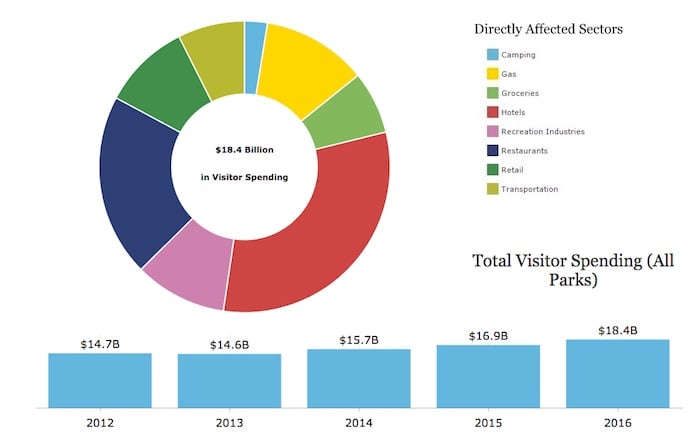
According to the 2016 NPS Visitor Effects Spending Report, visitor spending last year supported 318,000 jobs, provided $12.0 billion in labor income, $19.9 billion in value added, and $34.9 billion in economic output to the U.S. economy. The lodging sector provided the highest direct contributions with $5.7 billion in economic output to local gateway economies and 56,000 jobs. The restaurants and bars sector provided the next greatest direct contributions with $3.7 billion in economic output to local gateway economies and 71,000 jobs.
The report pointed out that most park visitor spending was for lodging (31.2 percent) followed by food and beverages (27.2 percent), gas and oil (11.7 percent), admissions and fees (10.2 percent), souvenirs and other expenses (9.7 percent), local transportation (7.4 percent), and camping fees (2.5 percent).
Despite those bullish numbers, NPCA staff pointed out that the Park Service gets only 60 cents for every $1 it needs each year just to keep its $12 billion maintenance backlog from growing. Additionally, there are not enough rangers and park staff to manage the record-breaking crowds, with the number of Park Service staff declining more than 10 percent since 2010, the NPCA release said.
Story Categories:
A copy of National Parks Traveler's financial statements may be obtained by sending a stamped, self-addressed envelope to: National Parks Traveler, P.O. Box 980452, Park City, Utah 84098. National Parks Traveler was formed in the state of Utah for the purpose of informing and educating about national parks and protected areas.
Residents of the following states may obtain a copy of our financial and additional information as stated below:
- Florida: A COPY OF THE OFFICIAL REGISTRATION AND FINANCIAL INFORMATION FOR NATIONAL PARKS TRAVELER, (REGISTRATION NO. CH 51659), MAY BE OBTAINED FROM THE DIVISION OF CONSUMER SERVICES BY CALLING 800-435-7352 OR VISITING THEIR WEBSITE. REGISTRATION DOES NOT IMPLY ENDORSEMENT, APPROVAL, OR RECOMMENDATION BY THE STATE.
- Georgia: A full and fair description of the programs and financial statement summary of National Parks Traveler is available upon request at the office and phone number indicated above.
- Maryland: Documents and information submitted under the Maryland Solicitations Act are also available, for the cost of postage and copies, from the Secretary of State, State House, Annapolis, MD 21401 (410-974-5534).
- North Carolina: Financial information about this organization and a copy of its license are available from the State Solicitation Licensing Branch at 888-830-4989 or 919-807-2214. The license is not an endorsement by the State.
- Pennsylvania: The official registration and financial information of National Parks Traveler may be obtained from the Pennsylvania Department of State by calling 800-732-0999. Registration does not imply endorsement.
- Virginia: Financial statements are available from the Virginia Department of Agriculture and Consumer Services, 102 Governor Street, Richmond, Virginia 23219.
- Washington: National Parks Traveler is registered with Washington State’s Charities Program as required by law and additional information is available by calling 800-332-4483 or visiting www.sos.wa.gov/charities, or on file at Charities Division, Office of the Secretary of State, State of Washington, Olympia, WA 98504.


National parks and their natural resources belong to you. The National Parks Traveler works to ensure you know how these essential places are being cared for.
Sign Up For Our Weekly Newsletter
Unsubscribe at any time.
INN Member

The easiest way to explore RV-friendly National Park campgrounds.

Here’s the definitive guide to National Park System campgrounds where RVers can park their rigs.
Our app is packed with RVing- specific details on more than 250 campgrounds in more than 70 national parks.
You’ll also find stories about RVing in the parks, tips helpful if you’ve just recently become an RVer, and useful planning suggestions.


Comments
Yeah, people would not have gone on vacation if there weren't National Parks. (Sigh)
The national parks' reason for being is *not* as an economic engine. AAMOF, the economic draw of the parks is a bug, not a feature.
The parks exist because those pieces of landscape deserve preservation. Period.
Sorry to disagree-but the very enabling act for the NPS gives us two roles-preservation and "providing for the enjoyment". While preservation should come first in the long run, because without preservation there will be no future enjoyment, saying that the "only" reason for the National Parks is preservation is flat out wrong.
I tried the other day to reserve a campsite in Zion's Watchman Campground and found the NO VACANCY sign is up until October 10 -- the end of the current reservation window.
If $34.9 billion was generated by the National Park System, where does this money go. Maybe they need to evaluate the budget.
It goes to the hotels, gas, labour etc, not entirely (or even mostly) to the NPS. The intersting issue is how can the NPS fail to monetize 331 million visits to cover their needs (including maintenance). That gets to the heart of the management issue
Ricky, they can't monetize it because many of the people here, and elsewhere, think everything should be free.
too true, sadly. Free is what you get in Venezuala
'Everything'.
Still waiting for a quote proving that generalization to be true rather than hyperbole.
I believe, in my personal opinion [try that phrase on for a while in every instance you cite trash only sourced in your opinions], I believe in my personal opinion that much of the mission of the NPS, to preserve and protect, should not be monetized. If you only preserve and protect what you can make a buck off of, not much will get done, but it still needs to be done.
No one is denying a preservation and museum function but that is not all the NPS is for and if it can't be sustained monetarily it won't be in the long run. 331 million visits monetized at $30 (a fairly low figure) covers the entire maintenance backlog in 1 year! Lower the figure to $5 over 6 years (~2 Billion visitors!) and it is easily achievable.
Actually, monetizing some parts will pay for preserving and protecting the others. Once again, the concepts aren't mutually exclusive.