
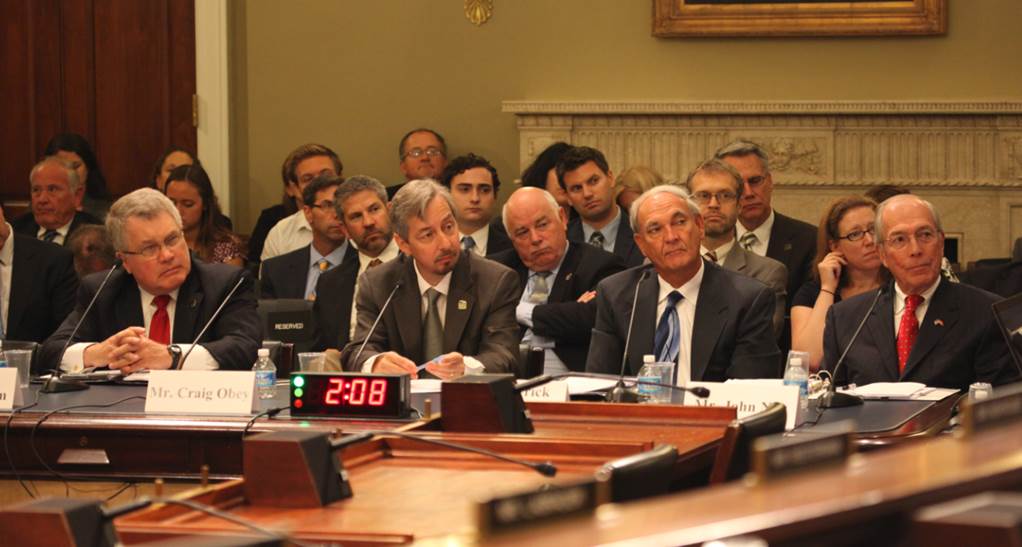
Today's National Park Service lacks business savvy, from trying to micro-manage businesses in the parks to being slow to respond to visitor desires and services, a Congressional subcommittee was told by business leaders whose companies operate in the National Park System.
One after another told the House Subcommittee on Federal Lands that changing business practices, and asking park visitors to pay more for services, will help reduce the Park Service's $11.5 billion maintenance backlog while providing visitors a better experience.
“The visitor services we provide in national parks are often inhibited by NPS policies which limit visitor experiences and reduce our payments, called franchise fees, to the agency," Derrick Crandall, counselor to the National Park Hospitality Association, told the subcommittee chaired by Rep. Tom McClintock of California.
“We are confident that increases in visitor services, including lengthening operating hours at units like Alcatraz and Statue of Liberty, adding appropriate services and allowing dynamic pricing of services, could increase franchise fees to the NPS by 50 percent within three years," Mr. Crandall added.
The hearing was one of two Thursday that examined how the Park Service does business. The other, held an hour earlier, delved into contracts the Park Service utilizes in managing its lodging, dining, and other visitor services.
While the committees' Republican leadership made it clear that solving the Park Service's budgetary problems would have to be accomplished without higher appropriations, Craig Obey of the National Parks Conservation Association told the representatives that Congress must take a greater fiduciary interest in the National Park System.
"Our national parks are investments worth preserving. Yet, for decades now, successive congresses and administrations have put park resources at risk through underinvestment. Operations funding for the National Park Service is down 7 percent ($178 million) in today’s dollars from where it was only five years ago, which has led to a reduction in rangers and other staff to educate visitors and protect resources," Mr. Obey, NPCA's senior vice president for government affairs, said in his written comments. "In addition, the National Park Service’s construction budget has declined by 62 percent ($230 million) over the last decade in today’s dollars. Between these reductions and insufficient investment on the transportation side, it’s no wonder that the deferred maintenance backlog has grown to $11.5 billion."
To bridge that gap, he urged the committee members to support extension of the Federal Lands Recreation Enhancement Act, which generates nearly $200 million annually for parks through user fess, to endorse President Obama's 2016 budget that would boost the Park Service's funding for both operations and construction accounts, create an endowment fund for the parks, authorize the Centennial Challenge program that would match federal dollars with private philanthropy, support more highway funding to address infrastructure needs across the park system, and make it possible for the Park Service to utilize leasing of historic structures more often to preserve those structures.
From the concessionaires' viewpoint, points they made ranged from allowing longer leases to extending operating seasons in some parks. But many times the way the Park Service manages its operations were used to drive points home.
“No other agency that we work with micro-manages us to the level of the National Park Service . . . The price-approval process within the NPS is cumbersome and slow. . . Small operators are forced to spend disproportionate dollars to respond to prospectuses that are better suited to bigger companies doing business in many national parks. . . The NPS has lost sight in recent RFPs of the capital demands put upon the concessioner compared to the length of contracts.” -- Pamela Koeberer Pitts, secretary, The California Parks Company.
“In looking toward the future, we hope that the National Park Service will become even more receptive to increasing visitor service where it is needed, and where it makes sense, in a timely manner while at the same time, always protecting the National Parks’ natural and cultural resources. Prospectuses and contracts could be improved by giving concessioners a credit of some sort or other innovative rewards for making capital investments . . . Longer contracts would also allow concessioners to make larger capital investments that could be recovered by the end of the concession contract. And, finally, rewarding excellent concessioners in some way for being outstanding partners with the National Park Service and for providing outstanding visitor services . . . would help to solidify longevity and stability for good concessioners." -- John King, regional vice president, Forever Resorts.
“A system designed to reward those that do provide excellence in concession operations would benefit both incumbent concessioners as well as the National Park Service. Rather than challenging ourselves to innovate every time a concession contract comes up, it would encourage constant innovation and excellence in the performance of a contract. ... The current process lacks transparency and doesn’t allow unsuccessful bidders to understand their perceived shortcomings. This lack of transparency also leads to mistrust of the process, whether real or perceived.” -- Alex Klein - vice president and general manager, Grand Teton Lodge Company and Flagg Ranch Company.
“Stagnant park visitation reflects more leisure choices today but is also the result of reduced visitor activity choices – potential visitors are choosing other destinations. There are fewer park campsites, fewer lodging rooms, fewer restaurant seats, fewer ranger-led walks, fewer tours and outings. Visitor services eliminated by NPS have not been offset by new outdoor activities and special events.” “NPS is pursuing an unsustainable strategy of forcing higher payments by concessioners to the agency while simultaneously reducing business opportunities.” -- Terry MacRae - Hornblower Cruises; chairman, National Park Hospitality Association.
“[W]e quickly discovered that many more guests wanted to visit the Dry Tortugas than we were allowed to take. The market had spoken – visitors wanted to experience the Dry Tortugas National Park and preferred our boat over other options... After more than 20 months, the NPS finally agreed to the increase… The torturous path of paperwork between the local park and the region and the national office was costly to all parties and was stressful to the relationship between our company and NPS…What did not appear to gain consideration was the 10,000+ potential park visitors that could have experienced Dry Tortugas during this period, or the revenue loss to NPS of $250,000 or more. ...With the substantial and ongoing budgetary restraints that the NPS is facing, it seems to me that the NPS can, with little effort, recover a larger portion of the costs of its many excellent programs from those directly benefiting from those programs. Recreation and tourism are a trillion dollar industry, and national parks are widely regarded as a top asset of this industry.” -- Chris Belland - CEO, Historic Tours of America.
Stories about:
Story Categories:
A copy of National Parks Traveler's financial statements may be obtained by sending a stamped, self-addressed envelope to: National Parks Traveler, P.O. Box 980452, Park City, Utah 84098. National Parks Traveler was formed in the state of Utah for the purpose of informing and educating about national parks and protected areas.
Residents of the following states may obtain a copy of our financial and additional information as stated below:
- Florida: A COPY OF THE OFFICIAL REGISTRATION AND FINANCIAL INFORMATION FOR NATIONAL PARKS TRAVELER, (REGISTRATION NO. CH 51659), MAY BE OBTAINED FROM THE DIVISION OF CONSUMER SERVICES BY CALLING 800-435-7352 OR VISITING THEIR WEBSITE. REGISTRATION DOES NOT IMPLY ENDORSEMENT, APPROVAL, OR RECOMMENDATION BY THE STATE.
- Georgia: A full and fair description of the programs and financial statement summary of National Parks Traveler is available upon request at the office and phone number indicated above.
- Maryland: Documents and information submitted under the Maryland Solicitations Act are also available, for the cost of postage and copies, from the Secretary of State, State House, Annapolis, MD 21401 (410-974-5534).
- North Carolina: Financial information about this organization and a copy of its license are available from the State Solicitation Licensing Branch at 888-830-4989 or 919-807-2214. The license is not an endorsement by the State.
- Pennsylvania: The official registration and financial information of National Parks Traveler may be obtained from the Pennsylvania Department of State by calling 800-732-0999. Registration does not imply endorsement.
- Virginia: Financial statements are available from the Virginia Department of Agriculture and Consumer Services, 102 Governor Street, Richmond, Virginia 23219.
- Washington: National Parks Traveler is registered with Washington State’s Charities Program as required by law and additional information is available by calling 800-332-4483 or visiting www.sos.wa.gov/charities, or on file at Charities Division, Office of the Secretary of State, State of Washington, Olympia, WA 98504.
INN Member

The easiest way to explore RV-friendly National Park campgrounds.

Here’s the definitive guide to National Park System campgrounds where RVers can park their rigs.
Our app is packed with RVing- specific details on more than 250 campgrounds in more than 70 national parks.
You’ll also find stories about RVing in the parks, tips helpful if you’ve just recently become an RVer, and useful planning suggestions.


Comments
If you don't like the concept of working to provide services to everyone, not just the rich, then you're in the wrong business, concessioners.
Megaera- perhaps you posted on the wrong article. Where does this article say that the concessionaires don't want to provide services to everyone? If anything this says just the opposite, i.e. that they want to provide more services but the NPS won't let them.
(May be a duplicate)
Megaera - did you post to the wrong article? I don't see anything here that suggests the concessionaires don't want to provide services to everyone. In fact, I read just the opposite. They want to provide more services but the NPS won't let them.
Hmm..makes me wonder. Is this issue associated with no tap water supply and no accessible rest rooms during the winter months at SNP?
Sorry, but you don't know what you are talking about. Three flush facilities are open in the winter as are eight vault toilets and many, many frost free hydrants. Maybe you should work to get your "facts" straight about SNP
I'm not ready to jump on the concessionaires bandwagon as they are lobbying for their own interests which I am sure differ at times from that of the NPS. I am not sure increasing visitation should be a goal as at some point it detracts from the experience and I think there is plenty of evidence that many of the parks are already overcrowded. I do suspect that their claims of cumbersome and slow processes is true as that seems to come with any entity as large as the NPS. Finally, perhaps I misunderstood the claims of lack of funding but the math presented doesn't come close to equaling an 11.5 billion shortfall.
I think Megaera may be referring to what will undoubtedly be a raise in prices which limits accessibility to those who can afford higher prices
So Chrys, where does it say they will arbitrarily raise prices?
Perhaps not arbitrarily, but:
I find it distressing that considering the importance of the role of Concessions in the history of the NPS that we do not have a comprehensive administrative history on the subject. Concessions have played an important and vital role in the history of our national parks and an administrative history of the subject is long overdue.
Harry Butowsky
Kurt - couldn't "dynamic" also mean reducing prices? If their costs vary shouldn't they be able to vary their prices accordingly? But lets get to the root of it. Megaera expects the concessionaires to sell at a loss so the non "rich" can get their entitlement.
My suggestion would be to unlock the pricing but don't grant a monopoly on the concessions. Have multiple operators compete with one another. That will keep pricing in check and provide the best services for the public.
EC, I'm curious to learn more about "dynamic pricing," but my guess is that it calls for higher prices, especially when that phrase is followed by "could increase franchise fees to the NPS by 50 percent within three years."
50 percent is a fairly large jump in three years, don't you think?
I'll see if Derrick can share more details. He reads the Traveler, so perhaps he could weigh in on this thread.
As for "sell at a loss" and "don't grant a monopoly," the first can't be determined unless the concessionaires opened their books to the public. As for monopolies, bidding is open to all-comers. It's just a matter of who can handle the task, both logistically and physically.
Kurt, or who has the inside political tract. I am beginning to be a bit of a broken record, but the book "YOUR YOSEMITE" written by a former superintendent of that Park who also has a very impressive resume both in non-profits, etc. will help EC greatly as it deals with many of the points he is making. EC, you may not agree with all that is in the book, but it is excellent, it goes into grate detail with the history of the park, the trail maintenance, rescue, fire, interpretation chapters are great reads, it is very good. There is much on the history of concessions in Yosemite, perhaps the most extensive and profitable of concessions inside a major park. It will answer many of the questions you pose on this listserve. Mr. Binnewies was an excellent Park supertintendent, keenly intelligent, very aware of the issues we are discussing now. A footnote, his son is the current sheriff of the county I reside in, he has done an excellent job, so much so, he was unopposed in his last election.
I'm reminded of the time that the cigarette company officals stood and lied before congress to say that tobacco wasn't deadly.
Concessionaires are the problem in the NPS. THeir dirty money and Jarvis non stop poor mouthing are what made this mess. Giving them the keys to the NPS is like like giving a teenager whisky and car keys. FLREA is a criminal law that allows the NPS to perpetuate all sorts of fee abuses. But I'm sure it suits the concessionaires monied agendas. It certainly suits Jarvis.
"especially when that phrase is followed by "could increase franchise fees to the NPS by 50 percent within three years."
Of course the 50% number was not exclusive to pricing. It included longer opening times and additional services as well. Further, lowering prices could be more than made up for with higher volume thereby expanding franchise fees as well. Your implication that prices would rise 50% in three years is well off the mark.
"As for monopolies, bidding is open to all-comers."
Yes, but once the bidding is over, the winner has a monopoly. When there is a governmental granted monopoly then price setting by the governmental entity is appropriate even if inefficient. But if a natural monopoly doesn't exist, as I believe should be the case in the NPS, then competition will control pricing and the market will be far more efficient. Let Xanterra run Grant and Aramark run Fishing Bridge. Word will get out quickly who has the better prices and services.
The National Park Service is in the ‘business’ of protecting the natural, historic, and cultural aspects of all our national treasures in its charge. Limiting visitation or services, for any variety of reasons, across the park system, is essential for preserving these places. This, in no way limits “guest experiences”; it actually guarantees opportunities for education and enjoyment for future generations. Any concessionaire who has the privilege of operating in the national parks not only needs to understand this, but make it their number one priority as well.
In my many years of visiting the National Parks across this country, never once did the actions of the park service, or its staff, ever let me down. My only disappointments have been experiences with concessionaires. I’ve consistently experienced lousy meals and bad service in restaurants, visited untidy rooms or facilities, and have met several less than friendly (even rude) employees in retail venues. My most recent disappointment was participating in a guided tour offered by Xanterra, with a guide who blatantly ignored park regulations regarding wildlife and safety.
Concessionaires need to address their own shortcomings in the services that they offer before pointing fingers or making demands. As well as humble themselves in the realization that the National Parks DO NOT belong to them.
Speaking of Yosemite, my son and daughter are hiking Half Dome tomorrow. I can assure you, they will enjoy the concessions at the end of the day.
Ron, I'm going to have to start charging you an advertising fee....
"Limiting visitation or services, for any variety of reasons, across the park system, is essential for preserving these places."
Could you explain how lengthening the hours to visit Alcatraz or the Statue of Liberty (the two examples cited in the article) is essential for preserving them?
I must say in my extensive visits to the Parks, I have enjoyed the food and other services and never had a negative experience - though I was a little annoyed with the warning for leaving a grill out at my Yellowstone campsite - don't know if that was a NPS rule or Xanterra.
Concessionaires are businesses. They exist to make money, not to volunteer for the NPS. What I see in the article above are requests (not demands) to better fund the parks and park activities and to conduct their businesses with more transparency and flexibility from the NPS. Certainly nothing unreasonable about that. And, in fact if instituted, it would likely lead to improved services for the park visitors.
It is unfortunate that you were “annoyed” by being warned about your grill. When you could have been thankful that this individual was looking after your safety, as well as letting you go with a mere warning, and not an expensive citation (and/or confiscation of your grill). This is a NPS regulation. The back of your campground map, that campers receive at check-in, clearly states the campground rules and a warning about food and FOOD ODORS attracting bears. The warning lists a number of items (whether new, clean, dirty, empty or full), which may not be left outside, in tents, or in tent trailers, at any time, day or night, unless they are in immediate use. This list includes stoves, grills and hibachis. Warnings are also attached to picnic tables, and are clearly posted in numerous places around the campgrounds.
While this regulation and/or its enforcement may seem “inconvenient”, it is just one of the many efforts of the National Park Service to do its job. Which in this case, was keeping you and other campers safe, preventing damage or loss of personal property, and above all, protecting the bears and other wildlife in the Yellowstone ecosystem.
Park regulations, operating hours, how traffic and crowds are managed, as well as many other logistics that the average visitor doesn’t even think about…. All these things are carefully considered by the NPS, often with input from concessionaires, stockholders, outside agencies, scientists, as well as the public. A great deal goes into the decision making processes of how the parks operate, and great (often tedious) effort goes into carrying out necessary tasks. So those things that may seem inconvenient, or annoying, were, first and foremost, implemented to protect the parks and their resources, and maintain visitor safety. Something that the greedy suits and ties fail to understand.
Julie, excellent post. There is an book, "ALL ABOUT BEARS", by Rachal Mazur, just a very educational read on the issues of bear management in our National Parks. Rachal is a pro, highly educated, been working on this issue her entire career. Rachal lays out the history and science behind the importance of current park bear management policies and why we citizens need to support those efforts. Thank you for your post.
Thank you, I will definitely look for that book. Things have come a long way since Yellowstone's bear "lunch counter"! I can certainly appreciate the efforts of those, like Rachal, who put their field of study to use to promote change and awareness. Thanks again.
So tell me Ron, why was my stove and coffee pot an issue?
A bear’s sense of smell is at least seven times greater than that of a bloodhound. They can detect even the smallest amount of food residue on items, no matter how thoughtfully a camper may have cleaned them.
Sense of smell aside, bears are very intelligent, and have excellent memories. They can see and recognize anything that they have ever associated with food in the past. So even if your stove was clean, and your coffee pot has never held anything but water, they still won’t mind checking it out. (Neither will the raccoons, coyotes, squirrels, camp robbers, and ravens!)
This is why it is extremely important to practice bear aware methods and keep a clean campsite, even when in a “developed” campground in bear country. Even things like dirty dish water, plate scrapings, and old coffee, should always be disposed of properly, and never tossed into a campfire ring.
Bears are also attracted to the fruity sweet smells of our personal care items. So campers should take care in storing their toothpaste, toothbrushes, soaps, shampoos, etc. as well.
Those park regulations are definitely not “for show”, and rangers and park staff are not making up stories when they warn of bear activity. Especially in Yellowstone.
Ron,
I suspect you know your way around bears fairly well after spending most of your career in Yosemite!
Skip Prange
Then perhaps Ron can explain why we should be more concerned about a clean stove and pot than a garbage dumpster and food storage boxes?
Increasing the operating hours that parks are open will certainly increase revenues for concessioners, and the franchise fees to the parks. But what about increased operating costs and maintenance due to the longer hours. What's the net benefit?
"What's the net benefit?"
A legitimate question.
"While this regulation and/or its enforcement may seem “inconvenient”, it is just one of the many efforts of the National Park Service to do its job. Which in this case, was keeping you and other campers safe,"
Julie - somehow I thing the dumpster full of raw garbage and the food storage boxes were far greater attractants then my Coleman stove and coffee pot that has only been used to boil water. There are two strategies when dealing with bears. 1) eliminate the odors that attract them. With the garbage dumpsters and food storage, that strategy has already been sacrificed. My stove and coffee pot did not enhance the "odor" risk. 2) Make sure the bears aren't rewarded when they follow the odors. The locked dumpsters and locked food storage containers accomplish that as does a washed stove and pot. Putting those items in my car would have not made a single difference as to the safety of the campers.
Many of those rules are for show as is the inevitable warning "we had bear activity in the camp last night" when you check in.
Julie you are not listening. They don't need a keen sense of smell. The place is already wreaking from the garbage dumpster and food storage. If the bears are going to be drawn to odors, it isn't going to be from my stove and pot.
Please reflect on your own statement: "...locked dumpsters and locked food storage containers accomplish that..."
As I said, bears are intelligent. Those that may have already tried to work their way into dumpsters and food lockers, and have been foiled by them, know to ignore them, despite the smell. They will instead seek out (or be tempted by) easier targets, like those items that campers have left unsecured outside. Keep in mind, that this is Yellowstone we're talking about here. You could remove every dumpster and food locker from the entire park, and guess what, there will still be bears, at any place, at any time, day or night. Including busy campgrounds, boardwalks, and roadways.
You are welcome to your opinions about your stove and coffee pot. Your choice to blatantly ignore campground rules and NPS regulations is at your own risk. Perhaps the next time you decide to do as you please in a campground, you can enjoy the $250 citation, and possible loss of your items. At that point, perhaps you will realize that the signage and other printed warnings, are not "just for show". Lets just hope that your choices do not cause injury (or worse) to others, or result in the removal or death of an animal.
" They will instead seek out (or be tempted by) easier targets"
For which, like the dumpsters and food storage containers they will get no reward. What's the difference?
"Your choice to blatantly ignore campground rules and NPS regulations is at your own risk. Perhaps the next time you decide to do as you please in a campground, you can enjoy the $250 citation, and possible loss of your items."
I didn't "blatantly ignore" anything. I followed standard camping procedures and was unaware of that requirement. Did I make a mistake in not more diligently making myself aware of the rules, yes. When informed, I complied.
Fortunately most park visitors are intelligent people capable of understanding that rules and regulations usually have good reasons behind them.
But there will always be a few whose lack of intelligence and maturity coupled with a fantasy that they are entitled to have everything their way. They will throw a foot stomping hold the breath and turn blue tantrum. Most people, fortunately, outgrow that by second grade.
And then some people are just sheep and despite the nonsense of the rules and regulations they blindly follow along. Rather than casting aspersions, perhaps you would like to explain why a stove and coffee pot are more a threat than a garbage dumpster and food storage boxes? I'm not " throw(ing) a foot stomping hold the breath and turn blue tantrum", I am asking a question. Given me a rationale response and I'll be happy. So far nobody has been able to justify the rule other than by saying its the rule.
EC, while you may have only used your stove and coffee pot to boil water I suspect you would be in the minority in that most people brew coffee and cook on their stoves. I wouldn't expect the rangers to take time out to smell everyone's coffee pot and stove, hence the rule. If the rule was only clean stoves and pots could be kept out, how many would follow the rule and how many debates as to what is clean would occur?
Once again I would punish the offenders (those with dirty dishes) rather than inconvenience the many. But I will give you credit for the best excuse put forth yet.
BTW is was the camp manager not a ranger that posted the notice.
Good heavens is this ecbuck guy serious or is he putting us on?
Here's an article about concessions and he turns into an argument trying to justify his stupidity in bear country.
If it was an article about proper anchors in rock climbing, would he try to tell us how silly it is to obey the law of gravity?
As for the subject of the article, I have to ask if the prime duty of t Park Service is to run a business or try to preserve a park?
"Here's an article about concessions and he turns into an argument trying to justify his stupidity in bear country."
Once again hardly. I complimented the rangers and concessionaires in response to someone else's complaints and made a side comment I was annoyed by a warning. It with those that reacted with claims of stupidity and other name calling that have turned it into an argument.