
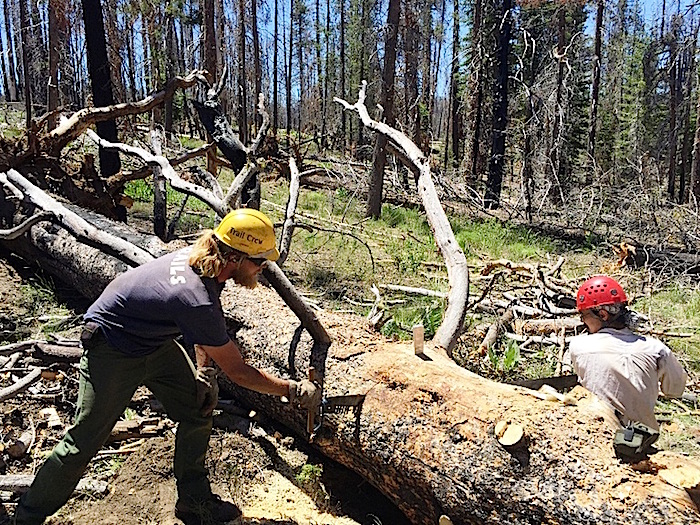
Sometimes, you just need to resort to sweat and muscles to get the job done. That was the case recently in the wilderness backcountry of Lassen Volcanic National Park in California, where crews worked to clear trails of trees knocked down by a wind storm back in February.
Especially hard hit was an eight-mile stretch of the Pacific Crest Trail at Lassen’s northern boundary near Badger Flats and Soap Lake.
“This was an extremely productive project, which was safely accomplished through our partnership with the Pacific Crest Trail Association,” said Superintendent Steve Gibbons.
The PCT traverses about 17 miles of Lassen’s designated wilderness, necessitating the use of cross-cut saws to clear trails. Eight volunteer Pacific Crest Trail Association cross-cut sawyers worked with six members of Lassen’s trail crew for four days to buck out the downed trees along the trail. Crews cleared 368 trees from the park’s northern boundary to the Nobles Emigrant Trail junction with an additional 50 trees cleared south to the Rainbow Lake area. The 17-mile section of the PCT running through Lassen Volcanic National Park is now clear of fallen trees, in time for the influx of thru-hikers currently making their way from Mexico to Canada.
The project attracted some of the most skilled volunteers and cross-cut saw aficionados from across northern California due to the sheer number of trees that needed to be removed. The project was proof positive that no blow down event is too big for a team of cross-cut sawyers to handle efficiently and safely.
“We are fortunate to have a dedicated trail crew and willing volunteers with specialty cross cut saw training under their belts to help take care of our park,” said Gibbons.
For trail information, campground openings, and current conditions to plan your trip, please visit the park website at www.nps.gov/lavo or contact the visitor center at 530-595-4480 or [email protected].
Stories about:
Story Categories:
A copy of National Parks Traveler's financial statements may be obtained by sending a stamped, self-addressed envelope to: National Parks Traveler, P.O. Box 980452, Park City, Utah 84098. National Parks Traveler was formed in the state of Utah for the purpose of informing and educating about national parks and protected areas.
Residents of the following states may obtain a copy of our financial and additional information as stated below:
- Florida: A COPY OF THE OFFICIAL REGISTRATION AND FINANCIAL INFORMATION FOR NATIONAL PARKS TRAVELER, (REGISTRATION NO. CH 51659), MAY BE OBTAINED FROM THE DIVISION OF CONSUMER SERVICES BY CALLING 800-435-7352 OR VISITING THEIR WEBSITE. REGISTRATION DOES NOT IMPLY ENDORSEMENT, APPROVAL, OR RECOMMENDATION BY THE STATE.
- Georgia: A full and fair description of the programs and financial statement summary of National Parks Traveler is available upon request at the office and phone number indicated above.
- Maryland: Documents and information submitted under the Maryland Solicitations Act are also available, for the cost of postage and copies, from the Secretary of State, State House, Annapolis, MD 21401 (410-974-5534).
- North Carolina: Financial information about this organization and a copy of its license are available from the State Solicitation Licensing Branch at 888-830-4989 or 919-807-2214. The license is not an endorsement by the State.
- Pennsylvania: The official registration and financial information of National Parks Traveler may be obtained from the Pennsylvania Department of State by calling 800-732-0999. Registration does not imply endorsement.
- Virginia: Financial statements are available from the Virginia Department of Agriculture and Consumer Services, 102 Governor Street, Richmond, Virginia 23219.
- Washington: National Parks Traveler is registered with Washington State’s Charities Program as required by law and additional information is available by calling 800-332-4483 or visiting www.sos.wa.gov/charities, or on file at Charities Division, Office of the Secretary of State, State of Washington, Olympia, WA 98504.


National parks and their natural resources belong to you. The National Parks Traveler works to ensure you know how these essential places are being cared for.
Sign Up For Our Weekly Newsletter
Unsubscribe at any time.
INN Member

The easiest way to explore RV-friendly National Park campgrounds.

Here’s the definitive guide to National Park System campgrounds where RVers can park their rigs.
Our app is packed with RVing- specific details on more than 250 campgrounds in more than 70 national parks.
You’ll also find stories about RVing in the parks, tips helpful if you’ve just recently become an RVer, and useful planning suggestions.


Comments
Hats off to the volunteers who performed all that hard work and sharpened all those saw teeth! Also to Lassen’s management for not taking the easy way out. The use of chainsaws for such work is more the rule than the exception in many western parks.
http://www.georgewright.org/283buono.pdf
Some might disagree with this story’s statement that “the project was proof positive that no blowdown event is too big for a team of cross-cut sawyers to handle efficiently and safely.” At NW parks, especially Olympic, strong windstorms can leave hundreds of trees up to six feet in diameter stacked three high on top of each other, often on steep slopes. The oldtimers didn’t bother with crosscuts for such blowdowns. It was easier and safer to drill holes with a large hand auger and dynamite the trails clear. .
"Also to Lassen’s management for not taking the easy way out."
God forbid we get 2-3x as much accomplished using the right tools. Banning chainsaws for trail work makes as much sense as banning bicycles.