
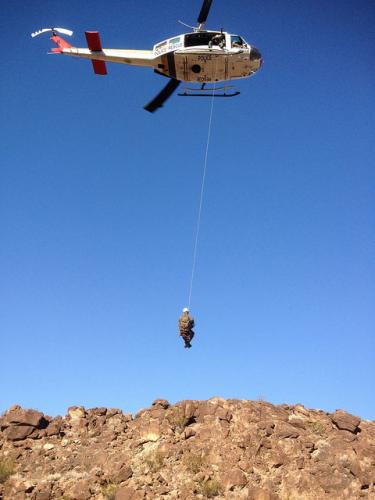
A member of the Las Vegas SAR team is being hoisted up during search and rescue operations at White Rock Canyon at Lake Mead National Recreation Area June 8, 2013. NPS photo.
After repeated problems with hikers failing to heed warnings about dangerous summer heat, officials at Lake Mead National Recreation Area are closing two trails until early September. A temporary emergency closure will go into effect on May 29 for the Goldstrike Canyon and Arizona Hot Spring Trails in an effort to prevent additional injuries and fatalities.
A similar closure was put into effect last year, but not until later in the summer. This year, officials are taking a more proactive approach after public safety incidents along the two trails doubled between 2013 and 2014. During the first seven months in 2014, these trails accounted for 37 incidents, resulting in three fatalities, 35 patients and 13 medical transports.
The summer of 2015 is barely underway on the calendar, but hot weather comes early to these harsh desert canyons, with temperatures already well above 100 the last weekend of May. In just the first five months of the current year, rangers have conducted fourteen search and rescue missions on the two trails, including five within the past week.
'People are miscalculating their ability to hike these strenuous trails in the summer, and it's not only endangering their lives, it's endangering the lives of other visitors and rescue crews,' said Patrick Gubbins, acting superintendent, Lake Mead National Recreation Area. 'These areas will re-open in the fall, when temperatures are cooler.'
An example of how badly things can go wrong in the heat occurred last summer, when 62-year-old James Johnson died on the trail to Arizona Hot Springs on June 3. His body was found about 150 yards from the Colorado River, and it's believed he attempted the hike without any water.
On June 8, 2013, rangers received reports that four Boy Scouts were lost near the Arizona Hot Springs and two adult males were suffering from heat stroke in the same area. Rescuers found one of the adults had died about one mile from the trailhead; the second was found in serious difficulty thirty minutes later; he was administered advanced life support and rescued by air two hours later.
The four Boy Scouts were located by Las Vegas Metropolitan Police Department Air Support, and were safely transported by air and treated by paramedics at the trailhead. These rescues required the efforts of about thirty personnel from the park and cooperating agencies.

No place to hide from the summer sun. This was the view from a helicopter of the area involved in a rescue on one of these trails in 2013. NPS photo.
Visitors can still access the popular hot springs via boat and the Colorado River, a route which not only requires a much shorter hike'but also keeps hikers closer to a source of emergency water in the river. The hot springs are located downstream from Hoover Dam, and the trails affected by the temporary closure begin along US 93 on both the Arizona and Nevada sides of the dam.
Those not familiar with the area may wonder why the trails in question are so dangerous, but the answer is a combination of terrain, distance and weather. The Goldstrike Canyon hike is described as "strenuous," and required both bouldering and climbing. The six-mile roundtrip may not sound unduly long, but combined with an elevation gain and loss of 800 feet, rough terrain and very high temperatures, the trip can tax the best-conditioned hiker.
I worked in this part of the park for three summers some years ago, and can attest to the draining nature of the heat. While the more open areas around Lake Mead itself may allow for a little relief from a breeze, the confined areas and bare rock leading down into both Black Canyon and White Rock Canyon are a literal oven, with the rock walls absorbing and radiating the sun's heat into confined spaces with a blast-furnace effect.
At the Willow Beach Ranger Station, a few miles downstream from the Arizona Hot Springs, it was not unusual for us to record summer temperatures above 120 degrees'and that's measured in the shade, which is a scarce commodity indeed in this area. That level of heat, combined with relative humidity readings in the single digits, can cause dehydration of the human body at an incredibly rapid rate.
One illustration of that drying effect was offered by my spouse, who, in an effort to hold down costs on my rookie ranger's salary, dutifully hung our laundry on an outside clothes line rather than using an electric dryer. She noted more than once that in the brief time it took to hang the last item from a load of wash on the line, the first items she had put out were already completely dry. That's dry!
Lake Mead does offers some fine opportunities for outdoor activities, including hiking, during the milder spring, fall and winter months, and water-based activities can be fun during the summer. When it comes to summer hiking, however, the park website offers some good advice: Don't.
For those who are determined to hike anyway, the park notes that the River Mountains Loop Trail and Historic Railroad Trail remain open, and are best enjoyed in the early morning hours. You'll find information about summer safety tips here.
Better yet, enjoy those fine hikes come October or so.
Stories about:
Story Categories:
A copy of National Parks Traveler's financial statements may be obtained by sending a stamped, self-addressed envelope to: National Parks Traveler, P.O. Box 980452, Park City, Utah 84098. National Parks Traveler was formed in the state of Utah for the purpose of informing and educating about national parks and protected areas.
Residents of the following states may obtain a copy of our financial and additional information as stated below:
- Florida: A COPY OF THE OFFICIAL REGISTRATION AND FINANCIAL INFORMATION FOR NATIONAL PARKS TRAVELER, (REGISTRATION NO. CH 51659), MAY BE OBTAINED FROM THE DIVISION OF CONSUMER SERVICES BY CALLING 800-435-7352 OR VISITING THEIR WEBSITE. REGISTRATION DOES NOT IMPLY ENDORSEMENT, APPROVAL, OR RECOMMENDATION BY THE STATE.
- Georgia: A full and fair description of the programs and financial statement summary of National Parks Traveler is available upon request at the office and phone number indicated above.
- Maryland: Documents and information submitted under the Maryland Solicitations Act are also available, for the cost of postage and copies, from the Secretary of State, State House, Annapolis, MD 21401 (410-974-5534).
- North Carolina: Financial information about this organization and a copy of its license are available from the State Solicitation Licensing Branch at 888-830-4989 or 919-807-2214. The license is not an endorsement by the State.
- Pennsylvania: The official registration and financial information of National Parks Traveler may be obtained from the Pennsylvania Department of State by calling 800-732-0999. Registration does not imply endorsement.
- Virginia: Financial statements are available from the Virginia Department of Agriculture and Consumer Services, 102 Governor Street, Richmond, Virginia 23219.
- Washington: National Parks Traveler is registered with Washington State’s Charities Program as required by law and additional information is available by calling 800-332-4483 or visiting www.sos.wa.gov/charities, or on file at Charities Division, Office of the Secretary of State, State of Washington, Olympia, WA 98504.


National parks and their natural resources belong to you. The National Parks Traveler works to ensure you know how these essential places are being cared for.
Sign Up For Our Weekly Newsletter
Unsubscribe at any time.
INN Member

The easiest way to explore RV-friendly National Park campgrounds.

Here’s the definitive guide to National Park System campgrounds where RVers can park their rigs.
Our app is packed with RVing- specific details on more than 250 campgrounds in more than 70 national parks.
You’ll also find stories about RVing in the parks, tips helpful if you’ve just recently become an RVer, and useful planning suggestions.

