
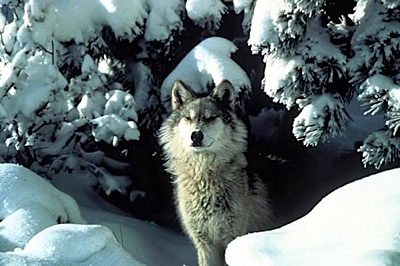
A decision announced Friday to delist wolves from Endangered Species Act protection in Wyoming has raised concerns that the action is premature. USFWS photo by Tracy Brooks.
In the wake Friday of the federal government's decision to remove wolves from Endangered Species Act protection in Wyoming, National Park Service officials were being asked to act to prevent the predators from being hunted in the John D. Rockefeller Jr. Memorial Parkway.
Under the delisting announcement made by the U.S. Fish and Wildlife Service, Wyoming would be handed management of wolves at the end of September. State officials have indicated they plan to open a hunting season for the predators on Oct. 1, with as many as 52 wolves permitted to be killed in the northwestern part of Wyoming. Outside of the state's northwestern corner wolves could be killed on sight as predators, with no bag limit.
"Current information indicates only about 10 percent of the Greater Yellowstone Area wolf population resides outside the Trophy Game Area in Wyoming, where they have been designated as predators and can be taken with very few restrictions," Fish and Wildlife officials said.
Federal law currently prohibits wolf hunts in either Yellowstone or Grand Teton national parks, although one could occur in the Parkway as early as next year, according to a USFWS release, unless the Park Service moves to halt it.
“It is truly a shame that after spending millions of taxpayer dollars to recover the gray wolf in this region that the federal government would choose to permit wolf hunting within our national parks," said Sharon Mader, Grand Teton program manager for the National Parks Conservation Association. "Permitting the hunting of an animal fresh off the Endangered Species List within a national park unit is unprecedented. Under the administration’s delisting rule, even those wolves seeking sanctuary in national park lands—America’s most sacred lands—could be hunted.”
In the Park Service's Intermountain Region Office, spokesman Patrick O'Driscoll said the agency was confident it could obtain a ban against hunting in the Parkway.
“We are working with the Wyoming Game and Fish Department, we intend to work with Wyoming Game and Fish to make sure that wolf hunting will never occur in the John D. Rockefeller Jr. Memorial Parkway," he said. “Rule-making (to ban hunting in the Parkway) is not on our radar. We don’t think we need to. We have a good enough relationship with the state of Wyoming and we have our own commitment not to allow hunting in the John D. Rockefeller Memorial Parkway.”
Interior Secretary Ken Salazar reached an agreement with Wyoming Gov. Matt Mead last summer to move forward with delisting wolves. Under the plan, the state committed to maintain a population of at least 100 wolves outside Yellowstone and Grand Teton.
In announcing their decision Friday, Fish and Wildlife Service officials said the grey wolf recovery program launched in the mid-1990s with the initial release of 14 wolves into Yellowstone has been highly successful.
"The most recent official minimum population estimate shows that the Northern Rocky Mountain wolf population contains more than 1,774 adult wolves and more than 109 breeding pairs. Most of the suitable habitat across the Northern Rocky Mountain region is now occupied and likely at, or above, long-term carrying capacity. This population has exceeded recovery goals for 10 consecutive years," they said in a release.
"The management framework adopted by the State is designed to maintain at least 150 wolves and 15 breeding pairs within the State of Wyoming. This is the same management objective as was adopted by the States of Montana and Idaho. The Service expects the Greater Yellowstone Area wolf population to maintain a long-term average of around 300 wolves, while the entire Northern Rocky Mountains Distinct Population Segment is expected to achieve a long-term average of around 1,000 wolves. These wolves represent a 400-mile southern range extension of a vast contiguous wolf population that numbers over 12,000 wolves in western Canada and about 65,000 wolves across all of Canada and Alaska."
Wyoming Game and Fish Department officials estimated the state's wolf population at 328 animals at the end of 2011, "including 48 packs and 27 breeding pairs. This included 224 wolves, 36 packs, and 19 breeding pairs outside Yellowstone National Park."
Conservationists were quick to criticize the USFWS's delisiting decision.
"In handing the management of wolves over to the states, the Service has failed to provide the leadership and demand the safeguards necessary to ensure that all of that hard work doesn’t just go to waste," Dr. Sylvia Fallon of the Natural Resources Defense Council wrote on her blog. "By initially setting recovery goals woefully too low, the Service has allowed the states to get away with managing the population down to inadequate minimums resulting in aggressive hunting and trapping seasons already established in both Idaho and Montana.
"Now, in an effort to finally wash their hands clean of wolves in the Rocky Mountains, they negotiated a deal to allow the state of Wyoming to treat wolves like vermin in the majority of the state – allowing wolves to be shot on sight for any reason – the exact type of practices that drove wolves to near extinction in the first place."
Story Categories:
A copy of National Parks Traveler's financial statements may be obtained by sending a stamped, self-addressed envelope to: National Parks Traveler, P.O. Box 980452, Park City, Utah 84098. National Parks Traveler was formed in the state of Utah for the purpose of informing and educating about national parks and protected areas.
Residents of the following states may obtain a copy of our financial and additional information as stated below:
- Florida: A COPY OF THE OFFICIAL REGISTRATION AND FINANCIAL INFORMATION FOR NATIONAL PARKS TRAVELER, (REGISTRATION NO. CH 51659), MAY BE OBTAINED FROM THE DIVISION OF CONSUMER SERVICES BY CALLING 800-435-7352 OR VISITING THEIR WEBSITE. REGISTRATION DOES NOT IMPLY ENDORSEMENT, APPROVAL, OR RECOMMENDATION BY THE STATE.
- Georgia: A full and fair description of the programs and financial statement summary of National Parks Traveler is available upon request at the office and phone number indicated above.
- Maryland: Documents and information submitted under the Maryland Solicitations Act are also available, for the cost of postage and copies, from the Secretary of State, State House, Annapolis, MD 21401 (410-974-5534).
- North Carolina: Financial information about this organization and a copy of its license are available from the State Solicitation Licensing Branch at 888-830-4989 or 919-807-2214. The license is not an endorsement by the State.
- Pennsylvania: The official registration and financial information of National Parks Traveler may be obtained from the Pennsylvania Department of State by calling 800-732-0999. Registration does not imply endorsement.
- Virginia: Financial statements are available from the Virginia Department of Agriculture and Consumer Services, 102 Governor Street, Richmond, Virginia 23219.
- Washington: National Parks Traveler is registered with Washington State’s Charities Program as required by law and additional information is available by calling 800-332-4483 or visiting www.sos.wa.gov/charities, or on file at Charities Division, Office of the Secretary of State, State of Washington, Olympia, WA 98504.
INN Member

The easiest way to explore RV-friendly National Park campgrounds.

Here’s the definitive guide to National Park System campgrounds where RVers can park their rigs.
Our app is packed with RVing- specific details on more than 250 campgrounds in more than 70 national parks.
You’ll also find stories about RVing in the parks, tips helpful if you’ve just recently become an RVer, and useful planning suggestions.


Comments
The cattle ranches of this area are the key ingredirent of this debate. There intrusion into this area for profit using leased goverment owned lands for grasing of their private interprise is disgusting. The american public is dinged X2 for the beef on their dinner plate (if they can even afford to have the meat on the plate) for these private interprises, they use our lands to fatten their cattle and charge the folks in the US that buy this beef a huge mark up, and when the original species see din din on the hoof, whine about their loss, which they apply for goverment funds to reminbuse them for the loss of these cattle.
National lands below to the people of the USA. Not a handful of wealthy or influencial western rangers who consider OUR LANDS their personal grazing grounds for profit.
The State of Wyoming has a long history of hating wolves. Remember that the Wyoming Farm Bureau tried right up until the last minute to stop wolves from being being reintroduced in Yellowstone.
Go on you tube and watch videos of how "sportsmen" (all laugh here) treat predators in Wyoming......I saw a video last week where this inbred named Tracy allowed his two hounds to kill a mother coyote and her two pups outside their den. His comment- they won't be taking any fawns anytime soon. This is the attitude of people in the NRM. There is no concept of stewardship of natural resources.....
We won't even get into the details of how the Wyoming plan became acceptable to the USFWS after years of being a deficient plan. Ashe appointment held up by Bourasso untilSalazar meets withMead to discuss Wyoming management plan. Theymeet-and presto-there is a plan agreed too. Right after Ashe gets his hold taken off by Bourasso and ashe and Salazar celebrate by going shopping for new rancher hats
Grazing fees on federal land will be the same in 2012. These fees are $1.35 per animal unit (one cow and a calf, five sheep, one horse, five goats). There are 26,000 permits granted in 16 western states, of which 3776 permits are onBLMland inMontanaand 772 permits on federal forests inMontana. How many of these ranchers on public land are complaining about the wolf, lion or grizzly attacking their stock or ungulates eating "their" grass? How many complained about the idea of a few bison being re-located out ofYellowstone? I have horses and pay $30.00 per month per head for private land. Ranchers and farmers in the west have been spoiled by the federal government as have the extraction industries. Entitlement, self-centered thinking, power and control, use of anger, victim stance thinking, sentimentality, and use of fear, power and control, concrete thinking, dehumanization of others are the core thinking errors of criminals too. We should keep this in mind when we hear of ranchers complaining about wildlife; sportsmen (hunters) too as they hunt on public land and complain about lions, bears, or wolves taking "their" elk-- hysterical exaggerations as it is with the ranchers. Another thought, how much of the beef is being sent to thePacific Rimwhile prices are going up here? Ranch on public land, farm on public land at a pittance, sell to the Asian markets? Complain about wildlife in a world that has shrinking wilderness and wildlife? More thinking errors: tunnel vision, exaggeration.
Excellent, Roger. Excellent.