
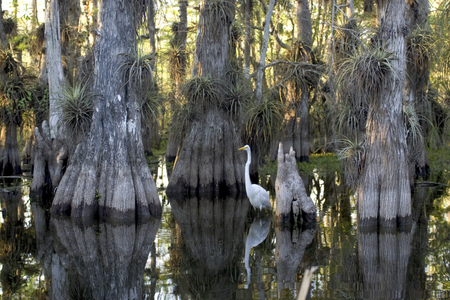
Great egret in cypress habitat at Everglades National Park. NPS photo.
Friends of the Everglades, a National Park Service partner of 40 years standing, is going through some tough times and must now regroup and rebuild. There’ll be tough sledding ahead for the venerable NGO, but nobody’s ready to panic.
When conservationist superstar Marjory Stoneman Douglas founded Friends of the Everglades back in 1969, a main purpose being to fight a proposed jetport that threatened the sanctity of Everglades National Park, environmental activists rallied to the cause and swelled the organization’s ranks. The Kissimmee/Okeechobee/Everglades ecosystem was clearly under assault from a wide variety of serious threats, and Friends of the Everglades was seen as just the sort of instrument needed to defend and restore it.
In the organization’s own words:
Our Mission is to preserve, protect, and restore the only Everglades in the world.
Our Goals:
• Compel government agencies to comply with existing environmental laws, and resist any efforts to weaken such laws
• Encourage politicians to recognize the long consequences of their actions.
• Spread awareness of the importance to the South Florida ecosystem.
Things worked out pretty well for Friends in its first 30 years or so of existence. It deservedly drew plenty of praise and lots of national attention for defeating the jetport proposal and helping to fend off threats to the Everglades ecosystem and Lake Okeechobee posed by water diversion, agricultural runoff and other pollutants, the westward sprawl of greater Miami, and related activities. Though Friends has strongly criticized the Comprehensive Everglades Restoration Plan (on grounds that it fails to adequately address many critical needs), it endorses the CERP’s broadly stated goal of restoring the Everglades ecosystem to something approximating natural functioning.
As anybody familiar with the organization’s hard-fought battles with the South Florida Water Management District and federal agencies can tell you, this NGO hasn’t shrunk from doing legal battle and has become very good at it. In the last decade Friends has filed or joined in at least ten lawsuits against the Federal government alone.
While the organization is best known for its legal actions in behalf of the Everglades, it has made important contributions of many types. Encouraging public awareness and participation in environmental issues is an important aspect of the Friends mission, and promoting environmental education in the Dade County public school system has been a pet cause. The organization’s Young Friends of the Everglades program is well run and very effective.
When Marjory Stoneman Douglas stepped down, she turned the Friends reins over to very capable leaders. One who played an especially vital role was Miami Herald environmental reporter Juanita Greene, who took over as Friends president and later served as conservation chair. (If you watched Ken Burns’ national parks documentary, you may recall that Ms. Greene not only championed Everglades causes, but also played an instrumental role in getting Biscayne National Park established.)
In its heyday, Friends of the Everglades attracted a lot of people and a lot of money. The NGO’s paid membership eventually topped out at about 4,000 and it had an operating budget of around $100,000. That’s a support base that many friends organizations would love to have. By 1994, Friends was operating out of an office in Miami, had two part-time employees (an administrator and a clerk), and seemed fated for bigger and better things.
But things have not been going well for Friends lately. Tough economic times have badly eroded the organization’s base of support. Paid membership has declined precipitously, reportedly to around 500. Revenues have fallen sharply as well, even though legal expenses and other costs create ever more pressing financial needs. The Miami office was recently closed, and the paid staff is down to one part-time clerk. To make things even worse, Juanita Greene recently retired and moved to Tallahassee to be nearer to her daughter, vacating her key position as Conservation Chair/First Vice President.
The organization is left with no choice but to regroup and rebuild. Acting president Connie Washburn has expressed confidence that this can be done well, albeit not quickly and easily. Good leadership is a vital component of the process, so it’s good to see that Juanita Greene’s replacement as conservation chair is Alan Farago, a lifelong activist with a strong environmental track record and a good feel for the South Florida political and environmental scenes. He and the other members of the Board of Directors can be expected to work very hard (and hopefully very effectively) to expand membership and boost the revenue stream.
Time will tell whether Friends of the Everglades can restore the membership levels and revenue stream that it enjoyed in its heyday. If you believe in this organization’s mission, you should fervently hope so.
Postscript: Friends of the Everglades founder Marjory Stoneman Douglas, daughter of Miami Herald founder Frank Stoneman, authored the influential book The Everglades: River of Grass in 1947. She died in 1998 at age 108 and her ashes were scattered in the Everglades.
Story Categories:
A copy of National Parks Traveler's financial statements may be obtained by sending a stamped, self-addressed envelope to: National Parks Traveler, P.O. Box 980452, Park City, Utah 84098. National Parks Traveler was formed in the state of Utah for the purpose of informing and educating about national parks and protected areas.
Residents of the following states may obtain a copy of our financial and additional information as stated below:
- Florida: A COPY OF THE OFFICIAL REGISTRATION AND FINANCIAL INFORMATION FOR NATIONAL PARKS TRAVELER, (REGISTRATION NO. CH 51659), MAY BE OBTAINED FROM THE DIVISION OF CONSUMER SERVICES BY CALLING 800-435-7352 OR VISITING THEIR WEBSITE. REGISTRATION DOES NOT IMPLY ENDORSEMENT, APPROVAL, OR RECOMMENDATION BY THE STATE.
- Georgia: A full and fair description of the programs and financial statement summary of National Parks Traveler is available upon request at the office and phone number indicated above.
- Maryland: Documents and information submitted under the Maryland Solicitations Act are also available, for the cost of postage and copies, from the Secretary of State, State House, Annapolis, MD 21401 (410-974-5534).
- North Carolina: Financial information about this organization and a copy of its license are available from the State Solicitation Licensing Branch at 888-830-4989 or 919-807-2214. The license is not an endorsement by the State.
- Pennsylvania: The official registration and financial information of National Parks Traveler may be obtained from the Pennsylvania Department of State by calling 800-732-0999. Registration does not imply endorsement.
- Virginia: Financial statements are available from the Virginia Department of Agriculture and Consumer Services, 102 Governor Street, Richmond, Virginia 23219.
- Washington: National Parks Traveler is registered with Washington State’s Charities Program as required by law and additional information is available by calling 800-332-4483 or visiting www.sos.wa.gov/charities, or on file at Charities Division, Office of the Secretary of State, State of Washington, Olympia, WA 98504.
INN Member

The easiest way to explore RV-friendly National Park campgrounds.

Here’s the definitive guide to National Park System campgrounds where RVers can park their rigs.
Our app is packed with RVing- specific details on more than 250 campgrounds in more than 70 national parks.
You’ll also find stories about RVing in the parks, tips helpful if you’ve just recently become an RVer, and useful planning suggestions.


Comments
It would be interesting to see how many other parks face a similar problem with their Friends organization. In some parks the Friends groups are a source of citizen input to the NPS to ensure that park managers maintain a focus on preservation of park resoruces. In other areas, the Friends groups have become major fund raisers to support park operations and mainenance in times of budetary shortfall. In still others, the Friends group provides a local source of volunteer trail and campground maintenance and staff for the winter information desk.
I wonder if there an overall analysis that compares differences in mission, membership, successes and challenges of Friends groups across the various units of the NPS? To what extent is particpation in a Friends group determined by economic cycles or cycles of perceived threats to the park?
Owen Hoffman
Oak Ridge, TN 37830
Mr Hoffman
If there is
"an overall analysis that compares differences in mission, membership, successes and challenges of Friends groups across the various units of the NPS? To what extent is particpation in a Friends group determined by economic cycles or cycles of perceived threats to the park?"
I would love to have access to it.
Seems to me that most Friends groups exist with little to no contact with other Friends groups.
Does the NPS like it that way?
In my 6 years of experience with a Friends group there have been a number of times when I wished there were some "friends" out there who had "been there/done that."
Lew Miller, Pres.
Friends of the Apostle Islands National Lakeshore
Lew, there is indeed a collection of friends groups, called the National Parks Friends Alliance. Its president is Curt Buchholtz, the executive director of the Rocky Mountain Nature Association, www.rmna.org, the friends group for Rocky Mountain National Park. You can reach him at (970) 586-0108. I'm sure he'd be happy to hear from you.
The failure to get a new lodge at Flamingo for visitors wishing to stay overnight in the Park, after going on 5 years from Katrina, should be an embarrassment to all associated with Park, including Friends of the Everglades. I hope a resurgent friends group will get this done.
Such a shame. I have the amazing honor of living in the home Marjory built and lived in for 82 years. I'm writing this in the very room where Friends of the Everglades was founded and based out of for many years. When I took the position that including being caretaker of her home I tried to join this group (figured it was the least I could do), but my queries were never answered.
I hope they are able to regroup.