
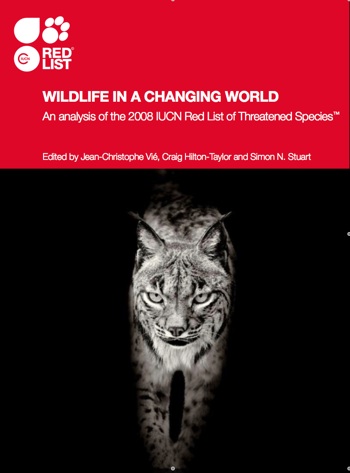
Seven years ago, governments around the world pledged to achieve a "significant reduction" in the ongoing loss of biodiversity by 2010. Unfortunately, the latest IUCN report says that goal will not be met, and that the wildlife crisis is greater than the world's economic crisis.
The report analyses 44,838 species on the IUCN Red List and presents results by groups of species, geographical regions, and different habitats, such as marine, freshwater and terrestrial.
It shows 869 species are Extinct or Extinct the Wild and this figure rises to 1,159 if the 290 Critically Endangered species tagged as Possibly Extinct are included. Overall, a minimum of 16,928 species are threatened with extinction. Considering that only 2.7 percent of the 1.8 million described species have been analyzed, this number is a gross underestimate, but it does provide a useful snapshot of what is happening to all forms of life on Earth.
"The report makes for depressing reading,” says Craig Hilton Taylor, manager of the IUCN Red List Unit and co-editor. “It tells us that the extinction crisis is as bad, or even worse, than we believed. But it also shows the trends these species are following and is therefore an essential part of decision-making processes. In the run-up to 2010, the global community should use this report wisely to address the situation.”
Likely to make the outlook worse is climate change, the report points out.
After examining the biological characteristics of 17,000 species of birds, amphibians and reef building corals, the report found that a significant proportion of species that are currently not threatened with extinction are susceptible to climate change. This includes 30 percent of non-threatened birds, 51 percent of non-threatened corals and 41 percent of non-threatened amphibians, which all have traits that make them susceptible to climate change.
Still, there are success stories, and some involve habitat in the national parks. For instance, in 2008 the IUCN reclassified the black-footed ferret from "extinct in the wild" to "endangered" thanks to a recovery program overseen by the U.S. Fish and Wildlife Service. Badlands National Park has proved to be a good home for the ferrets, as has Wind Cave National Park. Additionally, when the focus is on amphibian diversity, the group points to the southeastern United States as "a global centre for amphibian diversity, being particularly rich in salamanders," and of course Great Smoky Mountains National Park is arguably the salamander capital of the world.
To learn more about this sobering report, you can download a copy from this site: http://data.iucn.org/dbtw-wpd/edocs/RL-2009-001.pdf
Story Categories:
A copy of National Parks Traveler's financial statements may be obtained by sending a stamped, self-addressed envelope to: National Parks Traveler, P.O. Box 980452, Park City, Utah 84098. National Parks Traveler was formed in the state of Utah for the purpose of informing and educating about national parks and protected areas.
Residents of the following states may obtain a copy of our financial and additional information as stated below:
- Florida: A COPY OF THE OFFICIAL REGISTRATION AND FINANCIAL INFORMATION FOR NATIONAL PARKS TRAVELER, (REGISTRATION NO. CH 51659), MAY BE OBTAINED FROM THE DIVISION OF CONSUMER SERVICES BY CALLING 800-435-7352 OR VISITING THEIR WEBSITE. REGISTRATION DOES NOT IMPLY ENDORSEMENT, APPROVAL, OR RECOMMENDATION BY THE STATE.
- Georgia: A full and fair description of the programs and financial statement summary of National Parks Traveler is available upon request at the office and phone number indicated above.
- Maryland: Documents and information submitted under the Maryland Solicitations Act are also available, for the cost of postage and copies, from the Secretary of State, State House, Annapolis, MD 21401 (410-974-5534).
- North Carolina: Financial information about this organization and a copy of its license are available from the State Solicitation Licensing Branch at 888-830-4989 or 919-807-2214. The license is not an endorsement by the State.
- Pennsylvania: The official registration and financial information of National Parks Traveler may be obtained from the Pennsylvania Department of State by calling 800-732-0999. Registration does not imply endorsement.
- Virginia: Financial statements are available from the Virginia Department of Agriculture and Consumer Services, 102 Governor Street, Richmond, Virginia 23219.
- Washington: National Parks Traveler is registered with Washington State’s Charities Program as required by law and additional information is available by calling 800-332-4483 or visiting www.sos.wa.gov/charities, or on file at Charities Division, Office of the Secretary of State, State of Washington, Olympia, WA 98504.
INN Member

The easiest way to explore RV-friendly National Park campgrounds.

Here’s the definitive guide to National Park System campgrounds where RVers can park their rigs.
Our app is packed with RVing- specific details on more than 250 campgrounds in more than 70 national parks.
You’ll also find stories about RVing in the parks, tips helpful if you’ve just recently become an RVer, and useful planning suggestions.


Comments
The loss of global biodiversity is truly tragic and extremely concerning. The rate species are going extinction is phenomenal - and frightening. Indeed, it is being termed "The Seventh Great Extinction" ranking alongside other periods of enormous loss of life on earth. This goes far beyond the so-called "background extinction rate" that is within the envelop of normal specie loss by a factor of thousands. What must be kept in mind that humans do not exist apart from nature. We are part of the web of life. As strands break and disappear the entire web becomes more precarious.
Corporate America and Wall Street needs to take away the side eye blinders and take a hard look at the huge environmental damage that they have created here at home and abroad. Who's hands are on the chain saw, who's shoveling away the pristine mountain tops to get more coal, who's drilling into are oceans and wanting more coastal shorelines for more oil rigs, who wants more utility lines and mining done next to are national parks? Of course, it's corporate America, which to satisfy Wall Streets huge appetite for more greed and profit. Rape, greed and profit is the long standing motto of corporate America. Let's see them put 25% of there profits towards world conservation projects and show a true commitment in wanting to save the world species from near extinction. Please, no more fancy bill board commitments, or phony T.V. advertisements that displays a sugar coated concerns about saving the environment. But, a hard and honest display of true conservation stewardship in saving are world resources from holistic exploitation. Aldo Leopold, Rachel Carson and E.O. Wilson have it right...not Wall Street!!