
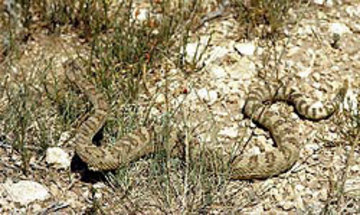
Great Basin rattlesnake. NPS photo.
When venomous snakes that endanger humans are moved elsewhere, translocation reduces survival rates. Snakes moved longer distances fare worse. At Great Basin National Park, wildlife biologists are studying translocated snakes to determine what translocation distance is “far enough.”
Venomous snakes, at least the native ones, are welcome in our national parks. But when these potentially dangerous reptiles turn up in the wrong places, such as park residential areas, campgrounds, visitors centers, busy trails and roads, and scenic overlooks, the potential for conflict often triggers intervention.
Killing a nuisance snake is not an option in a national park, so the normal procedure is to capture the snake and move it to a less problematic location. Park staff with appropriate training and experience can do this with little risk to themselves.
Unfortunately, studies have shown that translocated snakes have lower survival rates than snakes that are not moved. Distance matters, too. Snakes moved long distances – more than one kilometer (.62 miles) – have survival rates conspicuously lower than those moved shorter distances.
How far is “far enough”? Conceptually, it means a distance that is sufficient to eliminate the human-snake conflict that prompted the translocation without exposing the snake to unnecessary risk. Put into operation, it means that you stop after you reach an optimal distance because going further doesn’t make good sense.
Short distance moves of 100 meters or less are the preferred management option for rattlesnakes translocated in national parks. However, the argument for moves of this length rests mostly on anecdotal evidence or unstructured observation. Given a choice, wildlife managers would much rather base their managerial policies and practices on the results of empirical studies using scientific methods.
At Great Basin National Park, wildlife biologists are conducting such a study. The research findings will help to fine-tune current translocation guidelines for the park’s Great Basin rattlesnake (Crotalus lutosus). The Great Basin rattlesnake study is elegantly simple in design, if small in scale. Wildlife biologists had a veterinarian surgically implant temperature-sensing radio transmitters in three rattlesnakes, then released them within 100 meters of their capture sites. Each snake’s location and temperature (a key indicator of well-being) will be recorded weekly.
When scientists get good data, they try to make it serve as many useful purposes as practicable. Thus while the main goal here is put human-snake conflict reduction and associated tranlocation procedures on a more nearly scientific footing, the researchers expect the study to tell us useful things about rattlesnake natural history, movement patterns, and hibernacula (hibernation/overwintering shelters).
Postscript: And speaking of distance………. Go to this site and click on the speaker icon in the middle of the page about a third of the way down. .If you can hear this sound, you might consider putting some more distance between you and Crotalus lutosus.
Story Categories:
A copy of National Parks Traveler's financial statements may be obtained by sending a stamped, self-addressed envelope to: National Parks Traveler, P.O. Box 980452, Park City, Utah 84098. National Parks Traveler was formed in the state of Utah for the purpose of informing and educating about national parks and protected areas.
Residents of the following states may obtain a copy of our financial and additional information as stated below:
- Florida: A COPY OF THE OFFICIAL REGISTRATION AND FINANCIAL INFORMATION FOR NATIONAL PARKS TRAVELER, (REGISTRATION NO. CH 51659), MAY BE OBTAINED FROM THE DIVISION OF CONSUMER SERVICES BY CALLING 800-435-7352 OR VISITING THEIR WEBSITE. REGISTRATION DOES NOT IMPLY ENDORSEMENT, APPROVAL, OR RECOMMENDATION BY THE STATE.
- Georgia: A full and fair description of the programs and financial statement summary of National Parks Traveler is available upon request at the office and phone number indicated above.
- Maryland: Documents and information submitted under the Maryland Solicitations Act are also available, for the cost of postage and copies, from the Secretary of State, State House, Annapolis, MD 21401 (410-974-5534).
- North Carolina: Financial information about this organization and a copy of its license are available from the State Solicitation Licensing Branch at 888-830-4989 or 919-807-2214. The license is not an endorsement by the State.
- Pennsylvania: The official registration and financial information of National Parks Traveler may be obtained from the Pennsylvania Department of State by calling 800-732-0999. Registration does not imply endorsement.
- Virginia: Financial statements are available from the Virginia Department of Agriculture and Consumer Services, 102 Governor Street, Richmond, Virginia 23219.
- Washington: National Parks Traveler is registered with Washington State’s Charities Program as required by law and additional information is available by calling 800-332-4483 or visiting www.sos.wa.gov/charities, or on file at Charities Division, Office of the Secretary of State, State of Washington, Olympia, WA 98504.
INN Member

The easiest way to explore RV-friendly National Park campgrounds.

Here’s the definitive guide to National Park System campgrounds where RVers can park their rigs.
Our app is packed with RVing- specific details on more than 250 campgrounds in more than 70 national parks.
You’ll also find stories about RVing in the parks, tips helpful if you’ve just recently become an RVer, and useful planning suggestions.


Comments
I'm not sure what the issue is with Great Basin snakes, but I assume it's similar to problems with longer translocations of nuisance rattlers alluded to in a 2001 study Relocation of Nuisance Rattlesnakes: Problems Using Short-Distance Translocation in a Small Rural Community, which included this information:
I guess the bottom line here is that longer translocations leave the rattlers extremely upset, confused, and more likely to take lethaly dangerous risks while trying to find their way back to familiar habitat.
While working in one of the densest population areas of timber rattlers in the east, we were made aware of the study noted in the above message conducted in North Carolina. We started to relocate rattlers found in visitor use areas much shorter distances. Although we did not have the time to conduct any semblance of a scientific study, it did not seem that the snakes were returning to the high visibility areas frequented by people. I would find it of interest to see a study conducted on the movement of snakes relocated and the frequency that they reappear in areas that are of concern.
Just a thought for consideration by one of those grad students looking for a research topic.