
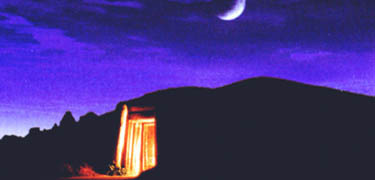
Should Ocmulgee National Monument, which preserves such vestiges of past cultures as this Earth Lodge, be renamed a national park? NPS photo.
While no decisions have been announced by the Interior Department as to how stimulus funds can best be used in the National Park System, there are plenty of suggestions being offered. One is to turn Omculgee National Monument into a national park.
It was back in 1934 when Ocmulgee National Monument, located in Macon, Georgia, was authorized to chronicle the connection between humans and nature going back more than 12,000 years. The monument, little more than 700 acres, contains traces of Southeastern culture starting with Ice Age residents to the historic Creek Confederacy. Within its borders you can find "massive temple mounds of a Mississippian Indian ceremonial complex that thrived between 900 and 1100 (AD) and many artifacts," notes the National Park Service.
Why should the monument be given "national park" status? Outwardly, says Richard Thorton, to bolster the economy in the Macon area. Beyond that, to honor earlier promises, he adds.
Mr. Thorton, an architect, city planner, and member of the Perdido Bay Muscogee (Creek) Tribe of Georgia and Florida, pointed out in an op-ed piece for the Macon Telegraph that it was in the 1930s, before the national monument designation was bestowed, that "civic leaders in Macon promoted the idea that the complex of Native American community sites on the south side of the Ocmulgee River should be acquired by the federal government and made into a national park" encompassing 2,000 acres.
"Once most of the land was acquired, an agreement was entered with the National Park Service by which if given the land by the people of Macon, a national park would be developed on the site. The donated land officially became federal property in 1936," he adds.
Well, on December 12, 1936, the land officially became part of the National Park System under the signature of President Franklin D. Roosevelt, but as a "national monument," not a "national park."
As many have pointed out over the years, a "national monument" in theory is treated the same as a "national park" by the National Park Service. However, as many chambers of commerce will add, the "national park" appendage carries much more cachet when it comes to tourists. Mr. Thorton adds that the difference in designation also has cost the monument itself, and the Interior Department can right that wrong by changing the designation.
The “monument” designation has condemned Ocmulgee to chronic under-funding and under-exposure. For many years, there has not even been a professional archaeologist assigned to Ocmulgee National Monument. In recent years, books on Native American archaeology barely mention Ocmulgee or don’t mention it at all. Archaeologists from outside the Southeast repeatedly regurgitate the poorly researched assumptions made by Ocmulgee’s archaeologists in the 1930s, when little else was know about the Native American civilizations in the Southeast.
So why should the federal government invest money into expanding and improving Ocmulgee National Monument into a full-blown “park” when the nation’s economy is in such dismal circumstances?
The most compelling answer is economic development. The Macon area, and Georgia in general, badly need an economic shot in the arm. Macon is centrally located and at the intersection of several major transportation routes. Increased economic activity in Macon would benefit the heart of the state. That increased economic activity would be a direct result of improving a very important archaeological zone into a major educational and recreational destination for heritage tourism.
I said “a major archaeological zone.” Why do archaeologists elsewhere and federal bureaucrats not seem to consider Ocmulgee important? In recent years the archaeological community has been discovering what Creeks have been telling them all along: Ocmulgee was where advanced Native American culture began in the Eastern United States. The recent discovery that the big mound at Cahokia, Ill. (Monks Mound) was started a hundred years after the Great Temple Mound at Ocmulgee goes a long way in proving that point. We also have been telling archaeologists forever — often to deaf ears — that the Creeks had contacts with the Mayas. We still have Maya and Totonac words in our language and Maya traditions in our heritage. We think Ocmulgee was founded by salt traders with Mesoamerican roots. In fact, hundreds of large ceramic brine drying trays (identical to those used by the Maya) were found at Ocmulgee in the 1930s.
Now, you can read the rest of his argument on this site. And, if you follow archaeology and historic and even prehistoric cultures, it's compelling.
But there are many other NPS properties that similar arguments no doubt can be made. For decades there have been efforts to change Dinosaur "National Monument" to Dinosaur National Park. The folks living near Cedar Breaks National Monument would prefer to have it called a national park. House Speaker Nancy Pelosi wants Golden Gate National Recreation Area transformed with the swish of a pen into Golden Gate National Parks (yes, plural).
The list goes on.
But the overriding question in the case at hand, as well as the other examples, is whether a redesignation of Ocmulgee National Monument to Ocmulgee National Park would be in the best interest of the National Park System as a whole? Already, with just 58 "national parks," the 391-unit system is far, far behind on its maintenance needs and obligations. Shouldn't the stimulus dollars that have been set aside for the National Park System try to erase some of that backlog, rather than adding to it?
And one would like to think the National Park Service could bolster the research mission of Ocmulgee National Monument without turning it into a "national park." Indeed, such a designation carries no magical power when it comes to obtaining the full potential of a unit of the National Park System. But if the monument were given the resources to transform itself into a regional research center of note, couldn't Mr. Thorton's goal be achieved just the same without a name change?
And while Mr. Thorton notes that Ocmulgee has no professional archaeologist on staff, he might find it interesting (or disappointing) that Grand Canyon National Park has no official staff geologist, that Mount Rainier National Park has no staff volcanologist, and that the Blue Ridge Parkway has no staff landscape architect.
There is no lack of needs around the National Park System. And while chambers of commerce across the nation no doubt would be thrilled to see the Park Service upgrade as many "national monuments" to "national parks" as possible, you have to ask whether the timing is right and the need worthy.
Story Categories:
A copy of National Parks Traveler's financial statements may be obtained by sending a stamped, self-addressed envelope to: National Parks Traveler, P.O. Box 980452, Park City, Utah 84098. National Parks Traveler was formed in the state of Utah for the purpose of informing and educating about national parks and protected areas.
Residents of the following states may obtain a copy of our financial and additional information as stated below:
- Florida: A COPY OF THE OFFICIAL REGISTRATION AND FINANCIAL INFORMATION FOR NATIONAL PARKS TRAVELER, (REGISTRATION NO. CH 51659), MAY BE OBTAINED FROM THE DIVISION OF CONSUMER SERVICES BY CALLING 800-435-7352 OR VISITING THEIR WEBSITE. REGISTRATION DOES NOT IMPLY ENDORSEMENT, APPROVAL, OR RECOMMENDATION BY THE STATE.
- Georgia: A full and fair description of the programs and financial statement summary of National Parks Traveler is available upon request at the office and phone number indicated above.
- Maryland: Documents and information submitted under the Maryland Solicitations Act are also available, for the cost of postage and copies, from the Secretary of State, State House, Annapolis, MD 21401 (410-974-5534).
- North Carolina: Financial information about this organization and a copy of its license are available from the State Solicitation Licensing Branch at 888-830-4989 or 919-807-2214. The license is not an endorsement by the State.
- Pennsylvania: The official registration and financial information of National Parks Traveler may be obtained from the Pennsylvania Department of State by calling 800-732-0999. Registration does not imply endorsement.
- Virginia: Financial statements are available from the Virginia Department of Agriculture and Consumer Services, 102 Governor Street, Richmond, Virginia 23219.
- Washington: National Parks Traveler is registered with Washington State’s Charities Program as required by law and additional information is available by calling 800-332-4483 or visiting www.sos.wa.gov/charities, or on file at Charities Division, Office of the Secretary of State, State of Washington, Olympia, WA 98504.
INN Member

The easiest way to explore RV-friendly National Park campgrounds.

Here’s the definitive guide to National Park System campgrounds where RVers can park their rigs.
Our app is packed with RVing- specific details on more than 250 campgrounds in more than 70 national parks.
You’ll also find stories about RVing in the parks, tips helpful if you’ve just recently become an RVer, and useful planning suggestions.


Comments
I hate this movement to change monuments to parks. We now have Black Canyon of the Gunnison National Park and Great Sand Dunes National Park. The monument designation made sense for those two parks, but the names were changed for political reasons. If we're going to negate the monument designation, then we'd might as well rename them all.
According to the Earth Lodge Historic Structure Report from 2005 http://www.nps.gov/history/history/online_books/ocmu/ocmu_earthlodge_hsr... its reconstruction in the 1930s and the subsequent activities were faulty and while the lodge is spectacular for the visitors it is not historically accurate. Most probably it was not covered in earth, but only the walls were earthen.
The most important features of Ocmulgee are the early mounds.
The proposal to redesignate Ocmulgee seems ill reasoned: As others mentioned, NPS units which are designated National Park are not necessarily appropriately funded. If the site is not mentioned in scientific or popular literature on Native Americans in the south east, it most probably is not because the site is a National Monument, but because the Earth Lodge does not fit in with anything elsewhere - and we know why by now.
Beamis,
Is it after 5 p.m. where you are? I think you're reaching with your latest comments. More isn't necessarily the merrier. Indeed, from where the Traveler is sitting, the NPS has more than enough on its plate right now. That's been our view for quite some time, and I reiterated it in the post above.
At least OCMU sits in a relatively accessible place - it's a perfect place to stop for people en route to/from Florida on I-75. Perhaps some more money spent on outreach?
I think you need to separate the politicians from the NPS and certainly from the Traveler.
Time and again I've pointed out -- as recently as March 1 -- that Congress likes to create parks, it just ain't that keen on funding them properly. I don't recall jumping on the bandwagon for spending stimulus funds willy-nilly just because someone dreams up a project where there's no need in the name of economic development.
Now, I'm going to hold back on how the stimulus funding is used in the National Park System until we have the plans in hand. If it's used to upgrade monuments to parks or build skywalks or the such, it's a waste of money.
But if it's used to help complete the Going-to-the-Sun Road restoration in Glacier, or to push forward the Everglades restoration, or build Dinosaur a new visitor center to replace the one that was condemned a couple of years ago, or repair leaking water systems or sewer systems elsewhere in the park system, I don't think you can argue that it's misspent money.
Now, many will disagree with the concept of stimulus funding for the weight it puts on the national debt, and that's understandable. But some of the economists whose words I've read think letting the economy crash and burn is a worse option.
Now, back to the stimulus package for the parks: Careful Traveler readers might remember this post following Interior Secretary Ken Salazar's first media teleconference back in January:
My concern then and now is that if Interior officials are banking on the stimulus package to cure the ills of the National Park System, then the future -- let alone the NPS Centennial in 2016 -- isn't too pretty. The $750million -$900 million tagged for the parks is a skinny shadow of the $9 billion needed to bring things up to snuff.
There needs to be a solid, realistic, long-term funding plan for the parks. And that hasn't materialized just yet. Even the Centennial Challenge would tackle only about a third of that backlog, and only if all the money were spent on the backlog, which it won't be.
Frank,
I disagree that the editors -- actually, editor, which would be me -- don't question the proposition of the stimulus. See my response to Beamis.
One does start to wonder if they shouldn't just rename everything a National Park and be done with it.
I would argue though, that what Park Advocates should campaign for would be legislation (ala the Antiquities Act) to allow the President to reclassify the designation of any NPS Property. This would require consolidating the number of designations in the National Park System to a small handful, based on the characteristics of use. For example, a "National Park" designation could be reserved for areas of at least a certain size that also include developed campgrounds for overnight stays, and maybe even also have at least one affiliated lodge for overnight stays as well. Remaining Natural Areas could then be designated National Monuments, or National Preserves. All the Battlefield designations could be consolidated as either National Battlefields or National Military Parks, etc.
That would at least make the names mean something, and might even resolve many of these branding debates that have proved to be such a distraction as of late...
In my opinion, the National Monument status is just fine for Ocmulgee. I'm not sure any place that's only 700 acres should receive the National Park status, and NM status seems particularly well-suited for an archaeology site.
Where does Beamis get the idea that national "parks" get more money that other designations. There is no evidence of such. Just look at the budgets of Lake Mead NRA, Gateway NRA, and Blue Ridge Parkway. Title designation is unrelated to funding.
Geez Beamis, stop whining! You sound like the whining party of "NO" to everything that President Obama's administration constructively wishes to do. Most prominent economic experts will agree that the stimulus package is a god send to many of the outer national parks towns and small cities. Such as adding more economic impetus to there lagging commercial markets that supply many of visitors with goods and supplies...and to the national parks. I assure you Beamis, in time you will see a more dynamic approach in re-tooling the national parks economies in a more transparent system in how they handle there expenditures with more accountability on resource management. That's something that the Bush & Cheney administration dare not do...and it's no guess why.
OK, OK, before things get, ahem, too unruly here, let me remind one and all of this site's Code of Conduct, and point out some of the key points:
* The authors of posts take responsibility for their words.
* Abusive comments and personal attacks will not be tolerated and will be deleted.
* Those behind abusive comments and personal attacks will be contacted privately and asked to be more constructive in their comments. If the comments and attacks persist, the author will be blocked from the site.
* Don't say anything online that you wouldn't say in person.
* If a subject of a post feels they have been wronged or simply wishes to respond in a post as opposed to a comment, that will be allowed.
Furthermore....
In general, we at the Traveler are pretty tolerant of comments. We do not want to sanitize this forum, nor do we want to create the impression that it tilts one way or the other politically or philosophically. Yet there is a line, one that should not be crossed, in the common decency of civil discourse.
In other words, let's play nice.
Kurt, your absolutely right...civility with the pen! Beamis, perhaps my literary and written skills are not as brilliant as yours. However, I do cherish the fact that I can put in my two cents worth of garble on NPT. It's a privilege to participate even if doesn't meet your expertise or critique as a notable piece of information. Besides, continuous whining with the pen begins to sound more like never ending soap opera.
Frank, I'm starting to feel like I'm herding cats. Thanks for your cooperation and understanding.
Hello,
I have been working to expand the Ocmulgee National Monument to a National Park for about twenty years. You are right that 700 acres or even 2,000 acres is too small for that status. If archaeology were the only value, I would also agree that it is insignificant to change the status. Ocmulgee is a major multiple mound site, which has been inhabited from Clovis to historic Creek times. Many more mounds and sites lie downriver, in an area which has been recognized as the third wildest area in Georgia, with one of the State's only three black bear habitats. Only one road crosses this fifty mile stretch of river and half of the landmass is already owned by a multitude of State, federal and local governments. The Ocmulgee Monument is Macon's number one tourism attraction and the Chamber of Commerce and Industrial Authority are pushing and funding the local share of a NPS boundary expansion study. The adjacent land being proposed to expand the Monument has already been donated or is already permanently preserved as wetland's mitigation or is county-owned. No Stimulus money is needed for this expansion. However, the larger vision is to create a 60,000 acre, 46 mile long National Park, by acquiring land to link the 47% of the existing river corridor, which is already preserved, yet under utilized. Since 90% is floodplain wetlands, the cost should range from $42 to $62 million. The benefits of unifying these lands and managing and promoting them for wildlife, cultural education and preservation, tourism, recreation and as a buffer zone for adjacent Robins Air Force Base, Georgia's largest employer, can be maximized by designating them as a national park.
If we don't save this area now, the archaeological sites will continue to be looted, the bears will gradually disappear and we will lose a last opportunity to save a unique portion of our natural and cultural heritage.
A new, local courthouse is estimated to cost $80 million and a new 5 mile, four-lane highway is estimated to cost $120 million. Where is the better, long-term value?
Please judge Ocmulgee on its own value. Not everything that has value has been saved and why not brand it for the highest economic return? We do want to get the most out of our public resources.
John Wilson
Macon, GA