
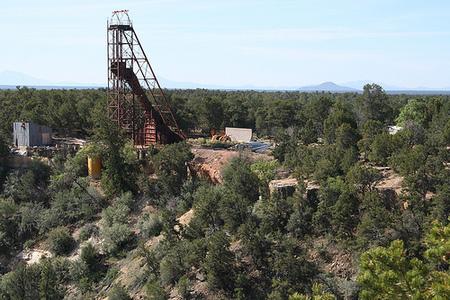
Orphan Mine, an abandoned uranium mine on the South Rim at Grand Canyon National Park. Photo by cogdogblog via Flickr.
The Orphan Mine, which produced uranium during 1956-1969 for America's Cold War nuclear weapons program, is situated on and below the South Rim at Grand Canyon National Park. Abandoned in 1969, the site is contaminated with hazardous materials, some of which are radioactive. Now the site must be cleaned up, and it’s a time-consuming, complicated process.
Recently, an NPS News Daily Headlines announcement originating at Grand Canyon National Park got me thinking about the past, present, and future impacts of uranium mines in and near our national parks. Here is the announcement in its entirety.
September 16, 2008
GRAND CANYON NATIONAL PARK
National Park Service to hold informational meetings on removal of man-made features at Orphan Mine Site within Grand Canyon National Park
Grand Canyon, Ariz. – The National Park Service (NPS) will hold three informational meetings, one in Flagstaff, AZ and two in Grand Canyon National Park, AZ to discuss the removal of man-made features at the Orphan Mine Site, located on the South Rim of the Grand Canyon.The first meeting will be held at the Coconino Forest Supervisors Office - Conference Room, located at 1824 S. Thompson St., Flagstaff on Monday, September 29, from 5:00 p.m. to 7:00 p.m. The second and third meetings will be held at the Shrine of the Ages Auditorium, on the South Rim of Grand Canyon National Park on Tuesday, September 30, from 10:00 a.m. to 12:00 noon and from 5:00 p.m. to 7:00 p.m.
The Orphan Mine Site (Site) was contaminated by historic uranium mining activity. The NPS will conduct an evaluation of cleanup alternatives, known as an “Engineering Evaluation/Cost Analysis” (EE/CA) for Operable Unit 1 (OU1) of the Orphan Mine Site (Site), which encompasses about 31 acres located on and immediately below the south rim of the canyon, to analyze the effectiveness, feasibility, and cost of various cleanup alternatives. Phase I of the OU1 EE/CA is the Man-Made Features Removal (MFR), which involves removing the abandoned mining equipment, debris, and certain other “man-made features” in order to collect additional soil samples. On-site work is expected to begin on or around November 1, 2008, and should be completed by February 1, 2009. The proposed activities will be discussed at the informational meetings.Phase II of the OU1 EE/CA, consisting of the field investigation and data collection/analysis, will be undertaken in 2009. Once completed, the OU1 EE/CA Report, including the analysis of cleanup alternatives and a recommendation regarding the preferred alternative, will be made available to the public for review and comment. In addition, a public meeting projected to take place in 2010 will be held to discuss the OU1 EE/CA Report. An EE/CA for OU2, which includes the middle and lower mine areas, will be completed at a later date.
The NPS is the lead agency under the Comprehensive Environmental Response, Compensation, and Liability Act (CERCLA) for site response action investigations, selection, and implementation. The NPS has determined that a CERCLA “non-time-critical removal action” is appropriate to address Site contaminants. When such a removal action is contemplated, applicable regulations require that an EE/CA be completed prior to the selection of the action. The Man-Made Features Removal is part of the EE/CA work plan for OU1, and is a necessary first phase to complete the investigation of contamination at the site.
Representatives from the NPS will be available at the informational meetings to provide background information, as well as information on the project scope and to answer any questions that the public and community of Grand Canyon may have.For additional information on this project or the public meetings please contact Maureen Oltrogge, Public Affairs Officer, at (928) 638-7779 or Shawn P. Mulligan, National Park Service, at (303) 415-9014.
Here is some relevant background info that mindat.org has supplied about the mine involved here.
A former underground [uranium-copper] mine with minor & trace commodities of Sb-Pb-Co-Au-Mn-Zn-Ag-Mo & baryte, located in the N½ sec. 14, T.31N., R.2E. (Bright Angel 15 minute topo map), 2 miles west of Grand Canyon Village on the South Rim of the canyon itself, immediately West of Maricopa Point. Discovered by Daniel L. Hogan in 1893 as a copper claim and dubbed the 'Orphan lode' by him. Converted to a uranium mine in 1956 and closed in 1969. Owned by Western Gold & Uranium, Inc.
..... Workings include 3 small, original workings, including a main adit. The middle working has a main adit about 25 feet long and about 15 feet of workings branching off. The lower working adit is about 45 feet long, turns and goes an additional 25 feet. There is a 1,600 foot deep shaft and crosscut more than 800 feet long.
Production for the period 1956-1969 was 4,260,000 pounds of U308 [triuranium octoxide, a uranium compound), plus 6,680,000 pounds of Cu [copper], 107,000 oz. of Ag [silver] and 3,400 pounds of [vanadium pentoxide].
Note that the man who discovered the mineral deposits back in 1893 gave this site the name Orphan Lode, which evolved into Orphan Mine. Ironically, “orphan mine” is now the term used to denote a mine that has been abandoned. Ergo, the Orphan Mine is an orphan mine.
Location matters. The abandoned Orphan Mine is situated in Grand Canyon National Park on and below the South Rim between Maricopa Point and Powell Memorial about two miles west of Grand Canyon Village. This is adjacent to the West Rim Drive.
Hikers on the South Rim Trail must detour around the upper part of the mine site, which has been fenced to prevent visitors from coming into contact with radioactive materials or contaminated mining wastes. The middle and lower parts of the site, which are below the rim and inaccessible to visitors, are also contaminated. The middle part of the site has contaminated wastes along the path of an aerial tramway that ran there until it was removed after being replaced by a hoisting shaft in 1959. The original "glory hole" in the lower part of the site (clearly visible from Maricopa Point) is also radioactive.
The National Park Service acquired the patented land at the mine site in 1963. Extraction rights retained by the operator expired in 1987.
During the period 1956-1969 this underground mine produced, among other things, 2,130 tons of U3O8, a uranium compound that is a naturally occurring (and comparatively stable) form of yellowcake. Yellowcake, which is commonly produced in concentrated form by refining mills as an intermediate step in ore processing, is further processed (and may be enriched) to manufacture nuclear weapons or reactor fuel for nuclear fission power plants. (We have a plant that makes nuclear fuel assemblies right here in Columbia, South Carolina.) Although this mine produced 3,349 tons of copper and appreciable amounts of other valuable metals and minerals during its working life, it is the uranium production history of this mine that makes the abandoned site a matter of concern.
The National Park Service's preliminary environmental investigations of the upper mine area confirmed the presence of hazardous materials. The tailings (waste rock) and ore at this site are radiologically contaminated. Radiation levels are elevated (in excess of 0.057 mR/hour) on at least 10 acres of the site and in a visitor-use area to the west. The combined beta and gamma counts sometimes exceed 3.0 mR/hour.
Having confirmed that hazardous materials are present, the Park Service initiated further evaluation pursuant to the provisions of the Comprehensive Environmental Response, Compensation, and Liability act (CERCLA). The ensuing Engineering Evaluation/Cost Analysis (EE/CA) will analyze the necessity for cleanup action and the cost of various cleanup alternatives for the upper mine area. When finished, the EE/CA will be made available for public review and comment.
As you can see, this is a very methodical and time-consuming process. The EE/CA process for the middle and lower parts of the mine site is not even scheduled to begin until 2010.
Story Categories:
A copy of National Parks Traveler's financial statements may be obtained by sending a stamped, self-addressed envelope to: National Parks Traveler, P.O. Box 980452, Park City, Utah 84098. National Parks Traveler was formed in the state of Utah for the purpose of informing and educating about national parks and protected areas.
Residents of the following states may obtain a copy of our financial and additional information as stated below:
- Florida: A COPY OF THE OFFICIAL REGISTRATION AND FINANCIAL INFORMATION FOR NATIONAL PARKS TRAVELER, (REGISTRATION NO. CH 51659), MAY BE OBTAINED FROM THE DIVISION OF CONSUMER SERVICES BY CALLING 800-435-7352 OR VISITING THEIR WEBSITE. REGISTRATION DOES NOT IMPLY ENDORSEMENT, APPROVAL, OR RECOMMENDATION BY THE STATE.
- Georgia: A full and fair description of the programs and financial statement summary of National Parks Traveler is available upon request at the office and phone number indicated above.
- Maryland: Documents and information submitted under the Maryland Solicitations Act are also available, for the cost of postage and copies, from the Secretary of State, State House, Annapolis, MD 21401 (410-974-5534).
- North Carolina: Financial information about this organization and a copy of its license are available from the State Solicitation Licensing Branch at 888-830-4989 or 919-807-2214. The license is not an endorsement by the State.
- Pennsylvania: The official registration and financial information of National Parks Traveler may be obtained from the Pennsylvania Department of State by calling 800-732-0999. Registration does not imply endorsement.
- Virginia: Financial statements are available from the Virginia Department of Agriculture and Consumer Services, 102 Governor Street, Richmond, Virginia 23219.
- Washington: National Parks Traveler is registered with Washington State’s Charities Program as required by law and additional information is available by calling 800-332-4483 or visiting www.sos.wa.gov/charities, or on file at Charities Division, Office of the Secretary of State, State of Washington, Olympia, WA 98504.
INN Member

The easiest way to explore RV-friendly National Park campgrounds.

Here’s the definitive guide to National Park System campgrounds where RVers can park their rigs.
Our app is packed with RVing- specific details on more than 250 campgrounds in more than 70 national parks.
You’ll also find stories about RVing in the parks, tips helpful if you’ve just recently become an RVer, and useful planning suggestions.


Comments
The costs are one side, but outside of the National Park is the land of the Navajo Nation. People and livestock there use water that is contaminated by abandoned uranium mines that are all over the tribal land. In a study of the Ojato Chapter of the Navajo's land done by EPA every well on the Arizona side was contaminated and all but one on the adjacent Utah part.
This map shows abandoned mines, wells and contaminated areas:
Attention: The file is huge.
http://yosemite.epa.gov/r9/sfund/r9sfdocw.nsf/63d4ce17a198b2e3882573c500...$FILE/Oljato.pdf
That is an interesting point about the contaminated well water that I hadn't considered. Is there any hope of cleaning up the wells or has the damage already been done beyond repair? Most people do not understand the true imapct that mining has, and really I think we are still learning the far reaching effects of it. The dollars and cents of it is just one little aspect of it.
A few comments on this article seem to be in order. During at least the early operating period for this mine, much of the uranium that was produced in this country and in Canada was for use by the US Government in producing nuclear weapons for the Cold War. This is also true for much of the milling capacity that was in existence at the same time. Most of these historic mills are now reclaimed. In many cases, the older Title I mills were reclaimed using funds from the Department of Energy under the UMTRA program since they produced during the 50's and early 60's strictly to supply the AEC with feed material for the weapons complex. The point is that at least some if not all of the costs to reclaim this mine are due to the Cold War and not nuclear power.
An additional point is that there is an Abandoned Mine Land program run by the Office of Surface Mines in the Department of the Interior that is funded by a fee collected on every ton of coal mined in this country. The latest annual report (at http://www.osmre.gov/annualreports/annualreport06.htm) indicates that $3 billion dollars has been spent to address abandoned mines since 1977. This money is used for coal and non coal mines. In 2006, the Navajo Nation received over $2 million dollars from OSM for abandoned mine work. Unfortunately, the NPS bought the property and may not be eligible for these funds.
The comments about uranium in well water neglects the fact that uranium is ubiquitous in nature and is found in naturally-occuring concentrations well in excess of drinking water standards in areas where there is no history of uranium mining. The USGS ran a program in the late 1970's to identify potential uranium resources, in part by sampling groundwater. This data (called the National Uranium Resource Evaluation) helps to show the prevalence of uranium in groundwater all over this country, but particularly in the Colorado Plateau/Four Corners region, so it should be no surprise that some wells on the Navajo Nation have high uranium concentrations. This is not to say that the wells cited by the commenter were not affected by abandoned mines in the vicinity; it is meant to point out that there may be other causes of high uranium. If they are affected by abandoned mines, this is the purpose of the AML program mentioned above and the Navajo Nation should be addressing those mines. See the NURE data at http://pubs.usgs.gov/of/1997/ofr-97-0492/
Finally, the make-a-mess-and-walk-away attitude of the past applied to all industries in our country...not just mining. Anyone around at the time can recall the Cuyahoga River catching on fire and Love Canal. Thanks to these disasters, we now have stringent environmental laws under NEPA but are unfortunately still dealing with the legacy of the approach by past generations. Among the worst of these sites are those associated with weapons development for the Cold War. Take a look at the billions spent by DOE (and yet to be spent) to clean up the old weapons complex sites. As far as the nuclear power industry, it was alway blessed with stringent safety and environmental standards under regulations by the NRC.
The bottom line is that the premise of this story is incorrect. The costs of cleaning up this mine near a national treasure are not a hidden cost of nuclear power but part of a huge public cost of cleaning up sites that are a legacy of ignoring the environmental impact of most anything that we did up until the last 3 decades.
I would second what MLG said. Also, the article said "During the period 1956-1969 this underground mine produced, among other things, 2,130 tons of U3O8, a naturally occurring uranium compound called yellowcake." Yellowcake is not naturally occurring. It occurs during the processing of the uranium ore.
You're right, Frank. Triuranium octoxide (U308) is a naturally occurring -- and unusually stable -- form of yellowcake. PM is partly correct. Some kinds of yellowcake are products of milling. Not this one, though.
The yellowcake that the Orphan Mine produced was indeed intended for America's Cold War nuclear weapons program, not nuclear power production. I revised the article and removed the reference to nuclear power production. If you'd like to dig deeper into this subject, see Michael A. Amundson, "Mining the Grand Canyon to Save It:The Orphan Lode Uranium Mine and National Security," The Western Historical Quarterly Vol. 32, No. 3 (Autumn 2001). Here is the abstract:
Thanks for your information. There is an personal account book written about workings of this mine that can provide more information and a richer understanding for those interested.
An Ebook is available about the history of the Grand Canyon Orphan Mine (updated from the printed book), written by the former Supervisor and his Geoloist wife - Maurice and Lorraine Castagne.
This book provides the reader with an inside look into the operation and workings of this "one of a kind" mine, with underground and surface photos, mining diagrams, mining terminology, and shared stories and happenings of one who was there.
This book provides a "inside look" into the miner's life, thier families and ties with the Grand Canyon Village, AZ.
It's too bad the uranium had to be mined at all. Then the mess wouldn't need to be cleaned up.
Bryan
How the cleanup affected Bryan has nothing to do with the history of the time. Just like the Twin Towers going down; if they'd not been build there wouldn't be any mess to clean up? Mining is what enables computers to be built, cars and even toothpaste. The original copper mine of Hogan became something different that employed many and served it's purpose. Unlike the mindset of some that helped and enabled the Towers to be brought down, because of vain ignorance, believing lies and being deceived, The Truth is greater than limited personal thoughts or beliefs. Truth stands like the Orphan Headframe did and is obvious, even when the physical is gone. Truth remains and not self-engrossed manipulated falacies. Eternity will not condemn this little mine, but little minds will be seen for what they are.
What a bunch of uranium mining industry hooey! The truth is the mine sent ore to concentrating facilities in Tuba City which used baffling concentrator. Nearly every bit of Uranium ore before 1954 was used for nuclear weapons, but the AEC started using more and more for research into making fuel rods. The nuclear energy industry started cutting into consumption begining in 1958, while the first nuclear power plant to generate electricity for the public operated by the AEC went into service in 1957. By 1960 nuclear power plants were springing up around the county. Most uranium ore produced in the U.S. after 1960 went to seeding breeder reactors. The uranium ore in the Ophan consisted primarily of Urananite but there were very substantial amounts of torbernite, meta-torbernite, tyuyamunite, metatyuyamunite, carnotite, zunerite, meta-zunerite, uranophane just to name a few. These secondary minerals, most formed from weathering and meteoric sourced diagenesis of urananite, are much more water soluable than urananite and are the cheif cotributors to the contamination at springs and creeks below the North and South Rims. As for it being harmless, you need to go down to Horn Creek and Salt Creek and start drinking the water yourself. After about a year you would have better than a 50% chance of suffering from radiation poisoning. Salt Creek spring consistantly exceeds EPA Maximum Contaminant Level (MCL) limits for uranium and Horn Creek, sampled in June to July 2002, was found to be 10x worse. You aren't facing a little mind here. I've been in mining all my life, and if it weren't for WWII I would be a fifth generation(instead of fourth) miner. If I had seen your posts seven years ago, I would have been even more disturbed by your obvious hacks against the very truth you profess. After more than fifty years of hiking the Grand Canyon and fighting nuclear energy (I bet you weren't wearing PPE to help with cleanups on Three Mile Island, The Hanford Plant, Chernobyl or Fukushima Diichi.) No, eternal damnation awaits those who cut corners when it comes to safety design, expect others to take care of their toxic wastes, cut even more corners on safety design and ignore environmental geologic warnings in order to feed their lust for energy and the money it generates. Screw the generations who follow; I want it now! I'll be dead and gone before it affects me, right? By the way, what do the Twin Towers have to do with U-238's half life which is the same as the age of the Earth? How about U-235 at more than 700 million years? How about U-236 at 23 million years. How would you like any of those in your kidneys, because that, along with radioactive Po, Ra, Pa, Ac, Pb and a host of thers, is where they will be if you take my Horn Creek challenge. It is you, not those you accuse of being small minded who doesn't have a handle on the truth. You are a mouthpiece, maybe unwittingly, for a dying industry. I appreciate your attempt at sunshiney piling on with double speak projection but it is terribly sophistic and dangerous. If you want to know what impartial, real science says about this, go to the USGS, or are you just certain anyone who doesn't believe in any of your baseless assertions is small minded? Twin Towers are long gone; Hanford will be with us for hundreds of generations and so will post mining breccia pipes. If the short comings of nuclear energy can be overcome, I have no problem with it. Sooner or later solutions will be found, but in the meantime we have broken poison vessels leaking into our drinking water. I bet you are thinking "What does Horn Creek have to do with your drinking water?" It is diluted by non-radioactive water from the River basin but contaminated more by the breccia pipes that have been disturbed by mining on both sides of the River. Forty Million people rely on the Colorado for their water. Shouldn't we be more concerned about them than a couple hundred miners who would be better off mining a different resource anyway? Many mines are chasing other, less dangerous resources, and are clamoring for good miners. Suck it up and do the right thing. Learn another mining skill. Your "truth" has been taken down, just like the Ophan headframe.
WShouldn't the mine owners cvlean it up?