
- By Tim Erickson - December 4th, 2025 4:53am
Colorado hookless Cactus
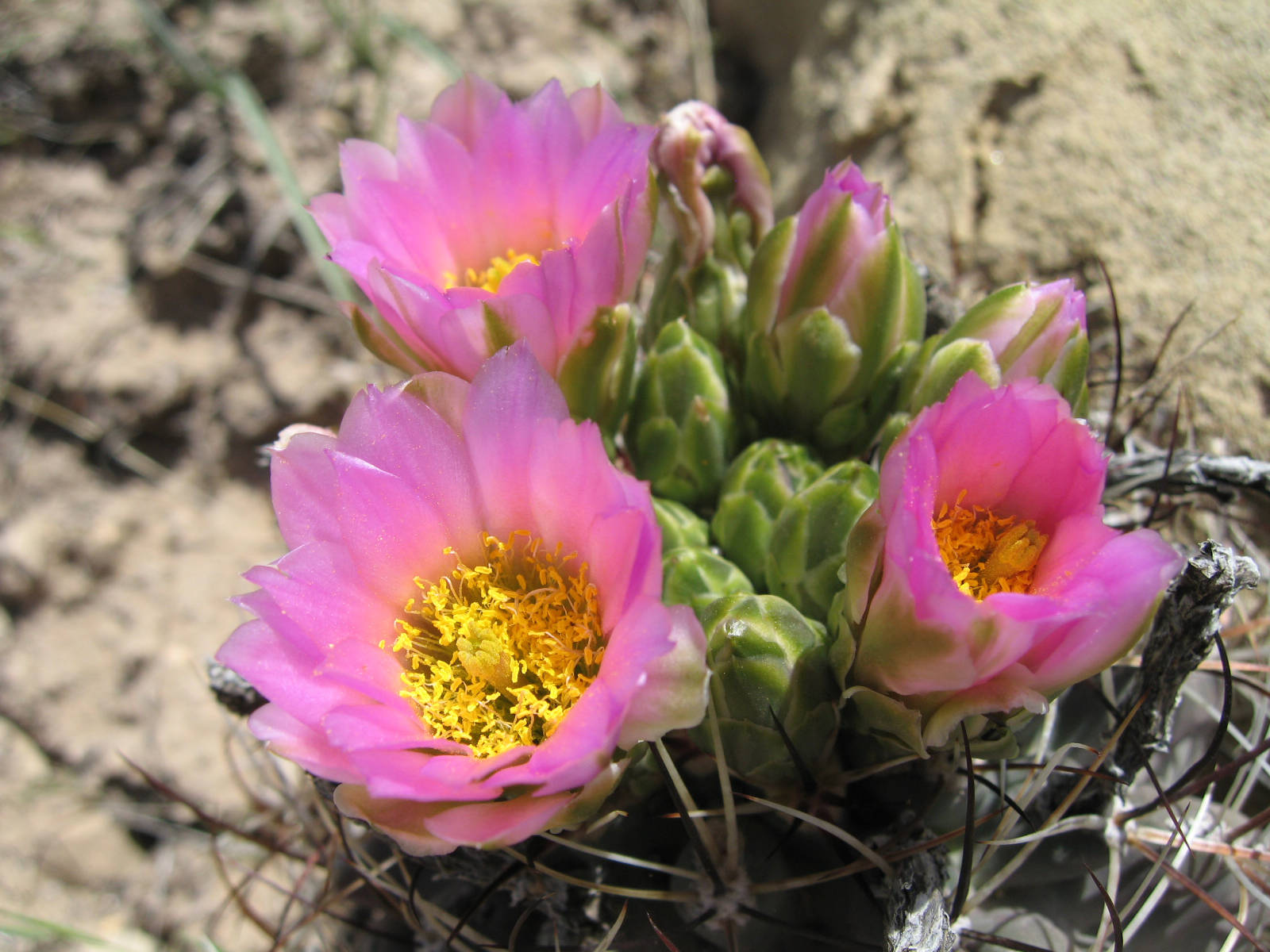
Sclerocactus glaucus
Status:
Threatened
Type:
General Information
The Colorado hookless cactus is a barrel shaped cactus that ranges from 1.2 to 4.8 inches (in.) (3 to 12 centimeters (cm)) tall, with exceptional plants up to 12 in. (30 cm) tall. Stems range from 1.6 to 3.6 in. (4 to 9 cm) in diameter. The stems have 8 to 15 (typically 12 or 13) ribs that extend from the ground to the tip of the plant. Along the ribs are areoles (small, cushion-like areas) with hooked spines radiating out (Heil and Porter 2004). There are two types of spines, radial and central, defined by the size and position on the plant (see Figure 1) (74 FR 47112, September 15, 2009). The 2 to 12 radial spines are located around the margin of the areole, extending in a plane parallel to the body of the plant. The radial spines are white or gray to light brown. They are up to 0.67 in. (17 millimeters (mm)) long, and less than 0.04 in. (1 mm) in diameter. The one to five central spines (usually three) are 0.5 to 2.0 in. (12 to 50 mm) long, are generally longer than radial spines, and extend from the center of the areole. The central spines include abaxial and lateral forms. Abaxial spines are typically single, point toward the top of the plant, and are noticeably bent at the tip at an angle usually less than 90 degrees. Lateral spines are usually present in pairs on either side of the abaxial spine, but are more or less straight and diverge from the abaxial spine at an acute angle (usually 20 to 50 degrees).The flowers are usually funnel-shaped, but sometimes bell-shaped. They usually have pink to violet tepals (petal-like flower parts not differentiated into petals and sepals) with yellow stamens (the male reproductive organ of the flower), and are 1.2 to 2.4 in. (3 to 6 cm) long and 1.2 to 2 in. (3 to 5 cm) in diameter. The fruit is short, barrel-shaped 0.31 to 0.47 in. (8 to 12 mm) wide, and 0.35 to 1.2 in. (9 to 30 mm) long.
The species historical range included Colorado. See below for information about where the species is known or believed to occur.
Habitat Requirements
Populations of Colorado hookless cactus occur primarily on alluvial benches (soils deposited by water) along the Colorado and Gunnison Rivers and their tributaries. Colorado hookless cactus generally occurs on gravelly or rocky surfaces on river terrace deposits and lower mesa slopes. Exposures vary, but Colorado hookless cactus is more abundant on south-facing slopes (Colorado Natural Heritage Program. Soils are usually coarse, gravelly river alluvium above the river flood plains, usually consisting of Mancos shale with volcanic cobbles and pebbles on the surface. Elevations range from 3,900 to 6,000 feet (ft) (1,400 to 2,000 meters (m)) (Heil and Porter 2004). Associated desert shrubland vegetation includes shadscale (Atriplex confertifolia), galleta grass (Pleuraphis jamesii), black-sage (Artemisia nova), and Indian rice grass (Achnatherum hymenoides). Populations also exist in big sagebrush (Artemisia tridentata) dominated sites and in the transition zone from sagebrush to pinyon-juniper (Pinus edulis and Juniperus osteosperma) communities.
Food Habits
Movement / Home Range
Distribution, Abundance, and Trends: Colorado hookless cactus is an endemic plant found in Delta, Montrose, Mesa, and Garfield Counties, Colorado. There are two population centers of Colorado hookless cactus: (1) on alluvial river terraces of the Gunnison River from near Delta, Colorado, to southern Mesa County, Colorado; and (2) on alluvial river terraces of the Colorado River and in the Plateau and Roan Creek drainages in the vicinity of DeBeque, Colorado. These populations may be morphologically and genetically discrete from each other. Introgression with S. parviflorus may play a role in these differences. This issue is being researched by the Denver Botanic Gardens.
Reproductive Strategy
Pollination is likely carried out by a broad assemblage of native bees and other insects, including ants and beetles.
Other
For more information:


National parks and their natural resources belong to you. The National Parks Traveler works to ensure you know how these essential places are being cared for.
Sign Up For Our Weekly Newsletter
Unsubscribe at any time.

INN Member

The easiest way to explore RV-friendly National Park campgrounds.

Here’s the definitive guide to National Park System campgrounds where RVers can park their rigs.
Our app is packed with RVing- specific details on more than 250 campgrounds in more than 70 national parks.
You’ll also find stories about RVing in the parks, tips helpful if you’ve just recently become an RVer, and useful planning suggestions.

