
Curecanti National Recreation Area (NRA) in Colorado is open year-round, so don’t let the cold and snowy weather of winter stop you from enjoying the park. In fact, there are some activities you can do only during winter.
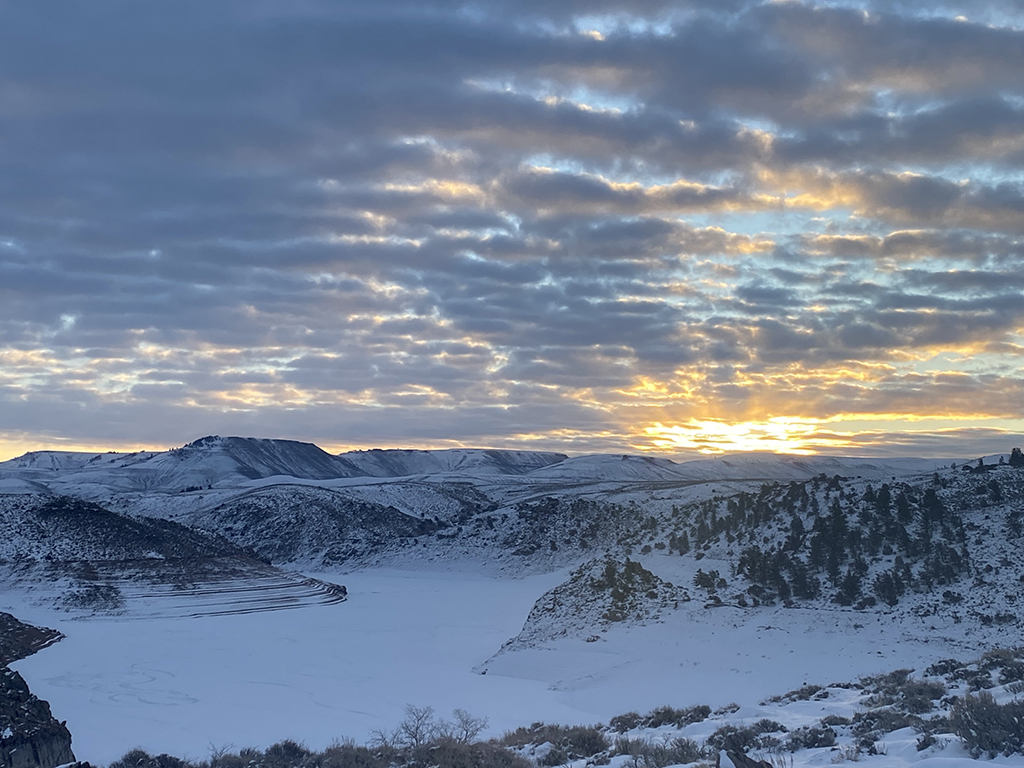
Ice Skating
Although there is not as much snow at the lower elevations of the park, winters can get harsh at Curecanti NRA, with temperatures ranging between 20 degrees Fahrenheit to 30 degrees Fahrenheit (-7 degrees Celsius to -1 degree Celsius) and overnight lows frequently dipping well below zero, sometimes reaching -40 degrees Fahrenheit (-40 degrees Celsius). As such, the edges around Blue Mesa Reservoir can freeze between 4-24 inches (10-61 centimeters) – enough for a little “wild ice” skating.
Where’s a good place to glide on the ice? Park Staff recommend Iola Basin, on the far west side of the park.
Note: The National Park Service does not monitor ice conditions. You are responsible for your own safety and should check ice thickness yourself. It is highly recommended to wear a personal flotation device (PFD), avoid skating alone, and carry ice picks. Watch out for pressure ridges, ice fishing holes, and varying ice thickness, especially near running water.
It’s a good idea to check ice conditions at the reservoirs. According to Park Staff:
Blue Mesa Reservoir
The reservoir starts to freeze at the east end. By the end of December, the ice thickness typically ranges from 4-12 inches (10-30 centimeters). Blue Mesa is usually covered with ice by mid-January. Ice thickness averages between 4-24 inches (10-61 centimeters). By May, the reservoir is free of ice.
Morrow Point and Crystal Reservoirs
Ice conditions on these reservoirs are highly variable and difficult to predict. Ice thickness is not monitored regularly in these areas.
Safety Tips
Ice clouded with air bubbles could mean weaker ice.
Avoid areas with partially submerged obstacles and artificial structures that cause weak ice.
Ice over running water is weaker than ice over still water.
Ice is never 100 percent safe, even under perfect conditions.
Beware of pressure ridges that cross the frozen surface of the reservoir. A pressure ridge is a line or wall of broken ice caused by forces pushing the ice. Load bearing capacity can be reduced in these areas or even have open water under them.
Bring a PFD (personal flotation device) when going onto any frozen body of water.
Thicker ice can support more weight. The National Park Service uses the equation P = 50 x T2, where P is the maximum weight in pounds that clear, solid lake ice should be able to support, and T is the ice thickness in inches.
This table gives estimates for the weight capacity of different ice thicknesses. Note: These guidelines are determined using clear, solid lake ice (i.e., no air bubbles, no structural weaknesses, etc.).
Ice Thickness
Weight Capacity
2 inches (5 cm)
200 lbs (91 kg)
4 inches (10 cm)
800 lbs (363 kg)
6 inches (15 cm)
1,800 lbs (816 kg)
Ice Fishing
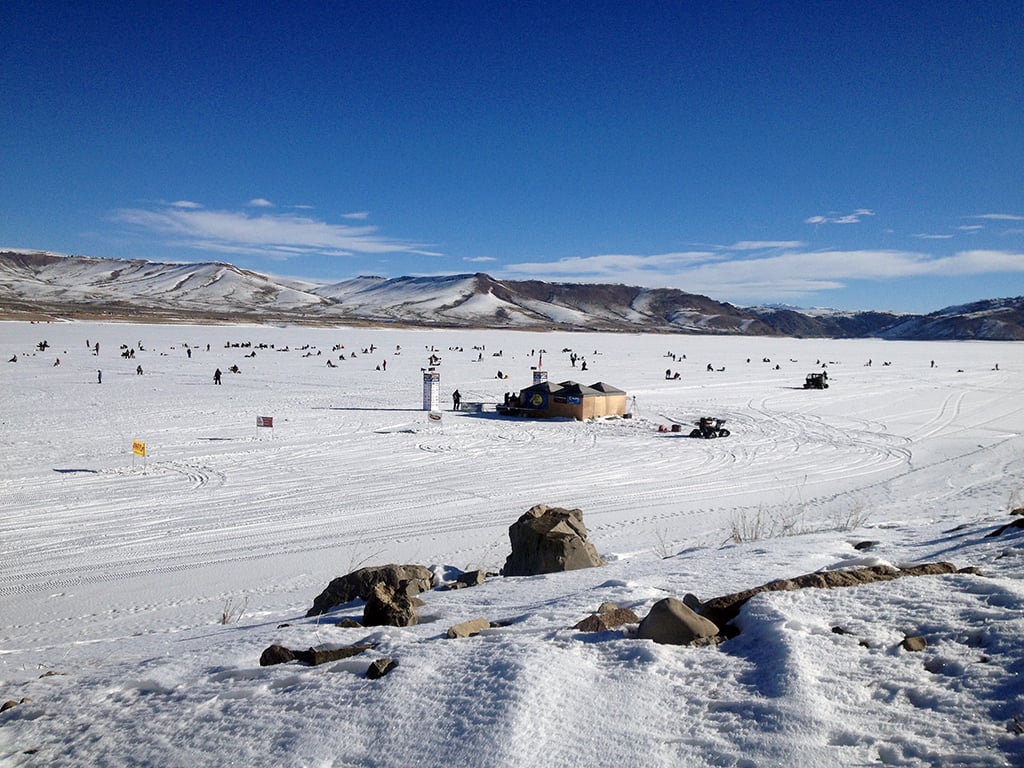
From late December through early March, you can drop a line through the ice and catch Kokanee (land-locked salmon), yellow perch, lake trout (Mackinaw), rainbow trout, and brown trout. A valid Colorado State fishing license is required for those 16 years and older, and bagging limits must be adhered to. Among the Colorado ice fishing regulations to be followed are:
- Ice fishing holes cannot exceed 10 inches (25 cm) in diameter, or 10 inches (25 cm) on any side.
- All fires on the ice must be enclosed in a container.
- No litter allowed on the ice.
- On the frozen surface of Blue Mesa Reservoir, vehicles may not exceed 1200 lbs.
- Only portable ice fishing shelters are allowed on the frozen surfaces of Blue Mesa Reservoir. Portable ice fishing shelters must be removed at the end of every day.
Snowmobiling
Own a snowmobile? You can use it here at the NRA, but operation is limited to the frozen surface of Blue Mesa Reservoir and on established access roads to the reservoir only. There’s also a maximum gross weight of 1,200 pounds (544 kilograms) for machine and cargo combined.
- Speeds over 45 mph prohibited.
- Avoid interfering with other recreators.
- Do not disturb wildlife. Snowmobile access may be limited to reduce stress to wintering wildlife during harsh winters.
Cross-Country Skiing
While there are not any groomed trails at Curecanti NRA, you can still take to the snow and ice. Below are three recommended areas for cross-country skiers.
Iola Basin at Blue Mesa Reservoir – Located at the far west end of the park. You might see wintering bald eagles. This is a great place for skiers of all ability levels. If you decide to try out your cross-country skis here, check ice conditions before skiing and avoid ice fishing holes.
East Elk Creek - Located one mile (1.6 kilometers) west of Elk Creek Visitor Center on Highway 50. Ski the level road to the East Elk Creek Picnic Area, for a roundtrip distance of 1.5 miles (2.4 kilometers). Here’s another great place for skiers of all abilities. Note: This area is closed to all access from March 1 through August 15 each year, for protection of wildlife habitat.
Red Creek – For a more strenuous workout suitable for intermediate and advanced abilities, ski this steep route beginning 4 miles (6.4 kilometers) west of the Elk Creek Visitor Center on U.S. Highway 50. Ski or snowshoe the road which leads to Red Creek Campground or continue beyond the campground toward the West Elk Wilderness Area of the Gunnison National Forest, for about 6 miles (9.7 kilometers).
Snowshoeing And Hiking
Curecanti’s trails are open year-round. The level of difficulty depends upon the amount of snow as well as the original topography of the trail itself. Because the trails are not marked during the winter, they may be a little harder to follow. Traction devices like Yaktrax or Kahtoola are recommended and, if the snow is deep enough, you might want to strap on those snowshoes to prevent postholing (when a hiker’s feet or legs sink deep into the snow) and possible injury.
If you plan to visit the NRA in winter, always check the park’s weather forecast and follow these simple winter safety rules:
- Wear proper clothing (layers of wool or synthetics, hat, gloves or mittens, sturdy water-resistant footwear, windproof/waterproof outwear)
- Travel with a companion. Avoid going alone.
- Always tell someone where you are going and when you plan to return.
- Know the weather forecast and condition of ice and snow in the area you plan to visit.
- Wear a personal flotation device (PFD) if you’re going onto the frozen surface of Blue Mesa Reservoir.
- Know how to get out from under the ice if you fall through.
- Be aware of hypothermia symptoms as well. Hypothermia is the lowering of the body’s temperature well below normal, most often occurs when air temperatures are between 30°F and 50°F (-1°C to 10°C). Symptoms include uncontrolled shivering, extreme exhaustion, coordination difficulties, numbness, memory lapse, unusual behavior, drowsiness, and loss of consciousness.
Click here for more information regarding hypothermia and treatment.
- By Rebecca Latson - March 26th, 2026 10:18am



