
From the foothills to the alpine habitat of Sequoia and Kings Canyon National Parks in California, the wide range of elevation changes means you’ll stand a good chance of seeing wildlife during your visit there, no matter where you are.
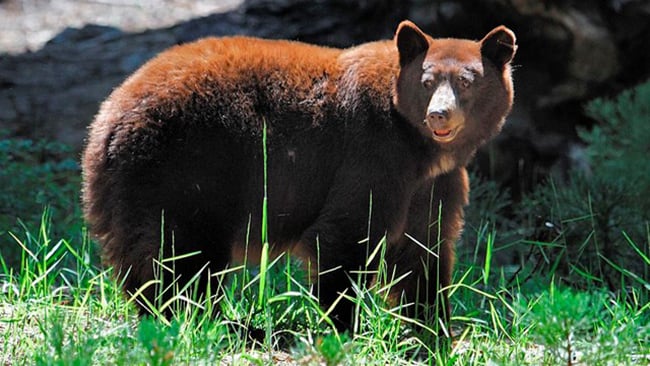
Home to 72 species of mammals, you’ll probably see squirrels and chipmunks and mule deer. You might spy a busy little pika scurrying over the rocky outcrops at higher elevations, or a marmot sunning itself. Perhaps you will even spot a coyote or black bear or an endangered Sierra Nevada bighorn sheep.
Keep your eyes on the ground around streams and lakes to see one or more of the 14 amphibian species including the endangered mountain yellow-legged frog or one of two species of newts (Sierra and California).
According to Park Staff:
Newts are active in and near foothill streams in the winter and spring. Their bright color, plodding walk, and interesting mating and feeding behaviors in streams makes them a fun animal to watch and photograph.
If you happen to see a California newt, you should not touch it - particularly an adult - as its skin secretes a potent neurotoxin tetrodoxin, the same toxin found in pufferfishes and harlequin frogs.

If you are a birder, bird photographer, or simply enjoy watching the birds, there are plenty to spot from the more than 200 species calling these parks home or migrating through. Some birds are present in the park but rare or uncommon, like the red-shouldered hawk or broad-winged hawk, while others like Anna’s hummingbird, American kestrel, and Steller’s jay are commonly seen. Keep a sharp lookout and have those binoculars or your telephoto lens handy.
Endangered Species
Two wildlife species federally listed as endangered live within the boundaries of Sequoia and Kings Canyon National Parks: the mountain yellow-legged frog and Sierra Nevada bighorn sheep. Efforts to recover and restore both species to their habitats are underway.

According to Park Staff:
Bighorn Sheep
Between March 19-22, 2014, a total of 10 [Sierra Nevada bighorn] ewes (females) and 4 rams (males) were translocated from land in the Inyo National Forest to the Big Arroyo area of Sequoia National Park by the California Department of Fish and Wildlife (CDFW), in cooperation with the National Park Service (Sequoia and Kings Canyon National Parks), U.S. Forest Service (Inyo National Forest), and the U.S. Fish and Wildlife Service.
For more information about bighorn sheep and the larger-scale recovery program, visit:
Sierra Nevada Bighorn Sheep Program.Mountain Yellow-Legged Frogs
Mountain yellow-legged frogs (Rana muscosa and Rana sierrae) are amphibians that inhabit naturally fishless lakes, ponds, and streams in the high country of the Sierra Nevada mountains. Once the most numerous amphibians in the Sierra Nevada, today mountain yellow-legged frogs have disappeared from 92% of their historic range. As a result, in 2012 Rana muscosa was listed as endangered and Rana sierrae was listed as threatened under the California Endangered Species Act; and in 2014 both species were listed as endangered under the federal Endangered Species Act.
How did this happen? Extensive research identifies two main reasons for their decline. First, trout were introduced in high-elevation lakes to draw recreationists and tourists to the area. This created an imbalance in the natural world. Trout eat tadpoles and small frogs and compete with frogs for insects. In addition, trout restrict frogs and tadpoles to small, low-quality areas and separate frog populations from one another. As a result, many mountain yellow-legged frog populations have died out. In addition, a fungal disease called chytridiomycosis is threatening the existence of frog populations that had once thrived in fishless areas. The disease affects the skin of frogs and causes most infected animals to die.
In 2001, park staff began using large nets and electrofishers (a device that temporarily stuns fish) to physically remove trout from selected waters. The goal was to restore the balance of nature to the pre-trout environment, with a focus on improving the health of mountain yellow-legged frogs. By 2011, nearly 44,000 fish were removed from 19 lakes, including complete removal from 9 lakes.
For those of you who enjoy recreational fishing, you need not be concerned about a lack of fishing opportunities, since trout remain in hundreds of the parks’ lakes and ponds.
The Douglas-Fir Tussock Moth

Insects are considered wildlife, and like all other national parks, Sequoia and Kings Canyon National Parks are home to thousands of insects. One of these, however, you should be aware of and do your best to avoid.
The Douglas-fir tussock moth is a native insect species to the parks. As an adult, it might be difficult to spot since it’s brown coloration blends in well with the trees. As a caterpillar, however, it’s easy to spot since it is fuzzy with bright orange dots down the length of its top.
These moths generally show up around June and are harmful to the fir trees, feeding on their needles and sometimes defoliating them, which can kill the trees – especially smaller seedlings and saplings. They also have a tendency to fall from the tree canopy, even landing on people, which is problematic, since they are harmful to humans.
According to Park Staff:
Some people are allergic to moths or other stages of the lifecycle. People are most likely to come into contact with the hairs on the caterpillars, which can cause irritation or an allergic reaction. Symptoms can include itching, rashes, watery eyes, runny nose, cough.
Less commonly, people experience shortness of breath, wheezing, and chest tightness. Hot weather and perspiration increase the severity of symptoms and individuals with a general history of allergies may be more susceptible to “tussockosis.” If you experience any of these more severe symptoms, seek medical attention immediately.
To avoid or mitigate exposure:
- If you see a tussock moth caterpillar, don’t touch it or any other moth life stage (egg masses or cocoons).
- Avoid skin exposure in areas where you see large numbers of caterpillars.
- Do not handle or disturb leaf litter, bark, wood piles, or any other material that may contain spent cocoons or larval skins.
- Wash exposed skin surfaces frequently (hands and face) with soap and water.
- If you get caterpillar hairs on your skin, apply a piece of adhesive tape to the affected area. Pull the tape (and hairs) off immediately, then shower or bathe to remove any residual hairs.
To learn more about the wildlife living within these two national parks, you can generate and download a Species List.
- By Rebecca Latson - July 14th, 2025 8:05am



