Sequoia trees are the world’s largest trees, and conditions within Sequoia and Kings Canyon National Parks in California allow these magnificent red-barked trees to reach peak heights. Located within the mid-Sierra zone (5,000-8,000 f feet / 1,524-2,438 meters), the mild winter and summer temperatures, deep winter snowpack, and rich fire history all combine to make this prime sequoia habitat.
According to Park Staff:
The giant sequoia (Sequoia gigantea) and the redwood (Sequoia sempervirens) are the last surviving species of the rather large genus Sequoia that grew over much of the Northern Hemisphere during ancient geological times. Only two other species of trees closely resemble them—the bald cypress of the U.S. Southern States and the cryptomeria of Japan.
Are sequoia trees taller than coastal redwood trees found at Redwood National and State Parks (also in California)? No, they are not taller (although they can reach heights of around 311 feet (95 meters), but they are much larger by volume, and definitely wider – especially at the base, where they can reach diameters of 26 feet (8 meters) and some even up to 30 feet (9 meters). The General Sherman Tree is the largest in the world at 52,508 cubic feet (1,487 cubic meters). The General Grant Tree is the second largest at 46,608 cubic feet (1,320 cubic meters).

Age doesn’t always correlate to size where giant sequoias are concerned. Large giant sequoias often owe their size to rapid growth rather than age, so an old giant sequoia will not necessarily be the largest specimen.
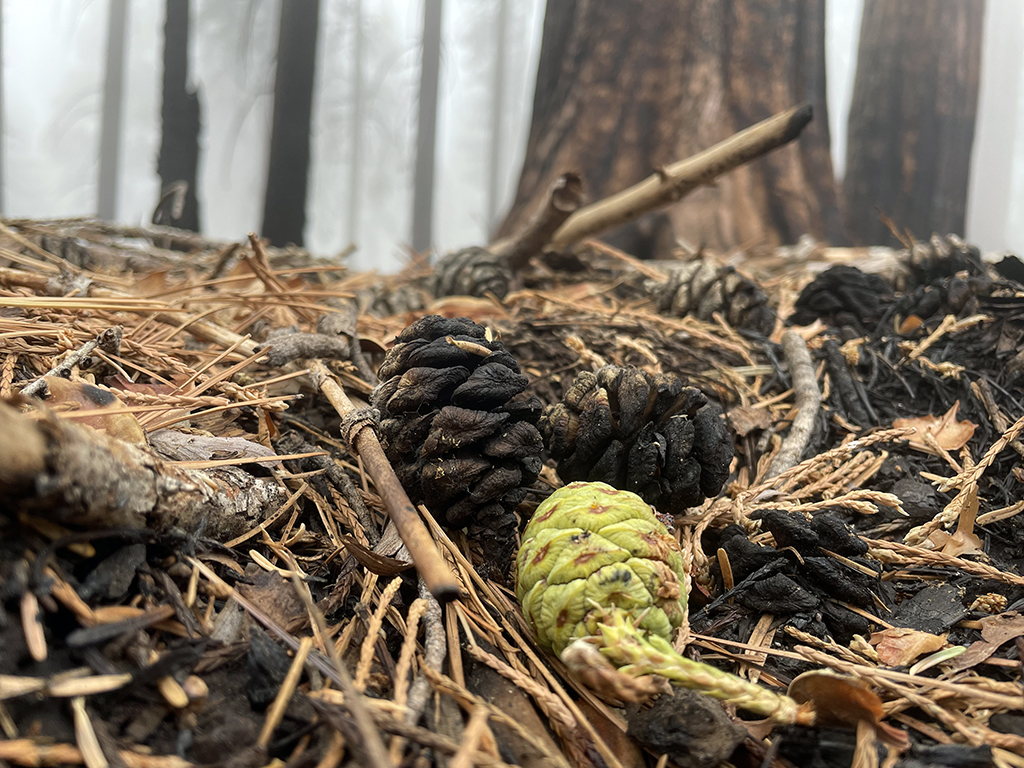
Sequoia trees start out as seeds no bigger than an oat flake. Their protective cones are serotinous, meaning they are sealed shut with resin and need the heat of a fire to dry out, open, and release their seeds. This allows for release and germination under the right conditions including a wildfire-cleared forest floor covered by available nutrients from fire-related ash. FYI, mature sequoias can produce as many as 400,000 seeds annually.
Giant sequoia trees can live to be more than 3,000 years old! According to Park Staff:
Giant sequoias are only outlived by bristlecone pines (oldest age recorded at 4,844 years in the Great Basin) and by Alerce trees (oldest age recorded at 3,639 years in Chile).
Sequoia trees have a shallow root system. Instead of the roots delving deep into the earth, they grow outward, extending 100 – 200 feet (30.5 – 61 meters) from the trunk. Sequoias like to join with, rather than compete against, other sequoias, and the roots from one tree can fuse with other sequoia tree roots to share resources.
The soft, fibrous, spongy bark can grow up to 2 feet (0.6 meter) thick and is rich with tannins – complex chemical compounds that are insoluble and resistant to decomposition. These tannins protect sequoias from threats such as fires, insects, and diseases. This is why you may still see growth from sequoias even after a wildfire, despite the tree having a fire-charred base.

While these giant trees are more resistant to threats, they are not immune. Climate change influences the growth and survival of sequoias, particularly in the form of droughts with unusually high temperatures known as “hotter droughts.” For instance, the high-temperature drought of 2012-2016 impacted giant sequoias in three ways, creating what the National Park Service called a “tipping point”:
- Extensive wildfires resulting in unprecedented fire-caused death of mature giant sequoias - Over 85 percent of all giant sequoia grove acreage across the Sierra Nevada has burned in wildfires between 2015 and 2021, compared to only one quarter in the preceding century. Thousands of large giant sequoias (those with trunks 4 feet/1.2 meters in diameter or larger) are estimated to have been killed in six recent wildfires, most of those in the 2020 Castle Fire and the 2021 KNP Complex and Windy fires.
- Native bark beetles killing giant sequoias - During and after the 2012-2016 hotter drought, USGS scientists and park managers in Sequoia and Kings Canyon National Parks documented a total of 33 giant sequoias that died standing in several different sequoia groves. All these trees had experienced recent fire and many had some basal fire scarring. Most of them grew in very wet areas, and a native bark beetle in the Phloeosinus genus appears to have killed them. Beetle kill of giant sequoias is a newly reported phenomenon, believed to be the result of drought-related impacts.
- Widespread giant sequoia foliage dieback (primarily 2014) - Acute foliage dieback occurred in many giant sequoias in Sequoia and Kings Canyon National Parks as a short-term response to the drought. Dieback was most pronounced in 2014, the most severe drought year in the park’s 122-year record. Amounts of dieback on individual trees ranged from none to >75%. The magnitude of dieback was variable between and within groves. Most sequoias affected by crown dieback recovered foliage quickly — by the summer of 2015, the affected dead foliage had been shed, and new foliage produced.

Featured In The National Parks Traveler
Podcast Episode 261 | Coming to the Aid of Giant Sequoias
Stand before a giant sequoia tree in Sequoia or Kings Canyon national parks or nearby Yosemite National Park and you’re overwhelmed by their size, and assume they’re impervious to anything that might be thrown at them. But as we learned from wildfires in 2020 and 2021 in Sequoia and Kings Canyon national parks, that’s not the case.
The Castle Fire in 2020 and then the KNP Complex and Windy fires in 2021 that burned through the two parks destroyed thousands of giant sequoia trees. Estimates put the losses at more than 14,000 mature trees, or roughly 13-19 percent of the world’s giant sequoias.
At the Sequoia Parks Conservancy, just days after the KNP complex fires started in September of 2021 plans were being made to raise funds to help the National Park Service restore and recover areas in the two parks that were burned. Today we’re discussing the ongoing recovery work with Savannah Boiano, the executive director of the Sequoia Parks Conservancy.
To listen to this podcast, click here.
Sequoia Groves
Sequoia groves may consist of anywhere between one and tens of thousands of sequoia trees mixed in amongst other tree species. The park has identified approximately 40 different giant sequoia groves. You can drive to some of these groves, while others require a long, often strenuous hike to access. Below are six sequoia groves easily reached by park visitors.
According to Park Staff:
Giant Grove - Set on a rolling plateau between the Marble and Middle Forks of the Kaweah River in Sequoia National Park, Giant Grove is the largest of the unlogged giant sequoia groves, and it contains more exceptionally large sequoias than any other grove, including the largest living sequoia, the General Sherman Tree.
Grant Grove - Located in Kings Canyon National Park, this sequoia grove is accessible by a short spur road from Highway 180 and is just 1.5 miles (2.4 kilometers) from the Kings Canyon Visitor Center. Here, you can see the second largest living sequoia tree in the world and the largest sequoia tree within this grove, the General Grant Tree.
Redwood Mountain Grove - This grove burned to near extinction in the 2021 KNP Complex Fire. Forty percent of the grove burned at moderate to high fire severity, and many giant sequoias were killed. At this time, the trails remain closed due to hazardous conditions related to the fire.
Muir Grove - The mid-sized Muir Grove in Sequoia National Park is a two-mile (3.2-kilometer) hike from the parks' Generals Highway and is much less-visited than Grant Grove or Giant Forest. The Muir Grove features a high density of mature sequoias as well as a dramatic approach and entrance to the grove, with views across a creek gorge of the impressive giant sequoias on the grove's east side. The trail to this grove continues further into the grove for those who want a longer hike.
Big Stump Grove - Big Stump Grove, near the entrance to Kings Canyon National Park, is worth a visit for those interested in exploring the site of the Smith-Comstock Mill and logging camp. Here, you’ll find several remaining old growth stumps and the young sequoia trees that regenerated following historic logging operations. In this grove, scattered old growth sequoias were spared from logging, and many young sequoia stands have established in the openings created by logging. Many of these trees are over a century in age and four-to-six-feet (1.2-1.8 meters) in diameter.
Converse Basin Grove - The Converse Basin Grove, managed by the U.S. Forest Service in the Giant Sequoia National Monument, is one of the largest sequoia groves in total area and provides a window into an era of large-scale logging. The most noted sequoia spared by the loggers is the 269-foot (82-mter) tall Boole Tree. It is the largest tree in America's national forests, and it contends with two other living sequoias as the sixth largest in overall volume.
To read more details about each of these groves, click on the “Sequoia Groves” link above.

- By Rebecca Latson - July 14th, 2025 8:05am