
When you were a child, did dinosaurs fascinate you? Even as adults, dinosaurs and fossils still exert a hold on our imagination. During a visit to the Quarry Exhibit Hall in the Utah portion of Dinosaur National Monument, you can indulge both your inner child and adult curiosity about these “terrible lizards” by actually looking at, and in some cases touching, Late Jurassic Period fossils still embedded in the rock. These preserved bones are around 150 million years old.

How did these fossils get there? How were they preserved? How do scientists know how old these fossils are?
As a rule (but not always), for something to become a fossil, three things are necessary:
- Rapid burial
- Hard parts
- A method of preservation
When an organism dies, it needs to be covered quickly by something like sand, mud, or clay. This rapid burial prevents oxygen from aiding bacteria in breaking down and digesting the dead organism. Rapid burial also prevents scavengers from picking at the body, and erosive forces from wearing away the body.
The most likely parts of a dead organism to undergo fossilization are the hard parts, like bones and teeth and even armored hide. Sometimes the soft parts of an organism are fossilized, but most often, it’s those hard parts.
Once the organism is buried and prevented from decaying or being scavenged, it may be preserved via several different methods:
- Replacement - water rich in dissolved minerals replacing the dead organism’s organic materials.
- Permineralization – minerals filling spaces (ex. porous bone within the hard parts of an organism.
- Compression - flattened remains of plants or soft-bodied animals preserved as carbon films.
- Mold and Cast – organisms leaving impressions in the sediment (molds) and sediment filling that mold being to create a cast of the original.
In the case of the dinosaur bones discovered at Dinosaur National Monument, their fossils are found in a rock unit called the Morrison Formation, named for the town in Colorado where the layer was first described. This formation is composed of sandstones and mudstones. The mudstone part of the formation belongs to a subunit of the Morrison Formation called the Brushy Basin member, a mudstone mainly composed of bentonite, a clay containing volcanic ash believed to have come from volcanoes south and west of the ancient floodplain that later became the Morrison Formation. These sediments that ultimately became mudstones and sandstones are where almost all the fossils from the Brushy Basin member are found in sandstones, including the bones of the Quarry Exhibit Hall.
According to park staff:
At the time the Quarry dinosaurs were alive in the Late Jurassic, the world's continents had already begun to split apart from the supercontinent Pangea. North America was located further south than it is today. It would still be many millions of years before the Rocky Mountains began to rise. Based on analysis of oxygen isotopes in marine fossils, the global climate in the Late Jurassic is thought to have been much warmer and more humid than it is now. Fossilized plant species indicate that most of the Morrison ecosystem was home to lush forest and shrubland. The landscape was cut through by multiple large rivers that left limestone and sandstone deposits with ripple marks indicating the directon of water flow. The plane that would become the Quarry Wall was still horizontal at the time. Its sandstone was once sandy bottom of a river channel. Fossils indicate that the area experienced at least three severe droughts, followed by localized flooding events when the rains returned.
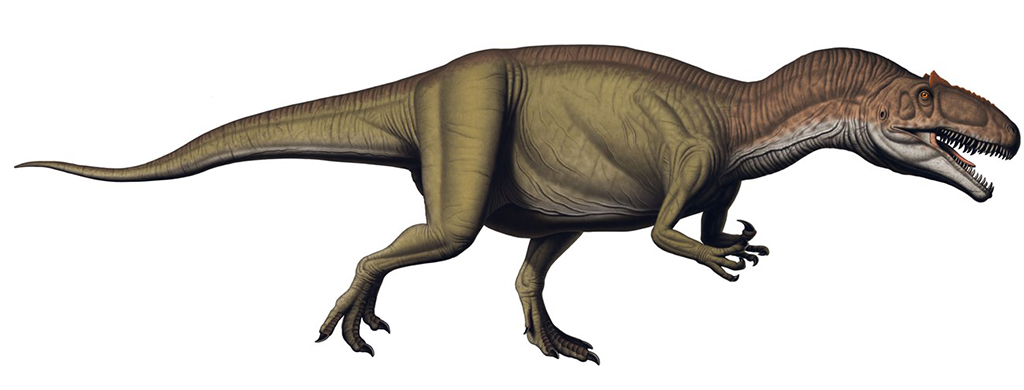
When excavating the Morrison Formation in this area, paleontologists found a wide array of animals fossilized in the rock. Of course, the dinosaurs are the most popular among park visitors. The largest of these were the long-necked, plant-eating sauropods, Apatosaurus, Barosaurus, Camarasaurus, and Diplodocus. The smaller plant-eating dinosaurs included the ornithischians, Stegosaurus, Camptosaurus, and Dryosaurus. The habitat also contained large dinosaurian predators. The most common of these was Allosaurus. Less common was the smaller, horn-nosed Ceratosaurus.
The dinosaurs in the Quarry Exhibit Hall lived in the Late Jurassic period, long before the end-Cretaceous extinction event. While dinosaurs are the most popular fossils at the Quarry, it's actually clams that are much more common. The Jurassic clams of the Quarry belong to the group Unionidae, which still has many living members in freshwater rivers around the world today. Their presence is a clear indication that the Quarry sandstone was home to a freshwater river channel in the Late Jurassic. We know from modern river ecology that unionid clams require a permanent source of moving water to survive. When water is present, clams are sometimes buried alive in the river sediment. These are usually found with closed shells. Conversely, unionid clams that die when water isn't present are typically found with their shells open. During excavations at the Quarry, paleontologists found at least three events where large numbers of clams were fossilized with open shells. This suggests that their river habitat experienced at least three severe droughts where large swaths of the river dried up, causing the clams to die.
If you visit the wall of fossils at the Quarry Exhibit, or even just look at photos of the fossil wall, you will notice all the bones are disarticulated (separated from one another). What happened here? Scientists look at processes and events occurring during the present day to help them figure out what occurred to the dinosaurs back in the Jurassic period.

According to park staff:
[This disarticulation of dinosaur bones indicates] that they would have had some time for their flesh to decay before burial. Some of the bones even bear signs of scavenging, such as tooth marks. All of this seems to indicate that the land-dwelling animals were just as affected by droughts as the clams. Based on observations of modern wetland ecosystems, paleontologists think the dinosaurs spent a lot of time around the river, especially during droughts. Without rain, the plants would have died in large numbers or had greatly reduced nutritional value. Each day, the dinosaurs would have had to travel farther for this low-quality food, and still return to the river for water. For some, this lifestyle was unsustainable, and they died.
Studies of wetland ecosystems today have shown that large animals, such as elephants, tend to die along the shore or in the dried-up sections of riverbeds during droughts. When the rains return, these rivers often overflow their banks, restoring clam populations, depositing sediments, and carving new channels. Nearby bones and debris are collected during this process and swept downstream. These tend to settle along bends or sandbars, where the sediment is higher. Protruding elements such as vertebrae anchor the bones in the sediment, altering the river's scouring patterns and collecting debris. The upstream-facing ends of bones tend to sink as the water passes around them, sweeping sediments out from under that end of the bone. In effect, the bones set up the conditions for their own burial. Identical dispersal patterns also appear in the Quarry's fossil wall. For these reasons, it is thought that the current Quarry Wall was once a bend or sandbar in an ancient riverbed where debris and dinosaur bones collected. Like many animals today, the dinosaurs likely died along the shore or in dried-up sections of their river during droughts. Because some of the bones are articulated (connected as they would have been in life) and some are disarticulated, it's thought that individual dinosaurs were in various states of decay when they were buried, suggesting that they died at different times rather than in one catastrophic event. After the drought ended and the rains returned, the river would have overflowed with water again, sweeping the bones downstream. With the river flowing and continuously depositing sediment, this would have allowed the bones and debris to be buried quickly and begin the process of fossilization.
The dinosaurs at the Carnegie Quarry underwent a type of fossilization called permineralization. As the river flowed, its slightly acidic water continuously dissolved minerals from the sediment. Some of the water flowed down into the sand through a process called percolation. Buried in the sand were the dinosaur bones, which like all bones, were porous (full of tiny holes). The bones acted like a sponge, absorbing the water along with any sediments, bacteria, and dissolved minerals it contained. Some of these elements were deposited onto and within the bones' pores as the water flowed through. As the pores filled with minerals, bacteria ate away at the bones, producing calcium carbonate as a byproduct. The calcium carbonate formed a hard shell that entombed the bacteria and permeated the organic bone cells. With time, the bones became fully permeated with minerals, hence the name "permineralized."
Over millions of years, the continents moved and the landscape changed, hosting many different environments, including forests, inland seas, and others. Each of these environments left their own sediments behind, burying the ancient riverbed ever deeper. The weight and pressure of the uppermost layers slowly turned the sediments of lower layers into different kinds of sedimentary rock. Any bones or other evidence of ancient life that had fossilized in those sediments were preserved within their respective rock layers. Long after the Morrison Formation was buried, all the layers were bent upward into an anticline (hill-shape) when the Rockies rose. Over time, erosion took away the top of the anticline's hill, exposing the bent rock layers. This included the Morrison layer and the dinosaur fossils within it.
Now you know how the bones got where they are found and how they were fossilized, but how do scientists know how old those bones and other fossils are? The mudstone of the Morrison Formation is primarily bentonite, which comes from the volcanic ash mentioned earlier. The ash component has crystals in it, which are used for radiometric dating. This age dating method compares the abundance of a naturally occurring radioactive isotope within the material to the abundance of its decay products, which form at a known constant rate (half-life).
For more detailed information about Dinosaur National Monument’s geology and paleontology, you can read and download the park’s 2006 Geologic Resource Evaluation Report.
Note: if you find a fossil during your visit to this national monument, do not take it with you. Leave it there, take a photo of it and note the GPS coordinates, if you are able to. Report your find to park staff. It is illegal to take fossils (and rocks, plants, flowers, and artifacts) from this or any park unit of the National Park System.
- By Rebecca Latson - July 14th, 2025 8:05am



