
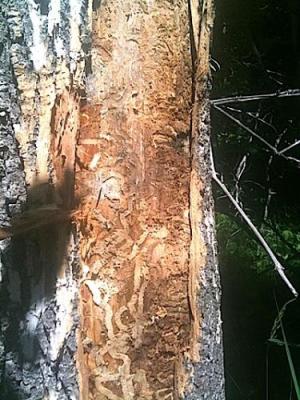
An example of the damage emerald ash borers can do to trees, from Sleeping Bear Dunes National Lakeshore/NPS
Globalization is not just a sweeping economic trend, but also one involving insects that's been going on for decades, one that is a serious threat to national park forests. At Great Smoky Mountains National Park in North Carolina and Tennessee, officials are taking a step they hope will slow any infestation of non-native insects that can wreak havoc on native forests by proposing a rule that only heat-treated firewood can be brought into the park for campfires.
In recent years more and more national parks --Shenadoah National Park and Sleeping Bear Dunes National Lakeshore, to name two -- have instituted bans on firewood brought into the parks with hopes of slowing the spread of emerald ash borers, a particuarly nasty Asian import that can kill a tree in two years. Eggs the insects lay under the bark of a tree hatch into larva that, in effect, girdle the tree and cut off its nutrient flow. Recent news reports predict that 99 percent of ash forests in the country will be wiped out by the beetle.
Great Smoky's forests also have been attacked by emerald ash borers, and another pest, the Hemlock woolly adelgid, has been the focus of a vigorous control program in the park. Now park officials want to try to slow the spread of these insects into the park by allowing only heat-treated firewood to be brought into the park. If the proposal is adopted, beginning in March 2015, the park would ban the importation of firewood that is not bundled and certified by the USDA or a state agency. Heat-treated wood will be available to purchase from concessioners in many of the campgrounds as well as from private businesses in the communities around the park, a park release said. In addition, visitors may still collect dead and down wood in the park for campfires.
“We are asking visitors to help us protect park forests by ensuring they are using heat-treated firewood,” said acting-Superintendent Cynthia MacLeod. “The Smokies have already lost magnificent stands of chestnut, Fraser fir, and hemlock. We need to do all we can to protect the park from further threats.”
A variety of destructive pests lay eggs or stowaway in firewood. According to park scientists, these insects from Asia and Europe have the potential to devastate over 30 species of hardwood trees native to the park. Movement of firewood has been implicated in the spread of gypsy moth, Dutch elm disease, emerald ash borer, thousand canker disease, Asian longhorned beetle, Sirex woodwasp, golden spotted oak borer, and other native and non-native insect and disease complexes, they add.
Numerous stakeholders representing federal and state agencies, conservation organizations, and universities are joining together to develop a national strategy to mitigate the risks associated with movement of firewood, including a public education campaign. National parks throughout the Appalachian region have taken action to limit the spread of insect pests in firewood including, in many cases, the banning of imported firewood. For the past three years, the Smokies has prohibited the importation of firewood from areas quarantined by the USDA Animal Plant Health Inspection Service (APHIS). Current park regulations prohibit the importation of wood and wood products from states (or specific counties in states) quarantined for insects such as emerald ash borer or tree diseases such as thousand canker disease.
Although the new proposed regulation prohibiting the importation of non-certified wood would not take effect until 2015, the park is asking visitors to make the switch to safe firewood now. Heat-treated wood is available from an increasing number of businesses outside the park and staff are working with concessioners within the park to use low-risk wood sources until they are able to make the transition.
A final decision on adopting the new regulation is expected by the end of the year. The public may submit comments by: mail at 107 Park Headquarters Road, Gatlinburg, TN 37738; e-mail at [email protected]; or comment cards available at visitor centers and campgrounds.
Story Categories:
A copy of National Parks Traveler's financial statements may be obtained by sending a stamped, self-addressed envelope to: National Parks Traveler, P.O. Box 980452, Park City, Utah 84098. National Parks Traveler was formed in the state of Utah for the purpose of informing and educating about national parks and protected areas.
Residents of the following states may obtain a copy of our financial and additional information as stated below:
- Florida: A COPY OF THE OFFICIAL REGISTRATION AND FINANCIAL INFORMATION FOR NATIONAL PARKS TRAVELER, (REGISTRATION NO. CH 51659), MAY BE OBTAINED FROM THE DIVISION OF CONSUMER SERVICES BY CALLING 800-435-7352 OR VISITING THEIR WEBSITE. REGISTRATION DOES NOT IMPLY ENDORSEMENT, APPROVAL, OR RECOMMENDATION BY THE STATE.
- Georgia: A full and fair description of the programs and financial statement summary of National Parks Traveler is available upon request at the office and phone number indicated above.
- Maryland: Documents and information submitted under the Maryland Solicitations Act are also available, for the cost of postage and copies, from the Secretary of State, State House, Annapolis, MD 21401 (410-974-5534).
- North Carolina: Financial information about this organization and a copy of its license are available from the State Solicitation Licensing Branch at 888-830-4989 or 919-807-2214. The license is not an endorsement by the State.
- Pennsylvania: The official registration and financial information of National Parks Traveler may be obtained from the Pennsylvania Department of State by calling 800-732-0999. Registration does not imply endorsement.
- Virginia: Financial statements are available from the Virginia Department of Agriculture and Consumer Services, 102 Governor Street, Richmond, Virginia 23219.
- Washington: National Parks Traveler is registered with Washington State’s Charities Program as required by law and additional information is available by calling 800-332-4483 or visiting www.sos.wa.gov/charities, or on file at Charities Division, Office of the Secretary of State, State of Washington, Olympia, WA 98504.


National parks and their natural resources belong to you. The National Parks Traveler works to ensure you know how these essential places are being cared for.
Sign Up For Our Weekly Newsletter
Unsubscribe at any time.
INN Member

The easiest way to explore RV-friendly National Park campgrounds.

Here’s the definitive guide to National Park System campgrounds where RVers can park their rigs.
Our app is packed with RVing- specific details on more than 250 campgrounds in more than 70 national parks.
You’ll also find stories about RVing in the parks, tips helpful if you’ve just recently become an RVer, and useful planning suggestions.


Comments
For quite some time now here in the wild west, campgrounds -- both public and private -- have been posting notices asking campers to use only wood from LOCAL sources. The idea being that it might be less likely to contain bugs imported from a different part of the country where a different fauna exists. So far, I haven't seen any requests for heat treated wood, but it might be coming.
Well, one of the big differences between west and east, is the diversity of tree species. Most of the vast coniferous forests in the west only have a few species of trees, while in the east it's hundreds of species found in certain forest zones, so you have a lot of different pests targeting certain types of trees. In the west, it's that prolific native pine beetle, that does a lot of damage, but in a way, they are a natural occurrence that have co-evolved with those forests, and should be seen as a decomposer. Without pine beetles, the forests in the west would take thousands of years to decompose. They help break down dead and diseased trees, and then fire helps turn them to ash, which brings about nitrogen, which brings on the next generation of trees Of course, parts of california are now being destroyed by invasive species that haven't co-evolved with the trees, so nothing is truly safe.
I've also bared witness to the destruction of the Ash trees...and the hemlocks. So, when you get species that haven't co-evolved with the forests, the result is usually pure destruction.
Gary, you once again are pontificating about something you know nothing about. Pine beetles do no such thing. Pine beetles bore into LIVE trees, lay their eggs and dye. The next spring, the eggs hatch, the new beetles fly to a new LIVE tree, bore in, lay their eggs and die. Pine beetles do nothing to break down dead and diseased trees other than to make them dead.
Actually, I lived in Sun Valley Idaho, and have seen them and studied this up close and personal, so I do know quite a bit about it. I've only lived in the Southeast for 2 and a half years. Pine Beetles are the kick-starter and one of the most necessary decomposers of the pine forests.
http://www.pc.gc.ca/eng/docs/v-g/dpp-mpb/sec1/dpp-mpb1b.aspx
Usually when trees are drought stressed, that is when they take over. When trees are healthy, and have the right amount of moisture they can do better to ward off pine beetle infestations. The problem with the western forests is too much fire suppression and realtors selling property in areas that need fires every decade. That's created about a half century of overgrown secondary secessional forests that have zapped all the nitrogen out of the soil, and making ALL the forests weaker and more susceptible to pine beetle infestations.
Also, adult beetles don't always die over winter. If it's not a heavy and very cold winter, they don't die off, like you claim.
Wrong - The beetles has no better than a one year life cycle - regardless of the weather. "Very cold" only comes into play for the larva. Sustained periods of -20 (lower) degree weather will kill the larva.
http://www.na.fs.fed.us/spfo/pubs/fidls/we_pine_beetle/wpb.htm
But in any case pine beetles don't "help break down dead and diseased trees". They merely kill them.
Yep, hence they are decomposers. I think you need to brush up on what that term means.
Nope - I know exactly what it means. Killing is not decomposing. Decomposing occurs on dead plants or animals after the killing and pine beetles play no role in that decomposition in the natural life - or in the afterlife you want to grant them.
de·com·pos·er
[dee-kuhThink I'd have to agree with EC on this one, especially if your definition of "decompose" is:
1.to break down (organic matter) or (of organic matter) to be broken down physically and chemically by bacterial or fungal action; rot
2.chem to break down or cause to break down into simpler chemical compounds
3.to break up or separate into constituent parts
It would seem the beetle is no more a "decomposer" of a tree than a bullet is to a human.
That aside, what is particularly disconcerting is that with warming temperatures, some forests are seeing two generations of pine beetles in one summer. A double-whammy, if you will.
http://www.jstor.org/stable/10.1086/665007
We are not calling into question Gary's detailed, scientific analysis of a situation here. He has proven that his methodology is without flaw so I suggest folks re examine the data until you arrive at the right conclusion.
Seems to be reoccuring theme around these parts. Thanks for the chuckle! ;-)
Kurt, they are a pathogen. So, in human perspectives, more like cancer. A human saw would be more like a bullet to a tree. And yes, they start the process of breaking down stressed forests (an act of decomosition). The parks canada article I posted above talks about them as decomposers. Fire is also a decomposer of forests. Very beneficial decomposer, because they put nitrogen back into the soil.. Unfortunately, climate change is making many trees susceptible to pathogens, hence what seems to be happening even here in the Smokies.
Here's a decent video on some of this in relation to climate change:
I've never understood why anybody needs to carry firewood into a national park or anywhere else. Using what's there serves two valuable purposes: it clears a fire hazard and prevents the spread of non-native insects. If you're camping, get off your butt and gather.
Kurt,
I have met with Mitton and discussed his theory with him. Problem is, he can't explain why the double breed phenomenon hasn't occurred in lower elevations where the temperature has always been warmer. Nor does he explain why this new phenomenon has occurred during a period when temps didn't rise. Without being able to explain those, I don't see how he can attribute double breeding to global warming.
http://www.forbes.com/sites/jamestaylor/2014/06/25/government-data-show-...
The exchange of fauna and flora has gone unabated since 1492. 1493: Uncovering the New World Columbus Created is a great book in that regard. Obviously, as worldwide trade speeds up and increases, we're seeing more of those invasive species.
That may increase the need for the NPS to be a gardener rather than just a guardian. :)
http://www.nytimes.com/2014/07/06/opinion/sunday/the-wilderness-act-is-f...
JohnBick -- that idea's time has passed. Bans on gathering firewood from the forests near campgrounds came about because over the years virtually all the dead and down wood had been used up. Campers seeking wood began attacking living trees with their hatchets.
Most western campgrounds now have firewood for sale at the host's campsite or somewhere else. That provides wood, but prevents damage to trees in the camp. (Heck, I've even seen cases where people hacked up picnic tables and benches for firewood.)
Like so many of those awful rules and regulations that chafe so many people, these have evolved simply because too many people leave their common sense and responsibility at home. So rules have had to replace those qualities.