
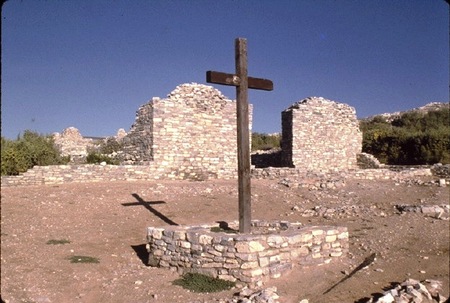
Salinas Pueblo Missions ruins. NPS photo via Esprit15d and Wikipedia.
The ruins at Salinas Pueblo Missions National Monument near Mountainair, New Mexico, do more than just remind us of Spain’s shattered dreams of empire in the American Southwest. They also remind us that climate change is an old phenomenon that has powerfully influenced human well-being through the centuries.
Salinas Pueblo Missions is an old park, having been established by presidential proclamation on November 1, 1909, exactly 99 years ago today. Initially designated Gran Quivira National Monument in recognition of the park’s best known ruin, the park acquired its present name through redesignation on 28 October 1988. Originally 160 acres in extent, it was enlarged at least three times in the interim (1919, 1980, and 1981), absorbing two New Mexico state monuments along the way and bringing it to its present size of 1,071 acres.
Salinas Pueblo Missions is situated east of the Manzano Mountains in the Estancia Basin of central New Mexico where it preserves the best existing examples of the 17th century Spanish Franciscan mission churches and convents built in this country at about the same time that the Pilgrims arrived in New England. Preserved in this unit are the ruins of four of America’s six remaining 17th-century Spanish mission churches as well as the ruins of three of the largest Pueblo Indian villages.
Annual attendance at this park has been about 33,000 in recent years. There is much to entertain visitors, especially those with a nuanced appreciation of Spanish colonial history, Native American cultures of the Southwest, and archeological research.
The park’s feature attraction is the Gran Quivira Ruins, which includes the largest Christian church ruin in the entire Southwest. The site has a parking lot, a small visitor center, a half-mile interpretive trail, the ruins of an uncompleted mission church, and the partially-excavated remains of the Las Humanas pueblo (long known as Gran Quivira), which may have had as many as 2,000 residents in its heyday. There are also preserved church ruins at the Quarai and Abó sites. The main visitor center is at the Shaffer Hotel (corner of Broadway & Ripley) in Mountainair.
For an artist's conception of what Gran Quivira might have looked like four centuries ago, see this site.
Growing public awareness and concern about climate change has highlighted a facet of the Salinas Pueblo Missions story that deserves much more attention that it has heretofore received. The stark truth is that the missions and pueblos that this park commemorates were abandoned because a drought of extraordinary ferocity and duration made life unbearable for the Spanish and the Indians throughout the Salinas Jurisdiction. The region’s once-thriving Native American communities and the Spanish missions established there at such great sacrifice withered and died. Explorers entering the region after the late 1670s found it utterly depopulated.
Here, as at Mesa Verde National Park and various other places where the ruins of dead civilizations speak to us, we are reminded of a great verity: In the never ending game of man versus nature, nature always bats last.
Post Script: Historians continue to speculate about the origin of the name Gran Quivira. Hypotheses abound, but no one can nail down an explanation that historians can all live with. Dating to the days of Coronado, who led the first Spanish expedition to penetrate the region, the name “Quivira” was linked to rumors of a mythical (and very wealthy) city said to be situated somewhere in the eastern Great Plains. It’s conceivable that explorers who entered the area after the 1670s attached the name to the abandoned pueblos and church ruins of the Salinas Jurisdiction because they thought they had found the remains of the fabled city.
Story Categories:
A copy of National Parks Traveler's financial statements may be obtained by sending a stamped, self-addressed envelope to: National Parks Traveler, P.O. Box 980452, Park City, Utah 84098. National Parks Traveler was formed in the state of Utah for the purpose of informing and educating about national parks and protected areas.
Residents of the following states may obtain a copy of our financial and additional information as stated below:
- Florida: A COPY OF THE OFFICIAL REGISTRATION AND FINANCIAL INFORMATION FOR NATIONAL PARKS TRAVELER, (REGISTRATION NO. CH 51659), MAY BE OBTAINED FROM THE DIVISION OF CONSUMER SERVICES BY CALLING 800-435-7352 OR VISITING THEIR WEBSITE. REGISTRATION DOES NOT IMPLY ENDORSEMENT, APPROVAL, OR RECOMMENDATION BY THE STATE.
- Georgia: A full and fair description of the programs and financial statement summary of National Parks Traveler is available upon request at the office and phone number indicated above.
- Maryland: Documents and information submitted under the Maryland Solicitations Act are also available, for the cost of postage and copies, from the Secretary of State, State House, Annapolis, MD 21401 (410-974-5534).
- North Carolina: Financial information about this organization and a copy of its license are available from the State Solicitation Licensing Branch at 888-830-4989 or 919-807-2214. The license is not an endorsement by the State.
- Pennsylvania: The official registration and financial information of National Parks Traveler may be obtained from the Pennsylvania Department of State by calling 800-732-0999. Registration does not imply endorsement.
- Virginia: Financial statements are available from the Virginia Department of Agriculture and Consumer Services, 102 Governor Street, Richmond, Virginia 23219.
- Washington: National Parks Traveler is registered with Washington State’s Charities Program as required by law and additional information is available by calling 800-332-4483 or visiting www.sos.wa.gov/charities, or on file at Charities Division, Office of the Secretary of State, State of Washington, Olympia, WA 98504.
INN Member

The easiest way to explore RV-friendly National Park campgrounds.

Here’s the definitive guide to National Park System campgrounds where RVers can park their rigs.
Our app is packed with RVing- specific details on more than 250 campgrounds in more than 70 national parks.
You’ll also find stories about RVing in the parks, tips helpful if you’ve just recently become an RVer, and useful planning suggestions.


Comments
Your observations about climate change in the time of the Abo, Quarai and Gran Quivria are important in today's atmosphere of "Climate Change". The climate of North America has been warming since the last Ice Age. Ancestral Puebloan peoples used to farm in wetter areas of the 4 Corners area in places like Chaco Canyon and Abo. Climate change that has been happening for a long time, is not a recent phenomenon and is credited as one of the major factors that drove the "Anasazi" to the more consistent wetter areas along the Rio Grande