
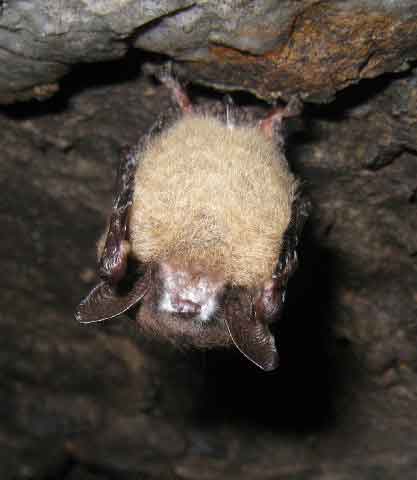
Bat with WNS. Photo by West Virginia Division of Natural Resources
The news from Great Smoky Mountains National Park to start the week wasn't good: a bat in the park has tested positive for Geomyces destructans, the fungus and the presumptive causative agent of White Nose Syndrome.
White Nose Syndrome (WNS) is named for the white fungus that forms on the faces of many infected bats. WNS was first identified in 2007, and has killed over 90% of the bats in many of the caves and mines in the Northeast. As reported last year in the Traveler, the U. S. Fish and Wildlife Service has called WNS "a wildlife crisis of unprecedented proportions." The problem is just now beginning to show up in the Southeast.
The mechanism(s) by which the fungus leads to death are under investigation, but one possibility is that bats become restless during hibernation, moving about the cave and burning up fat reserves or losing body water they need to survive the winter.
Biologists at the park have received confirmation that one Little Brown bat collected from its hibernating refuge in the Park’s White Oak Blowhole cave tested positive for the fungus. White Oak Blowhole cave contains the largest known Indiana bat hibernacula in Tennessee. The Indiana bat is a federally listed endangered species which has seen declines in the Northeastern U.S. due to WNS.
The fungal infection of one of the two bats collected in the Park was confirmed by the U.S. Geological Survey’s National Wildlife Health Center in Madison, Wisconsin. In addition to confirming the fungal infection of the Little Brown bat, a common bat species, photographs taken of federally listed Indiana bats in the cave were found consistent with the early stages of WNS.
Great Smoky Mountains National Park Wildlife Biologist, Bill Stiver said, “We closed all of the Park’s 17 caves and two mine complexes to any public entry a year ago to prevent the possible importation of the WNS pathogen on visitor’s clothing or gear, but scientists have confirmed that bat-to-bat transmission of the fungus occurs. We take this very seriously because national parks are often the primary refuge that endangered species can count on for protection.”
Stiver emphasized that the Park’s caves would remain closed and Rangers would increase their enforcement to reduce the likelihood that visitors might transport the WNS pathogen to uninfected colonies either in the Park or elsewhere. Violators face fines of up to six months in jail or $5,000.
“While a lot of people may misunderstand and even dislike bats,” Stiver said, “they may be hugely important in controlling the population of many insect pests. We are very concerned about the potential decline of bats from both an ecological and human health standpoint.”
Story Categories:
A copy of National Parks Traveler's financial statements may be obtained by sending a stamped, self-addressed envelope to: National Parks Traveler, P.O. Box 980452, Park City, Utah 84098. National Parks Traveler was formed in the state of Utah for the purpose of informing and educating about national parks and protected areas.
Residents of the following states may obtain a copy of our financial and additional information as stated below:
- Florida: A COPY OF THE OFFICIAL REGISTRATION AND FINANCIAL INFORMATION FOR NATIONAL PARKS TRAVELER, (REGISTRATION NO. CH 51659), MAY BE OBTAINED FROM THE DIVISION OF CONSUMER SERVICES BY CALLING 800-435-7352 OR VISITING THEIR WEBSITE. REGISTRATION DOES NOT IMPLY ENDORSEMENT, APPROVAL, OR RECOMMENDATION BY THE STATE.
- Georgia: A full and fair description of the programs and financial statement summary of National Parks Traveler is available upon request at the office and phone number indicated above.
- Maryland: Documents and information submitted under the Maryland Solicitations Act are also available, for the cost of postage and copies, from the Secretary of State, State House, Annapolis, MD 21401 (410-974-5534).
- North Carolina: Financial information about this organization and a copy of its license are available from the State Solicitation Licensing Branch at 888-830-4989 or 919-807-2214. The license is not an endorsement by the State.
- Pennsylvania: The official registration and financial information of National Parks Traveler may be obtained from the Pennsylvania Department of State by calling 800-732-0999. Registration does not imply endorsement.
- Virginia: Financial statements are available from the Virginia Department of Agriculture and Consumer Services, 102 Governor Street, Richmond, Virginia 23219.
- Washington: National Parks Traveler is registered with Washington State’s Charities Program as required by law and additional information is available by calling 800-332-4483 or visiting www.sos.wa.gov/charities, or on file at Charities Division, Office of the Secretary of State, State of Washington, Olympia, WA 98504.
INN Member

The easiest way to explore RV-friendly National Park campgrounds.

Here’s the definitive guide to National Park System campgrounds where RVers can park their rigs.
Our app is packed with RVing- specific details on more than 250 campgrounds in more than 70 national parks.
You’ll also find stories about RVing in the parks, tips helpful if you’ve just recently become an RVer, and useful planning suggestions.


Comments
"Stiver emphasized that the Park’s caves would remain closed and Rangers would increase their enforcement to reduce the likelihood that visitors might transport the WNS pathogen to uninfected colonies either in the Park or elsewhere. Violators face fines of up to six months in jail or $5,000." Exactly what violation are we talking about??? I understand the important of bats in out ecosystem but I am even more worried about the "brown nose syndrome" that has infested the crazy bats who hang out in the Capitol Building.
I am disappointed in the first comment. The 'violation' is to try and go the caves while they are CLOSED! Seemed pretty simple explanation to me. But, then even on this website, we still have to put with anti-government comments that in this case, have no business here. This is a very bad situation and we need to take it seriously.
To clarify for anonymous #1, any crime committed in a National Park is punishable by fines OF UP TO six months in jail or $5,000. I think thats reasonable and completely agree with anonymous #2. And to confirm that the violator doesn't always get the maximum fine just look at the guy who shot and killed an elk in the Smokies, he will probably only receive a $500 fine. Is that just?
This is indeed very sad news.